Strike in over 40 ports in Europe and the Mediterranean – a serious threat to supply chains in October 2026
W piątek 30 października 2026 roku skoordynowana akcja strajkowa dokerów pod hasłem „Ports in Action” może sparaliżować ponad 40 portów w Europie i basenie Morza Śródziemnego. Epicentrum protestów stanowią Włochy, gdzie strajk obejmie osiem kluczowych terminali, w tym Genuę i Triest — bramy do rynków środkowoeuropejskich. Zakłócenia mogą generować kaskadowe skutki finansowe dla importerów, spedytorów i firm logistycznych przez kilka tygodni po zakończeniu protestu.
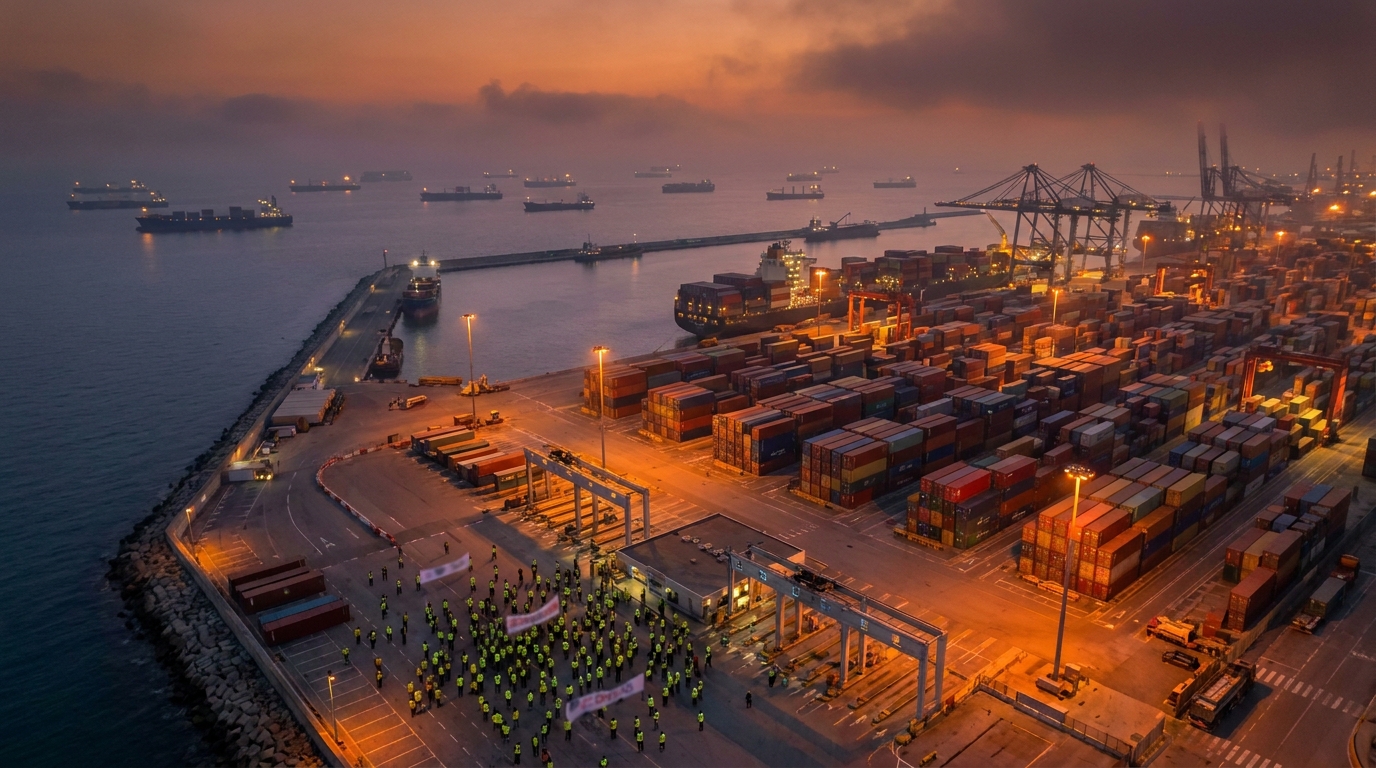
On Friday, October 30, 2026, more than forty key ports in Europe and the Mediterranean could face major operational disruptions. Coordinated strike action under the slogan "Ports in Action", supported by the World Federation of Trade Unions (WFTU), threatens the continuity of internationalrodosupply chains during one of the busiest trading periods of the year. For European importers, freight forwarders, and risk managers, this means an immediate review of operational plans and verification of financial exposure.
The scale and context of trade union mobilization
This year's autumn dockworkers' mobilization is not an isolated phenomenon. Its roots lie in a similar protest that took place in February 2026, which served as the industry's first warning sign. At that time, the transport and logistics industry realized that growing dissatisfaction among port workers could develop into a structural operational risk, not just a sporadic supply disruption.
The October strike, however, has a much broader scope and a more complex backdrop. Trade unions—grouped around the global organization WFTU—are combining two sets of demands: labor and political. On the one hand, port workers are protesting against deteriorating employment conditions, stagnant wages in the face of inflation, limited protection against dismissal, and the increasing automation of terminals, which is redefining the labor market in this sector. On the other hand, the political axis of opposition is the increasing militarization of commercial ports and the transport of military cargo through civilian infrastructure.
Regardless of the assessment of the validity of the demands, one fact counts for companies operating in the European supply chain: on Friday, October 30, more than forty port hubs may drastically reduce or completely suspend transshipment operations.
Italy as the epicenter of the port crisis
Geographical analysis of the threat clearly indicates that the greatest disruptions are expected on the Italian Peninsula. Two Italian trade unions — Basic Trade Union (USB) and ORSA Porti — declared a general strike encompassing not only dockers but also logistics workers, freight transport workers, and parts of public transport. This combination makes Italy the most exposed country in the entire mobilization.
Eight key Italian ports have been identified as most likely to be affected by the strike:
- Genoa — the largest port in Italy and one of the most important container hubs in the Mediterranean, acting as a gateway to Central European markets
- Triest — a strategic port for the import and export of goods to Austria, Hungary, the Czech Republic, Slovakia and other countries of Central and Eastern Europe
- Gioia Tauro — one of the largest transshipment hubs in the Mediterranean, through which cargo flows between the great ocean routes
- Livorno — an important point for handling ro-ro and container cargo for central Italy
- Ravenna — an important port handling bulk and container cargo for the Emilia-Romagna region
- Anko — a key connection point with the Adriatic and Balkan countries
- Civitavecchia — port serving the Lazio region and Rome
- Salerno — an important hub for southern Italy and trade with the Mediterranean countries
Of particular importance is the fact that Trieste and Genoa are the main gateways for goods bound for Poland, Germany, and the Baltic countries. Logistics companies operating on the Asia-Central Europe route, using the Southern Mediterranean corridor, should consider the upcoming strike as a direct threat to their operations.
International reachrodoyou — who else is on strike?
Although Italy is the epicenter of the mobilization, the protest has a pan-European and Mediterranean dimension. Trade unions from several other countries have joined the action:
- CGT Ports et Docks (France) — one of the strongest port associations in Western Europe, historically capable of effectively paralyzing French terminals
- ENEDEP (Greece) — representing port workers in a country that is a key transhipment hub for the Eastern Mediterranean
- LAB (Spain, Basque Country) — a regional association that could affect operations in the ports of northern Spain
- Liman-İş (Türkiye) — representative of port workers in Turkey, important due to the growing role of Turkish ports in handling the transit of goods from the East
- ODT (Morocco) — signaling possible disruptions in ports on the African side of the Strait of Gibraltar
The extent of the mobilisation means that even trying to reroute cargo through alternative ports could face difficulties – if western French ports or Greek transshipment hubs also curtail operations, options for bypassing the blocked hubs will be significantly narrowed.
Cascading effects on supply chains – what lies ahead for importers?
A port strike isn't an event whose consequences end with workers returning to work. Experience from similar industrial actions in the past—in Europe, the United States, and Australia—indicates a rebound effect lasting weeks, and sometimes months. Below, we present the most significant operational threats to logistics companies and their customers:
Transhipment delays and extended vessel lay-up times
The suspension of loading and unloading operations in ports directly translates into longer vessel laytimes. Vessels waiting to enter a blocked port generate costs for the shipowner, who in turn passes these costs on to the forwarder or cargo owner in the form of surcharges. Delays of just a few hours at a major shipping hub can disrupt the schedule of the entire shipping network.
Blank sailings and avoidance of ports by shipping lines
In response to the strike, shipowners will begin announcing so-called blank sailings—cancellations of scheduled sailings—and port omissions, meaning the omission of specific ports along the route. Cargo destined for the blocked port will be redirected to alternative terminals, often hundreds of kilometers from its destination. For the importer, this means not only higher land transport costs but also delays in the arrival of goods to the final recipient, lasting days or weeks.
Paralysis of land and rail transport in Italy
Of particular concern to companies operating in the Italian market is the declaration by the USB and ORSA Porti unions that the strike will also include road and rail transport workers. This means that even if cargo were unloaded from vessels earlier, its collection from terminals and further distribution will be seriously hampered. The Italian logistics corridor serving Central European countries—including Poland—could be paralyzed at multiple stages simultaneously.
The bottleneck effect after the strike ends
This phenomenon, which the logistics industry calls post-strike congestion, often poses a greater operational challenge than the strike itself. The cargo accumulated during the protest creates a massive queue for processing, which ports—with limited equipment and staffing—must contend with for several weeks. Returning to normal processing times can take two to six weeks, depending on the severity of the disruption.
Credit and financial risk perspective
From the point of view of business risk analysis, a port strike is not only an operational problem – it is a financial phenomenon that can directly affect the liquidity situation of companies in the transport and logistics industry and their customers.
Extending the cash conversion cycle
Goods stuck in ports—on ships, in terminals, or in alternative transport—cannot be delivered, received, and invoiced. Every day of delay means a delay in invoice generation and payment. For companies operating on tight margins or relying on external working capital financing, a longer cash conversion cycle can mean real difficulties in meeting current liabilities.
Demurrage and detention costs
Importers whose containers are blocked at ports or cannot be collected on time will incur additional costs in the form of demurrage fees (for keeping a container on a ship or terminal beyond the permitted time) and detention fees (for the delayed return of an empty container to the shipowner). These fees increase progressively with each day of delay and can quickly consume the entire margin on a commercial transaction.
Risk for SMEs and highly leveraged importers
Large companies with diversified supply chains and access to cash reserves can absorb disruptions lasting several weeks. The situation is different for small and medium-sized logistics companies, especially importers operating under a model just-in-time with limited inventory. For these entities, a supply blockage may mean the need to seek emergency bridge financing, delays in settling liabilities to suppliers, or—in extreme cases—problems servicing existing debt.
When verifying the credibility of counterparties in the coming weeks, risk analysts should take into account that the deterioration of liquidity indicators in this period may be directly related to the effects of the strike and not to the structural problems of a given entity.
Recommendations for companies in the transport and logistics industry
Managing risk in the face of an impending strike requires proactive action. The sooner a company begins to review its exposure and implement contingency plans, the lower its actual operational and financial losses. Below are key recommendations:
- Overview of delivery schedules: Identify all shipments scheduled to be handled by ports affected by the strike during the time window of October 28 – November 15, 2026. Include not only the day of the strike, but also the several-week bottleneck effect after it ends.
- Contact with the forwarder and shipowner: Maintain constant contact with logistics partners to monitor the situation in individual ports. Shipowners will announce decisions on blank sailings and port omissions several days before planned sailings.
- Activation of emergency plans: Check the availability of alternative ports of entry - in the case of Italy, it is worth considering redirecting cargo via Croatian ports (Rijeka), Slovenian ports (Koper) or North African transhipment hubs.
- Time and storage buffers: If possible, increase inventory levels of critical components or products before the end of October. Companies operating a just-in-time model should temporarily increase safety buffers.
- Verification of force majeure clauses: Review commercial contracts for force majeure and delay provisions beyond the parties’ control – port strikes may qualify as an event excluding liability in many jurisdictions.
- Overview of working capital financing needs: Consult your financing institution about a possible increase in your working capital credit limit or factoring line at the turn of October and November, as a liquidity buffer in the event of a payment freeze.
- Counterparty risk monitoring: If you are a creditor or work with entities that are heavily dependent on imports via Mediterranean ports, increase the frequency of monitoring their financial condition during this period.
Risk Summary and Assessment
The union mobilization scheduled for October 30, 2026 represents one of the most serious episodes of operational risk for European supply chains in years. A coordinated, multi-nationalrodoThe unique nature of the protest, encompassing more than forty ports from France to Turkey, with a clear epicentre in Italy, creates an unprecedented scenario of disruption for maritime trade in the region.
From a business risk assessment perspective, it's important to emphasize that the financial consequences of the strike—extended payment cycles, additional logistics costs, and reduced margins—will continue to be felt by companies for several weeks after its conclusion. For credit and financial risk managers, this means that the fall of 2026 will require increased vigilance when assessing the condition of contractors in the import, distribution, and logistics sectors.
Companies that take decisive preventative action now—just days before the planned strike—have a real chance of minimizing losses. Companies that ignore this threat or react too late may face difficult operational and financial losses in one of the most commercially important quarters of the year.