Container port congestion hits all-time highs with over 4,3 million TEUs out of circulation
Global congestion at container ports reached a historical record in August 2026 — vessels with a total capacity of more than 4.3 million TEU are waiting to enter ports, exceeding the peak of the COVID-19 pandemic. The effective loss of market capacity is equivalent to Evergreen's entire fleet, and schedule reliability has fallen to an alarming 60–65%. The situation poses a serious operational and cost risk to European supply chains ahead of the key autumn-winter season.
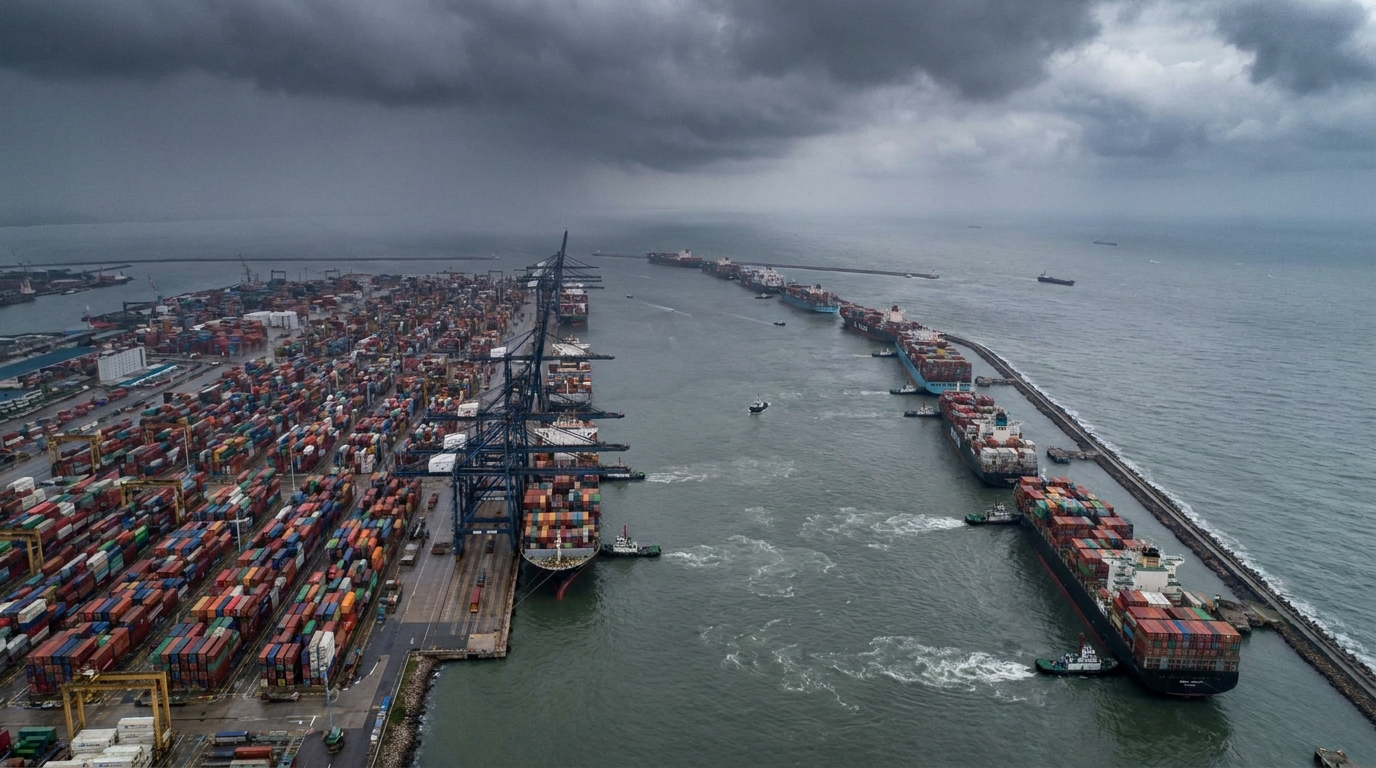
In August 2026, global container port congestion reached levels never before seen by the shipping industry—not only in absolute terms, but also in terms of the operational impact on the entire global supply chain. Data from analytics firm Linerlytica indicates that ships with a total capacity exceeding 4,3 million TEUsFor European risk managers and logistics owners, this figure should raise a red flag—and right now, as the crucial autumn/winter season approaches.
Record broken - new data exceeds pandemic peak
For many in the transportation industry, the COVID-19 pandemic remains synonymous with logistical chaos. The port congestion of 2021–2022, when vessels with a combined capacity of nearly 4 million TEU waited at ports, seemed unprecedented. The current situation exceeds these peaks—both in absolute numbers and in terms of real market consequences.
However, it is worth maintaining the appropriate analytical context. In 2022, the blocked 4 million TEUs represented as much as 15,7 % global container fleet of 25,3 million TEU at that time. Today, 4,3 million TEU is 12,6 % a much larger fleet, estimated at 34,4 million TEU. Despite the smaller percentage share, the market effects are just as severe – and in some respects more severe – than during the pandemic.
Analyst firm Sea-Intelligence uses a slightly different methodology, focusing not on the tonnage waiting in queues but on what it calls effective capacity loss. According to its estimates, current delays and downtime effectively remove the equivalent of 1,7 million TEUs To give you an idea of the scale of this phenomenon, this is more than the entire fleet of the Taiwanese shipping company Evergreen—one of the largest shipping lines in the world, ranked eighth in terms of capacity.
For comparison - before the pandemic, in the years 2011-2019, congestion consumed on average only 2,2% of global bandwidth and were treated as a harmless operational background. In June 2026, this rate had already increased to 5%, and the trend is still upward.
Schedule reliability at historic lows
As a direct consequence of the record-breaking congestion, the reliability of flight schedules has plummeted. Global delivery punctuality has stalled at just 60-65% — which means that statistically, every third or fourth shipment does not arrive on time. Furthermore, delayed ships arrive at their destination port on average 5 to 5,5 days after the planned date. By comparison, in stable conditions before the pandemic, delays averaged 3–4 days.
This seemingly small difference—one or two extra days—translates into significant disruptions to production and sales planning. For companies operating in a just-in-time mode, a component shortage for even dozens of hours can result in production line shutdowns, contractual penalties, and customer loss.
East Asia at the heart of the crisis - typhoons and queues of hundreds of ships
The immediate catalyst for this year's peak congestion is operational instability at East Asia's largest ports. A series of violent typhoons and tropical storms that hit the region in July and August 2026 virtually paralyzed port operations in China, the global center of container production and export.
The Portcast platform data shows the absolute scale of the phenomenon: at the peak moment of entry into Shanghai port waited until 139 ships, and in front of the neighboring one Ningbo next 77 unitsWaiting times at Shanghai's Yangshan Terminals—one of the world's largest and most advanced port complexes—have increased to 5-6 days for services belonging to the Gemini alliance, and for other carriers it even reached 7-8 days.
Alphaliner experts warn that the problem is not temporary. Climate change means not only an intensification of typhoons in Asia, but also prolonged droughts in other key transit hubs. This is evidenced by the situation on Panama Canal, where daily transit slots for large Neopanamax-class vessels will be drastically reduced from September 2026, due to the need to conserve freshwater resources. From September 3rd, the number of available daily slots is expected to drop to just nine, with further, even more restrictive restrictions planned from September 15th.
Megaships vs. European port infrastructure
In addition to climatic and geopolitical factors, industry analysts are increasingly pointing to structural problem of fleet architecture as one of the key drivers of growing congestion. This is the massive expansion of so-called megaships – container vessels with capacities exceeding 20,000 or even 24,000 TEU – and their impact on European transshipment ports.
AIS (Automatic Identification System) data for the port of Hamburg from July 2026 are eloquent:
- Evergreen — ships moored for 137 to 187 hours (5,7 to 7,8 days)
- hmmm — time at the quay was 89–103 hours
- ONE — units spent 98–111 hours in port
- Hapag-Lloyd — relatively shorter time: 37–55 hours
- Maersk — 52–63 hours at the quay
Such large discrepancies between shipowners are not a coincidence due to differences in operational efficiency. They are a simple consequence designing connection networks (so-called network design). Megaship services, which call at a decreasing number of European ports, generate avalanche-like, one-off transshipment operations on an exorbitant scale. While MSC's Swan cruise assumes an average transshipment of around 2500 TEU at each European port of call, Evergreen Line's CEM service—operated by ships with a capacity of over 23,000 TEU and calling at just three Western European ports—can generate a single transshipment of almost 7830 TEU in one port.
Such a gigantic concentration of volumes in one place and time creates the so-called peak loading — a sudden impact on terminal infrastructure, whose processing capacity is physically limited. The consequences are felt not only by port operators themselves, but above all by road and rail carriers: marshalling yards are blocked, truck queues are growing, and rail transport into Europe is experiencing multi-day delays.
Geopolitics does its part – the Red Sea remains closed
The port congestion wouldn't be so severe if it weren't for another, long-standing shipping crisis: the avoidance of the Red Sea and Suez Canal by most global shipping companies in response to the tense geopolitical situation in the region (including the armed conflicts in Iran). Redirecting traffic through the Cape of Good Hope adds 10-14 days to the typical journey from Asia to Europe, which:
- absorbs a huge part of the fleet's effective capacity (ships are "on the way" instead of carrying out subsequent voyages),
- exacerbates the shortage of available tonnage on the spot market,
- It puts an additional burden on already overloaded European ports, where ships arrive unevenly and with delays.
The combination of record port congestion and ongoing rerouting is creating a synergy effect that is pushing shipping costs up to levels comparable to the worst months of the pandemic.
Freight rates under pressure - SCFI at alarming levels
The cumulative effects of all these factors—port congestion, route diversions, restrictions in the Panama Canal, and a shortage of effective capacity—will have a significant impact on container freight prices. And they are already doing so.
According to Linerlytica estimates, Shanghai Containerized Freight Index (SCFI) reached the level 3355 points, which is an increase of 156 % compared to the period before the outbreak of the last armed conflict in Iran. At the same time, the S&P Global Platts Container Index rose on August 21 to the level $7565 per 40-foot container (FEU) — at most in 2026. Freightos Agency, one of the most reliable platforms for tracking freight rates in real time, clearly indicates port congestion as the main, growing factor driving the current price increase.
For European importers, this means a drastic increase in the costs of purchasing shipping capacity—both on the spot market and when attempting to renegotiate long-term contracts. Companies that concluded framework agreements before the current crisis can count on partial protection—although shipowners are increasingly using surcharges and force majeure clauses here too.
Business risk perspective for European companies
The current situation in the global shipping markets generates several categories of risk that supply chain managers in European companies should immediately consider in their business continuity plans.
Operational risk - delivery delays
With global schedule reliability at 60-65% and average delays of up to 5,5 days, companies importing industrial components or consumer goods from Asia face regular disruptions to production and sales planning. Companies operating in just-in-time or just-in-sequence modes, with minimal inventory buffers, are particularly vulnerable.
Cost Risk - Import Inflation
Freight rates that are over 150% higher than a year ago directly impact the cost of goods sold for importers and distributors. For industries with low margins (FMCG, electronics, textiles), this may mean passing on higher costs to end users, exerting additional inflationary pressure on European markets.
Fall/Winter Season Risk
August and September are traditionally a period of intense pre-season ordering, with companies bringing in goods for peak sales (Black Friday, Christmas, and winter holidays). With the current level of congestion and uncertainty surrounding delivery times, the risk of stock shortages or products arriving after the end of the sales season is a real threat to many retail sectors in Europe.
Counterparty Risk - Supplier and Carrier Issues
It's worth remembering that high freight rates and operational chaos aren't neutral for all market players. Smaller freight forwarders, forwarders, and logistics subcontractors who haven't secured long-term contracts or have limited cash resources may find themselves under severe financial pressure. The risk of delays in order fulfillment, unilateral changes to contract terms, or—in extreme cases—contractor liquidity problems increases.
What Should Companies Do? Recommendations for Risk Managers
In the face of the described crisis, risk management specialists in the logistics industry recommend several actions that can limit a company's exposure to the described threats:
- Verification of logistics contractors — Checking the financial and operational condition of key freight forwarders, forwarders, and carriers. It's worth using tools like EURODEBT.eu to assess the credibility of business partners in the transportation and logistics industry.
- Diversification of entry ports — considering alternative ports of call for cargo destined for Europe (e.g. Gdańsk, Koper, Bremerhaven) instead of concentrating on one hub that may be particularly vulnerable to congestion.
- Building storage buffers — increasing inventory security levels for critical components and goods for the autumn-winter peak period.
- Renegotiation of contractual clauses — review and update of force majeure, delay and penalty clauses in contracts with suppliers and customers to reflect current market realities.
- Monitoring rates and tonnage availability — Regular monitoring of SCFI, Freightos Baltic Index and operational reports of key shipowners to detect further market changes early.
- Scenario analysis — preparing contingency plans for a scenario of further deepening of the crisis (e.g. further restrictions on the Panama Canal, escalation of tensions in the Red Sea).
Summary – a systemic crisis, not a temporary disruption
The shipping crisis of the summer of 2026 is not a coincidental confluence of unfortunate circumstances. It is a symptom of deeper, structural tensions in the global logistics system: a changing climate, tense geopolitics, a mega-fleet architecture that is inadequate for port capacities, and persistently insufficient terminal infrastructure in key European hubs.
Blocking more than 12% of global container capacity, while simultaneously shutting down a significant portion of effective capacity through route diversion, creates a situation where the market will operate below its nominal capacity for an extended period. For European companies importing goods from Asia—and there are thousands of them—this means thinking about supply chain risk management not as an academic exercise but as an ongoing operational priority.
EURODEBT.eu will monitor further developments and keep you updated on changes in market conditions, the condition of key industry players and warning signals regarding the stability of European transport and logistics companies.