

Customs duties from China: The tax office is pursuing Polish logisticians for customs fraud. The TSL industry is on the brink.
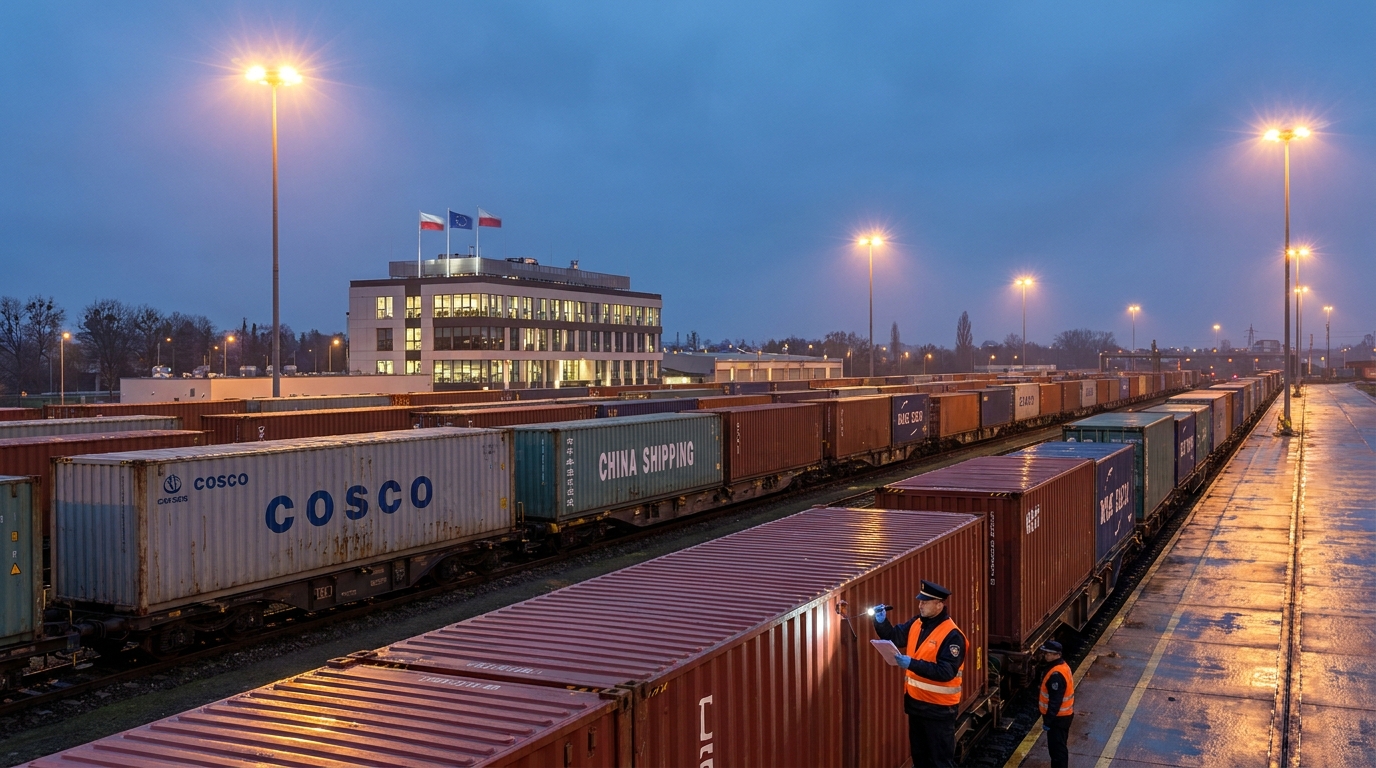
The Polish transport, forwarding, and logistics (TFL) industry is grappling with a growing crisis that could shake the entire sector's foundations. The National Revenue Administration (KAS) is sending mass demands for payment of overdue customs duties to logistics companies and rail carriers serving the New Silk Road—entities that, according to EU investigators, were not consciously involved in any fraud. Unable to recover payments from the actual perpetrators of the fraud—Asian front companies that have long since disappeared from the market—the tax authorities are reaching out to legal businesses operating in Poland and enforcing customs debts from them based on joint and several liability provisions. The consequences of this approach could be disastrous not only for individual companies but for the entire logistics infrastructure connecting Europe and Asia.
How did the customs fraud mechanism work?
To understand why Polish logistics companies find themselves in such a difficult situation, it's necessary to trace the criminal mechanism that underpinned the current crisis. This practice was initially discovered and documented by the European Anti-Fraud Office (OLAF) as part of a large-scale investigation into imports from China into the European Union.
The fraudsters' scheme was meticulously planned and consistently executed. Foreign importers, most often linked to Asian entities or specially established offshore companies, introduced goods into the European Union customs territory using false or manipulated documentation. The fraud involved two basic methods: either declaring containers' contents to be completely different from their actual contents, or drastically underestimating the customs value of imported goods.
The result was always the same: these companies paid a fraction of the duties and taxes due, thus gaining an undue, massive price advantage over honest competitors in the single European market. When tax authorities began to show interest in a given entity, importers immediately liquidated their operations and literally disappeared from the market, leaving behind empty companies and uncollectible debts. As a result, the tax authorities—in Poland and other EU countries—faced an impenetrable wall: the actual perpetrators became unattainable, and public budgets suffered real losses.
Joint and several liability - a law that hits the innocent
In this situation, tax authorities have resorted to a tool provided for both in the EU Customs Code and national tax regulations – the principle of joint and several liability for customs debt. However, its application in the current context raises fundamental legal and ethical questions.
According to the Ministry of Finance's interpretation, the mere fact of participating in a customs procedure—including submitting transit documents on behalf of the importer—can generate liability for a customs debt incurred as a result of providing incorrect data. In other words, if the data in a customs declaration proves to be inaccurate, any entity involved in completing the formalities may be held financially liable—regardless of whether they were aware of the irregularities or acted in complete good faith.
In practice, this means that KAS claims go to:
- Customs agencies — who professionally handled customs clearance and submitted documents on behalf of importers;
- Railway carriers — serving routes on the New Silk Road and transporting containers to EU customs offices;
- Logistics operators — responsible for organizing the supply chain and transit procedures.
The Ministry of Finance defends its position, pointing out that companies that consider tax decisions unfair have an appeal process available. For many entrepreneurs, particularly those in the SME sector, the prospect of years-long and costly legal battles with the tax authorities is tantamount to a verdict—even if they ultimately win, they could lose their financial liquidity long before the verdict is announced.
Voice of the Industry: The Innocent Pay for the Guilty
ŚrodoThe industry is reacting to this situation with growing concern. TSL market experts and practitioners emphasize a fundamental misunderstanding of the specific nature of freight carriers' work, which appears to underlie the tax authorities' actions.
Joanna Porath, CEO of the customs agency AC Porath, highlights a key issue: logistics companies and carriers are solely responsible for the transit procedure. Their task is to physically, safely, and on timely deliver cargo from the loading point—often a dry port on the EU's eastern border—to the designated customs office. This, and nothing more. Logisticians have neither the technical access nor the legal authority to open containers and verify their actual contents—customs seals are, by definition, inviolable until official clearance. Furthermore, customs agencies lack the tools and expertise to independently verify the specialized tariff classifications imposed by shippers and importers.
"It's like holding a courier responsible for the fact that the package he delivered contained smuggled goods," one industry expert comments. "The courier receives the package with a bill of lading and delivers it to the specified address. He has neither the right nor the obligation to open it and check its contents."
Importantly, OLAF's findings clearly confirm that Polish logistics and transport companies were not intentionally involved in customs fraud and are not considered suspects of participating in organized crime groups. Nevertheless, the law—as currently interpreted—allows for the enforcement of debts from them that were not their fault.
European Dimension: Poland is no exception
The problem described isn't unique to Poland. Similar cases are emerging across the European Union, wherever domestic logistics companies operated supply chains that were unwittingly entangled with dishonest Asian importers. Germany, France, the Benelux countries—in each of these countries, customs and tax authorities face the same dilemma: how to recover lost budget revenue when the actual perpetrators are out of reach?
The systemic nature of the problem stems from several overlapping factors. First, the dynamic development of Asia-Europe rail connections as part of the New Silk Road over the last decade has created enormous volumes of goods and customs documents that are difficult to effectively control. Second, the provisions of the Union Customs Code, although detailed, contain loopholes that allow for varying interpretations of the scope of responsibility of participants in transit procedures. Third, different Member States apply these provisions with varying degrees of rigor, which creates a heterogeneous and unpredictable environment.rodolegal framework for operators operating cross-border.
Systemic risk for Polish logistics
Experts are warning: the consequences of the current course could be far-reaching and very costly for the Polish economy. Poland occupies a strategic position in the European logistics network—a key hub for rail and road connections on the East-West axis. Over the years, Polish TSL companies have built a strong position in servicing the New Silk Road, becoming a crucial link in the flow of goods between Asia and Europe.
If the KAS policy does not change or clear rules are not developed to protect the good faith of participants in customs procedures, the industry faces the following threats:
- A wave of bankruptcies — tax authorities’ claims may exceed the financial capabilities of individual companies, especially smaller customs agencies and regional carriers, which may lead to their bankruptcy;
- Trade paralysis — companies, wanting to avoid risk, may massively stop serving customers from China or generally stop transiting goods from Asia, which will paralyze key trade routes;
- Increase in service costs — even those companies that decide to continue their operations will be forced to drastically increase service prices to cover the increased risks and costs of verification procedures;
- Loss of competitiveness — Polish operators will become more expensive and less attractive compared to competitors from countries where regulations are applied less rigorously.
Know Your Customer in the TSL industry – necessity or fiction?
In response to growing regulatory risk, some logistics companies are attempting to implement procedures previously known primarily from the financial sector—so-called KYC (Know Your Customer)—that is, procedures for thoroughly verifying customer credibility. In practice, this means, among other things, checking the credit and registry history of clients, verifying their corporate affiliations, analyzing previous customs declarations, and monitoring sanction lists and warnings from customs authorities.
The problem is that even the best-designed KYC procedures don't provide complete protection. Special purpose vehicles, created without any operational history or visible links to prior fraud, are by definition difficult to identify as high-risk entities. When commissioning a transport service, a logistics company often has no way to verify what's actually inside the containers or whether the declared customs value is accurate.
Moreover, implementing advanced verification procedures comes with real costs—both financial (IT systems, database access fees, and hiring compliance specialists) and operational (extended order processing times). For smaller entities, these costs can be prohibitive.
What does the situation require? A risk management perspective.
From a business risk management perspective, the current situation requires TSL companies operating in Poland and across the EU to take immediate adaptive steps. Risk managers at transport and logistics companies should first audit their customer portfolios for customs risk exposure, with particular emphasis on entities importing goods from China via Polish border crossings and rail terminals.
Key recommendations for companies in the TSL sector include:
- Revision of contracts with importers — in particular with regard to liability clauses for the accuracy of customs data and recourse mechanisms in the event of claims from the tax authorities;
- Implementation or expansion of KYC procedures — with particular emphasis on verifying new clients from outside the EU and entities with a short market experience;
- Customs risk insurance — it is worth checking the availability of insurance products protecting against claims by customs authorities on the basis of joint and several liability;
- Active participation in regulatory dialogue — companies should engage with industry associations lobbying for changes to the interpretation of regulations or the issuance of clear ministerial guidelines;
- Monitoring court cases and case law — tracking judgments in similar cases can provide legal arguments and indicate effective defense strategies.
Urgent need for dialogue: industry vs. Ministry of Finance
According to experts and representatives of the TSL sector, a key element in resolving the crisis is to establish a constructive dialogue between the Ministry of Finance and organizations representing the logistics industry as soon as possible. The goal of this dialogue should be to develop clear, transparent, and proportionate accountability criteria that, on the one hand, protect the interests of the state budget, while, on the other, do not lead to the ruin of entities that acted in good faith and within the limits of their authority.
In particular, it is proposed to:
- The Ministry of Finance issuance of official guidelines specifying what specific due diligence activities on the part of customs agencies and carriers are sufficient to exclude their joint and several liability;
- Introducing the so-called safe harbor for logistics entities that have exercised due diligence;
- Creating a mechanism for rapid industry consultations on the interpretation of customs regulations in new, precedent-setting cases;
- Harmonising the approach at EU level so that Polish companies are not treated more harshly than their competitors in other Member States.
Summary: Risk for partners and contractors
This situation directly impacts the risk assessment of working with Polish logistics companies and rail carriers. These entities could at any time become the recipients of serious financial claims from the tax authorities—claims that stem not from their own negligence, but from the activities of elusive fraudsters.
For business partners, contractors, and financing institutions in the TSL sector, this means considering this specific regulatory risk when assessing the financial condition and operational stability of Polish logistics companies. It's worth checking whether a given company has open customs and tax proceedings, what compliance procedures it has implemented, and how it manages the risk of joint and several liability.
The Polish logistics industry is in an unprecedented situation—paying the price for systemic imperfections in customs law and the helplessness of law enforcement agencies in the face of organized crime groups operating abroad. Without swift legislative intervention, or at least a change in interpretative practice, by the Ministry of Finance, the sector could enter a phase of deep structural crisis, the consequences of which will be felt across the entire Polish economy.










