

Dry Rhine 2026: Crisis on Europe's waterway hits supply chains and companies' liquidity
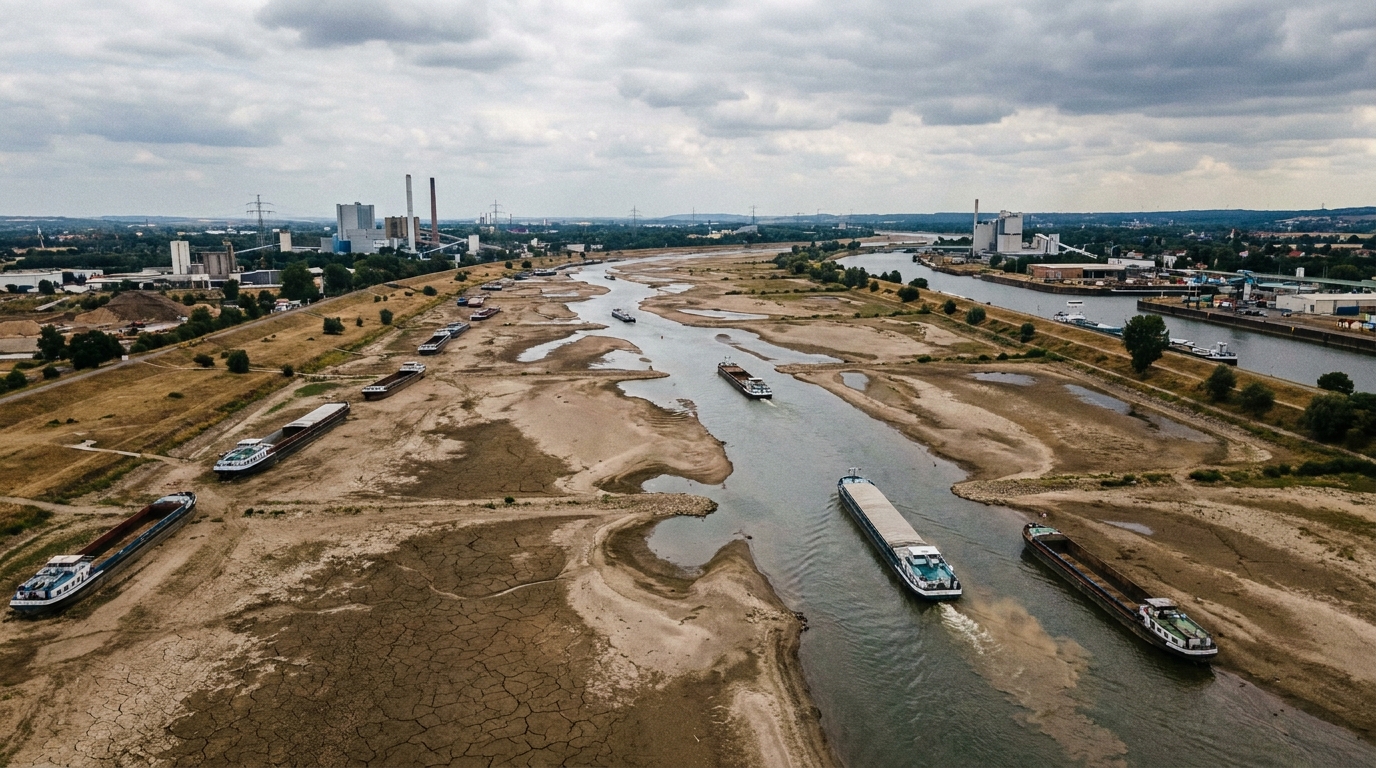
In August 2026, the European transport and logistics industry faced an exceptionally serious operational crisis. Historically low water levels on the Rhine—the continent's main inland shipping artery—led to a drastic reduction in river transport capacity, triggering a chain reaction of rising freight costs, delivery delays, and mounting financial pressure on hundreds of European businesses. What began as a meteorological phenomenon quickly escalated into a stress test for the entire architecture of European supply chains.
The Rhine as Europe's economic artery - what are the risks of blocking it?
The Rhine is no ordinary river. It's one of the most important logistics routes on the Old Continent, connecting the industrial heartlands of Germany, France, and Switzerland with the major seaports on the North Sea—primarily Rotterdam and Antwerp. Tens of millions of tons of goods are transported via this waterway each year: coal, iron ore, chemicals, fuels, grain, and industrial components. The cost of river transport is many times lower than road or rail alternatives, which for decades has made the Rhine a cornerstone of the profitability of many branches of European heavy industry.
When water levels fall below economically viable operating thresholds, the entire system begins to collapse. This is precisely what Europe experienced in the summer of 2026—and not for the first time. Similar, though less severe, episodes occurred in 2003, 2018, and 2022, clearly demonstrating an intensifying climate trend that the logistics industry must address systemically.
Barge capacity drops to 20 percent – what does this mean in practice?
A key parameter illustrating the scale of the crisis is the dramatic decline in vessel capacity. Under normal water conditions, inland barges operate at or near full capacity. In August 2026, with critically low water levels at critical measurement points—such as the famous Kaub gauge in Germany—the capacity of many vessels dropped to just one-fifth of normal. In practice, this means that transporting the same amount of cargo requires five times as many voyages or five times as many barges.
The financial consequences are immediate and severe. Shipowners operating on the Rhine have introduced so-called subsidies for low water levels (Ang. low water surcharges), which, depending on the river section and the type of cargo, can exceed the standard freight rate many times over. Freight rates for transporting a ton of cargo, which normally hover around a dozen euros, rose to several dozen, and in some cases even over a hundred, during the peak of the crisis. These costs are primarily absorbed by producers and importers—entities unable to renegotiate prices with customers on short notice.
For risk managers and credit analysts, this is a major wake-up call. Companies dependent on river transport—especially those with relatively thin operating margins—can go from profitability to loss-making in a matter of weeks if they don't have adequate safeguards in place.
Freight migration to roads and rails - overloaded infrastructure as the second bottleneck
The natural response to the paralysis of river transport is to shift cargo to alternative modes. Logistics companies and their clients began to massively seek out available trucks, wagons, and other transport resources to salvage delivery schedules. However, the reality proved brutal: Europe's road and rail infrastructure entered the Reynai crisis already significantly overloaded.
The truck driver shortage, which has plagued the TSL industry across Europe for years, has become increasingly acute. Available trucks are in short supply on the spot market, and their prices have skyrocketed due to the sudden surge in demand. Simultaneously, rail hubs—especially those serving intermodal transshipment terminals—have faced congestion. Freight line capacity in Germany and the Netherlands, already stretched to its limits, has been unable to absorb the additional volumes without significant delays.
The result was the creation of a kind of double bottleneck: first on the river, second on land. Companies that decided to quickly reorganize their supply chains paid dearly for it, both in higher rates and the loss of time organizing alternative logistics. Those that procrastinated or lacked sufficient operational and financial resources experienced significant delays in the delivery of raw materials and components.
The most vulnerable sectors: chemicals, metallurgy and energy
The crisis has hit different industries with varying degrees of severity, but several have found themselves in a particularly difficult situation.
Chemical industry
Germany and the Benelux countries are the European center of chemical production. Most large chemical plants located along the Rhine Valley depend on regular supplies of basic raw materials—from petroleum products, inorganic acids, and industrial gases. River transport restrictions pose a real threat of production downtime. Furthermore, due to their nature, some chemicals cannot be easily transported by road or rail, requiring specialized rolling stock, the availability of which is limited.
Metallurgy and steel industry
Large steel mills in the Ruhr Valley and eastern France are massive recipients of coking coal and iron ore transported by water from seaports. Even a few weeks of supply disruptions can necessitate reductions in blast furnace feed, generating enormous technological and operational costs. Shutting down and then restarting a blast furnace is a costly and time-consuming operation—a process the company cannot afford to repeat frequently.
Conventional energy
Some coal-fired power plants still operate in Europe, particularly as reserve capacity. Transporting thermal coal by barge is one of the cheapest methods available. Downtime on the Rhine translates into higher fuel costs, which, in a regulated or contractual energy market, can mean operational losses for the operators of such plants.
Legal and contractual aspects: force majeure and contract renegotiations
The Rhine crisis has raised a number of complex legal issues that directly affect participants in the transport and logistics industry. Many freight and supply contracts contain clauses force majeure — force majeure — which, in theory, protect the parties from the consequences of events impossible to predict or control. In practice, however, the application of these clauses is sometimes the subject of legal disputes.
The key question is whether systematically recurring droughts on the Rhine—recorded repeatedly over the past two decades—can still be considered unpredictable events, or whether they are becoming a predictable operational risk, for which preparation lies with shippers and forwarders. The answer to this question will determine who will bear the costs of delays and contract deviations.
For logistics companies and their customers, this means reviewing existing contracts and, where possible, renegotiating terms, including clauses regarding navigational conditions. Many companies have been forced to conclude contract amendments or negotiate extended delivery times, generating additional administrative and legal costs.
Liquidity Risk and Implications for the Corporate Debt Market
From the perspective of financial risk analysis – and this is the perspective we follow on the EURODEBT.eu platform – the Rhine crisis provides several important signals that should not be underestimated.
First, sudden and unforeseen jumps in logistics costs They pose a direct threat to the financial liquidity of businesses. Companies that planned their logistics budgets at the beginning of the year based on normal Rhine availability were faced with transportation expenses that were several times higher in August. This discrepancy between plan and reality necessitates the need to seek additional short-term financing—credit lines, factoring, or other liquidity instruments. Companies with tight financing structures may struggle to obtain these funds on acceptable terms.
Secondly, decline in production and delivery delays translates into the risk of contractual penalties and claims from contractors. Even if a company successfully invokes force majeure, the defense procedure itself requires time and money. In extreme cases, this can result in the termination of key contracts and the loss of strategic customers.
Thirdly, the market must monitor the condition of corporate debt issuers in the logistics, chemical, and steel sectors for a potential deterioration in debt service ratios. Companies that normally managed to repay their liabilities may, in a cost crisis, exceed the thresholds specified in their loan covenants, which may trigger safeguard mechanisms for banks and bondholders.
Structural weakness of the system: will Europe learn its lessons?
Each successive drought on the Rhine reveals the same deep-rooted weakness in European supply chains: over-reliance on a single transport route, lacking sufficient buffers and contingency plans. For years, the logistics industry has benefited from the low costs of river transport, optimizing its operating models for efficiency in favorable conditions. The price of this optimization is revealed precisely in moments of crisis.
Experts point to several directions of necessary adaptations:
- Investments in ships with a smaller draft — New generations of inland barges, designed to operate at low water levels, can significantly reduce vulnerability to drought. However, such fleet modernization requires time and billions of dollars in capital expenditure.
- Diversification of supply routes — Companies should identify alternative transportation routes in advance and build relationships with multimodal service providers, rather than retaining them only as a fallback option.
- Strategic stock reserves — maintaining buffers of raw materials and semi-finished products at a level that allows for several weeks of production without external supplies is a cost that can, however, protect against many times higher losses during a crisis.
- Indexation and insurance clauses in contracts — more and more companies are deciding to introduce automatic price adjustment mechanisms into their freight contracts depending on water levels and to purchase specialized navigation risk insurance.
However, implementing these proposals requires coordination at the sectoral and regulatory levels. A single company, even a large one, cannot eliminate systemic risk on its own. An active European policy is needed—both in adapting water infrastructure and supporting investments in fleets adapted to climate change.
Short-term outlook: cautious optimism under the circumstances
In late August 2026, rainfall in the Rhine basin brought some relief—water levels rose slightly at key points, allowing for increased barge capacity. However, industry experts agree: this relief is temporary and insufficient to offset the effects of the several-week crisis.
The logistical backlog accumulated in August will be felt for weeks and even months to come. Companies must rebuild warehouse reserves, address production backlogs, and financially address the consequences of the crisis. For forwarders and shippers, this is a time of intense operational work—and at the same time, a moment when the financial weaknesses of entities that have been overcome, not just affected, by the crisis will be revealed.
Conclusions for risk managers and financial market participants
The Rhine crisis in 2026 provides several practical lessons that should be reflected in risk assessment methodologies and credit policies for entities in the TSL sector and industries dependent on river transport.
Above all, hydrological risk should be treated as a full-fledged element of operational risk assessment logistics companies and their customers—as well as geopolitical, currency, and regulatory risks. When assessing the creditworthiness of companies dependent on the Rhine, it's worth analyzing their contingency plans and the degree of logistics diversification.
Secondly, Contract agreements concluded with transport companies should be audited in terms of clauses regarding navigation conditionsThe absence of such clauses or their unfavorable construction may mean that in the event of another drought, the entity will bear the full logistics costs without the possibility of spreading them among the transport service provider.
Thirdly, the chemical and metallurgical sectors in Germany, Austria and Switzerland deserve special attention from debt analysts in the context of monitoring liquidity and debt service ratios in the remaining months of 2026. The effects of the Rhine crisis will appear in the quarterly results with a delay - and this is when they may surprise the market.
The Dry Rhine isn't just a photo of a cracked riverbed on social media. It's a serious, measurable threat to the profitability and solvency of dozens of entities in the European market. Those who recognize it in time and properly price it in their risk models will gain an advantage. Those who ignore it may be surprised by the consequences, which will appear precisely at the most inopportune moment.










