

El Niño Hits Business Wallets: How Climate Anomalies Turn into a Risk of Contractor Insolvency
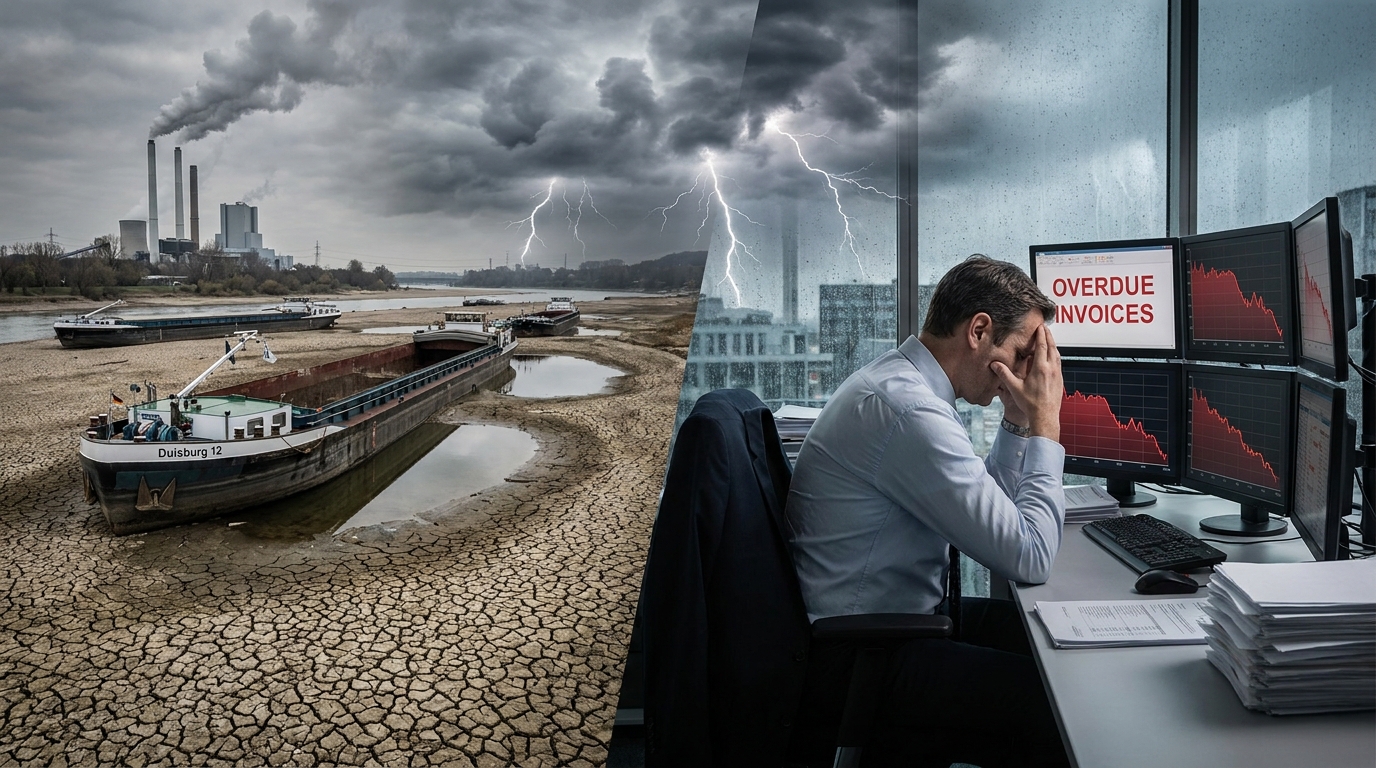
Credit insurer Atradius has published an analytical report that should be on the desk of every risk manager in Europe. Its conclusion is unequivocal and alarming: the El Niño weather phenomenon is no longer just a problem for meteorologists and logisticians. In 2025 and 2026, it will become a real, systemic catalyst for liquidity crises, increasing B2B payment delays, and a rising wave of insolvencies—particularly in Germany, but with direct consequences for the entire European network of partners, subcontractors, and suppliers. For the transport and logistics industry, this means a fundamental rethink of how contractors are vetted and credit risk assessed.
When Weather Becomes a Balance Sheet Risk
For decades, El Niño existed in the minds of businesspeople primarily as an abstract climate phenomenon—something that caused droughts in Australia, floods in South America, and storms in the Pacific. At most, it resulted in temporary disruptions in coffee or cocoa supplies, which the market usually absorbed without major drama. Today, this perspective is an anachronism.
The World Meteorological Organization (WMO) predicts that the ongoing El Niño cycle could persist until 2027. This is not an incident – it is a structural change in operating conditions for thousands of companies. Atradius, one of the world's largest trade credit insurers, explicitly defines this situation as a shift from weather risk (Wetterrisiko) to payment risk (Zahlungsrisiko). The mechanism of this transmission is complex but logical—and that is precisely why it is so dangerous to those who ignore it.
Germany at the heart of the impact: a country dependent on global supply chains
To understand the scale of the threat, one must first understand the specific nature of the German economy. Germany is an export powerhouse, but at the same time, it is deeply dependent on imports of key raw materials and semi-finished products from around the world. The food, chemical, energy, and steel industries all rely on supplies from regions most severely affected by El Niño.
The Atradius report highlights specific categories of raw materials whose prices are rising or whose availability is rapidly decreasing due to extreme weather events:
- Coffee and cocoa — Crops in Brazil, Colombia, Ivory Coast and Ghana are directly affected by droughts and erratic rainfall linked to El Niño
- Rice, soy and palm oil — crucial for the food and feed industry, and their main sources in Southeast Asia and Latin America are particularly susceptible to climatic anomalies
- Sugar and tropical fruits — more categories in which production is destabilizing and prices on commodity markets are rising to levels not seen for years
- Artificial fertilizers — here comes an additional geopolitical factor: tensions in the Strait of Hormuz and the uncertainty of navigation around Iran are disrupting the supply of raw materials necessary for the production of fertilizers, which is hitting food and feed prices with double force
The effect on German companies is direct: procurement costs are rising faster than they can be passed on to customers, operating margins are shrinking, and working capital is being tied up in more expensive buffer stocks. Companies that seemed like reliable trading partners a year ago may now be showing the first warning signs regarding liquidity.
The Rhine as a barometer of industrial health: river logistics under pressure
One of the most tangible and costly manifestations of the impact of climate anomalies on the European economy are low water levels on inland rivers – primarily on the Rhine, which is the absolute transport backbone for Western European heavy industry.
The Rhine supports transportation for some of the world's largest concentrations of chemical, petrochemical, and steel industries. When water levels drop below operating thresholds, cargo barges cannot load their full cargo or must bypass certain sections of the route entirely. The financial consequences are immediate and multifaceted:
- Delays in the supply of raw materials — factories do not receive materials on time, production lines stop, production plans fall apart
- Forced switch to alternative transport — rail and trucks are more expensive, less efficient and often overloaded during peak demand
- Surcharges for low water levels — shipowners and forwarders introduce special surcharges that can increase the total freight cost many times over a short period of time
- Freezing of working capital — Longer delivery cycles mean that money is tied up in goods in transit for a much longer period
- Revenue delays — if the finished product does not reach the customer on time, the invoice is not issued and payment is not received on time
For transport and forwarding companies, this is a particularly complex situation – they must simultaneously absorb higher operating costs and deal with customers who dispute invoices containing unexpected surcharges or who are struggling with their own financial problems.
The Domino Effect in the Payment Chain: How One Crisis Infects the Entire Network
Frank Liebold, Country Director of Atradius in Germany, in his commentary on the report leaves no doubt as to where the current trajectory is heading: a real and rapid increase in the number of insolvencies and hard losses due to bad debts is not a pessimistic scenario, but an increasingly likely reality.
The mechanism is classic for any liquidity crisis, but now it's driven by a factor that until recently was completely ignored in credit risk models—climate. The diagram is as follows:
- Company A (e.g., a food manufacturer) is experiencing a sharp increase in raw material costs and delivery delays.
- Company A's operating margins are shrinking, working capital is dwindling
- Company A starts negotiating longer payment terms with suppliers (company B, company C) or unilaterally delays transfers
- Companies B and C, dependent on timely revenues from company A, are starting to have problems settling their own liabilities.
- The cascading effect spreads through the entire network of partners, subcontractors and suppliers.
For transportation and logistics companies, which often operate as an intermediate link in this chain—providing services to manufacturers and wholesalers while also utilizing the services of subcontractors—the risk of exposure to this domino effect is particularly high. This is a two-way exposure: receivables from troubled customers and their own liabilities to subcontractors and fuel suppliers.
Global context: developing countries as the second epicenter of risk
The Atradius analysis highlights another dimension of the threat, one that is crucial for European exporters. El Niño not only disrupts supplies to Europe; it also destabilizes the economies of developing countries, which are important customers for European industrial products, machinery, and technology.
If a country where agriculture accounts for a significant portion of GDP experiences a catastrophic drought or flood, its import capacity drastically decreases. Governments must redirect foreign exchange reserves to import food instead of capital goods. Businesses in these countries suspend investments, postpone orders, and renegotiate contracts. For German and, more broadly, European exporters, this means an erosion of export revenues at a time when they are already struggling with rising supply costs.
This double whammy—higher entry costs and lower revenues—is a classic liquidity trap that can catch even companies with seemingly solid financial histories and previously impeccable payment records off guard.
Implications for contractor verification: what needs to change
For risk managers, accounts receivable specialists, and decision-makers at transportation and logistics companies, the conclusions from the Atradius report are clear: traditional methods of assessing a customer's ability to pay must be supplemented with new criteria. Assessing financial health based on historical financial statements is insufficient today in a world where the climate can fundamentally alter the liquidity position of a previously solid company within a few months.
The recommended set of actions covers several key areas:
1. Incorporating Supply Chain Resilience into Credit Analysis
Before granting trade credit or entering into long-term cooperation, it's worth investigating whether the supplier is heavily dependent on supplies from regions particularly susceptible to El Niño. Companies with a concentrated supplier base from a single geographic region or commodity category are structurally more vulnerable to climate shocks.
2. Increased frequency of monitoring payment capacity
In conditions of heightened climate risk, contractor monitoring cannot be a quarterly or annual activity. Early warning signs—extending collection cycles, requests for deferrals, changes in procurement policies—can emerge and escalate very quickly. Implementing continuous, automated monitoring based on current market and financial data is recommended.
3. Diversification of customer and supplier base
Transport companies heavily dependent on a single sector (e.g., serving the food or chemical industries exclusively) may find themselves facing liquidity challenges across their customer portfolio. Diversifying their service portfolio across sectors is a natural form of risk hedging.
4. Credit protection instruments as part of standard trade policy
Trade credit insurance, financial guarantees, and factoring are no longer niche products for the cautious—they're becoming standard equipment for companies operating in conditions of heightened uncertainty. It's worth noting that credit insurers like Atradius have access to vast resources of data on the health of companies worldwide. Using their analyses and products not only provides protection but also access to intelligence otherwise unavailable.
5. Hedging raw material and fuel costs
For transportation companies, managing fuel price risk is particularly important—El Niño also indirectly impacts oil prices through shipping disruptions and geopolitical tensions at critical points in global logistics. Hedging against fuel price volatility should be a standard element of the financial policy of every major transportation company.
EURODEBT.eu Perspective: Contractor Verification in the Era of Climate Risk
The Atradius report is part of a broader trend we're seeing in the European credit risk management industry: climate is becoming a first-order financial variable. What was the subject of ESG reports and sustainability debates just a few years ago now directly impacts companies' ability to meet their commercial obligations.
For users of verification platforms like EURODEBT.eu, this means a shift in approach to the information we look for when evaluating a contractor. In addition to standard financial data—debt ratios, profitability, liquidity, and payment history—information about a company's supply chain structure, its exposure to specific geographic and commodity markets, and the risk management tools employed is becoming increasingly valuable.
Germany remains Europe's largest economy and the natural supply chain hub for many Polish, Czech, Slovak, and Romanian transport companies. Liquidity problems in the German manufacturing and trade sectors inevitably spill over to their European partners—often with a delay of several weeks, but always. Monitoring the situation in the German market is therefore crucial not only for companies operating directly in Germany, but for anyone with significant exposure to local contractors.
Summary: The New Reality of Risk Management
El Niño 2025-2027 is testing the resilience of European supply chains and receivables portfolios to a new type of systemic risk—climate risk integrated with credit risk. Companies that are the first to understand this shift and adapt their risk assessment, counterparty verification, and receivables protection systems accordingly will gain a real competitive advantage.
Those waiting for a "return to normality"—understood as stable commodity prices, predictable inland navigation conditions, and timely payments from trading partners—may find themselves waiting longer than their financial reserves allow. The new normal looks different: a world in which a thermometer and a barometric pressure map have become as important a financial analyst's tools as a spreadsheet with a contractor's balance sheet.
EURODEBT.eu Recommendation: Companies operating in the transportation and logistics sector should immediately review their exposure to customers in industries particularly susceptible to the effects of El Niño—food, chemicals, and agricultural wholesale. Regular, automated monitoring of the payment status of customers in these sectors and actively considering credit insurance products are actions that, in the current market conditions, have ceased to be an option and have become a necessity.










