

Freight crisis on the Poland-Germany route: rates are plummeting and carriers' liquidity is hanging by a thread
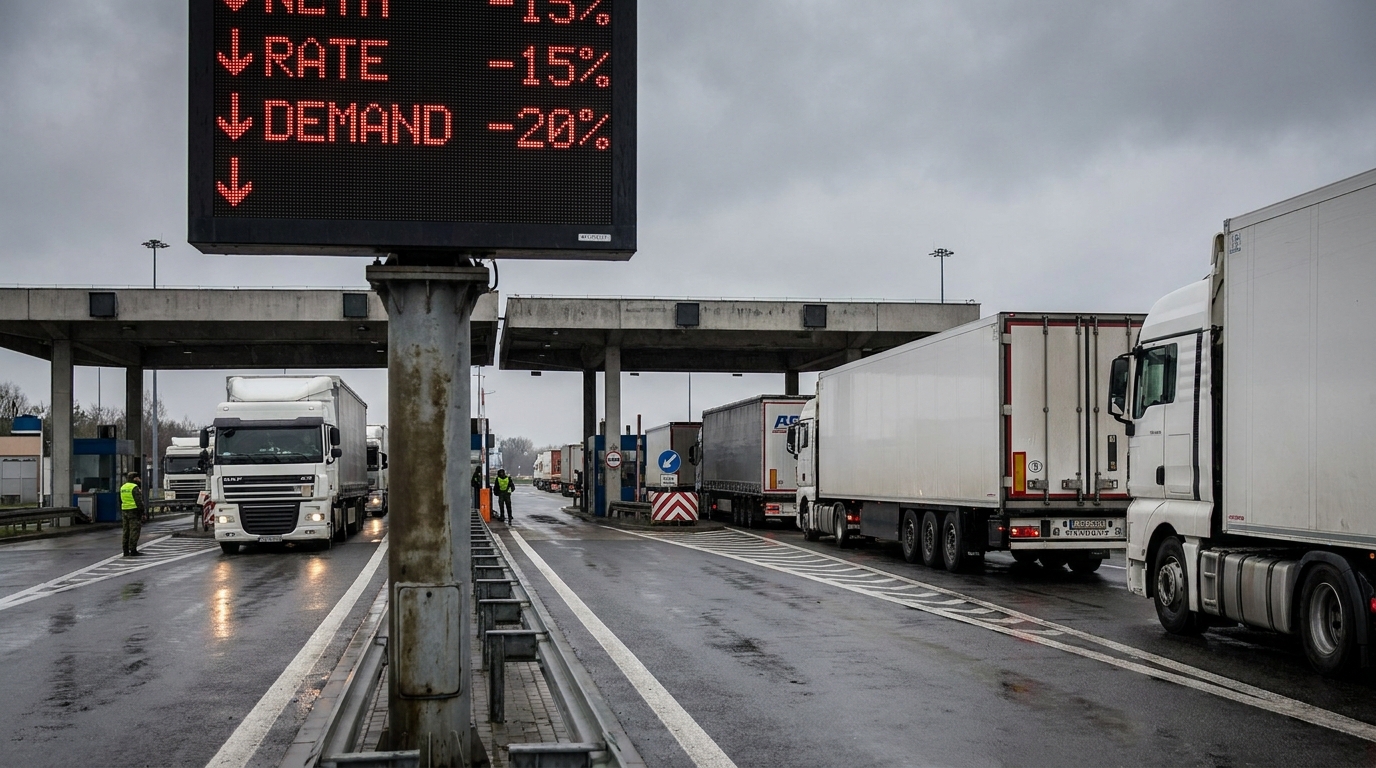
June 2026 brings extremely worrying signals to the transport and logistics industry in Poland. The latest market data, gathered from leading analytical platforms in the TSL sector, confirms what many carriers have been fearing for months: freight rates on one of Europe's most important corridors—the one connecting Poland with Germany—have plummeted by 15 percent in just four weeks. This isn't a seasonal adjustment or a temporary imbalance. It's a structural blow stemming from the ongoing recession at the heart of the European economy.
Germany slows down - Europe feels the effects
To understand the scale of the problem, one must look at Germany—the traditional economic leader of the Old Continent and arguably Poland's most important trading partner. In the second quarter of 2026, its manufacturing industry entered a clear decline. Data from subsequent months show shrinking order books in key manufacturing sectors: automotive, machinery, chemicals, and steel. These sectors previously accounted for a significant portion of the cargo handled by Polish carriers.
Lower production means fewer goods to transport—both for exports from Germany and imports to the country. This simple relationship has devastating consequences for the freight market. Demand for cargo space is shrinking significantly, while the supply of available vehicles remains unchanged. Polish carriers—and Poland boasts the largest truck fleet in the entire European Union—have found themselves in a situation where price is the only tool for winning orders. As a result, bidding continues to the downside, and freight rates spiral downward.
According to data developed by the Upply platform in cooperation with MiędzynarodoAccording to the International Road Transport Union (IRU), the scale of the one-off monthly slump is 15 percent - an alarming figure even in the context of the historical market fluctuations that the industry has often experienced.
The scissors effect: revenues down, costs up
If falling freight rates were accompanied by a simultaneous reduction in operating costs, the situation would be difficult but manageable. However, the reality is much more stark. Not only are the costs of running a transportation business not decreasing—they are actually rising in several key areas, creating a phenomenon that industry analysts call "scissors effect".
Firstly, fuel. Despite the general slowdown in the European economy, diesel prices remain relatively high. It's worth noting that market reports for the second quarter of 2026 clearly indicate that the only factor preventing even deeper declines in freight rates is the level of fuel prices—not actual demand from shippers.
Secondly, road tolls. Germany is systematically tightening its toll policy, linking toll rates to exhaust emission classes. For older vehicles, the cost of driving on motorways and expressways has risen dramatically. Polish companies, whose fleets still contain a significant percentage of vehicles meeting older emission standards, are experiencing this pain on a daily basis.
Third, labor costs. The shortage of professional drivers in Europe persists, and wage pressures continue unabated. Transport companies that have managed to attract and retain experienced drivers cannot afford drastic pay cuts—the risk of losing an employee to a competitor is too high.
Fourth, external financing. Interest rates in the eurozone, although slightly lower than during the peak of interest rate increases, remain at levels that significantly burden companies with leasing or working capital loan debt. And the transportation industry has historically been very dependent on external financing—rolling stock is a capital-intensive resource.
Under normal market conditions, some of these costs could be passed on to shippers through higher rates or fuel surcharges. With Germany slowing down and customers faced with dozens of order-hungry companies to choose from, carriers' negotiating power is practically nonexistent.
Risk analysis: who is most at risk?
From the perspective of credit risk management and assessment of the financial condition of contractors – which is the core of EURODEBT.eu’s mission – the current market situation requires precise identification of groups of entities exposed to the greatest turbulence.
Small and medium-sized sole proprietorships and micro-carriers
It is this group that is suffering the most severe consequences. Micro-sized transport companies, often operating with just one or two vehicles, typically operate without any cash cushion. Margins of 2-4 percent, which were sufficient for survival just a few months ago, have turned into operating losses with a 15 percent rate cut. For these companies, each week of operation below the break-even point brings them closer to the point where they will be unable to make timely lease payments, pay for fuel on trade credit, or pay their social security contributions.
Highly leveraged companies
Carriers that aggressively expanded their fleets between 2023 and 2025, financing purchases with loans and leases, are now particularly vulnerable to declining revenues. High financial liabilities coupled with shrinking margins are a classic recipe for a liquidity crisis. Particularly concerning are the cases of companies that purchased vehicles with the assumption of a specific freight rate—an assumption that, in June 2026, proves to be far from market reality.
Companies that are overly focused on one aisle or customer
Carriers whose client portfolios rely almost exclusively on the Polish-German route and on a few regular shippers from sectors most affected by the recession (automotive, steel, machinery) are simultaneously losing out on multiple fronts: lower order volumes and lower rates for those that do emerge. The lack of geographic and industry diversification is a serious gap in operational risk management in the current environment.
Systemic Risk: The Knock-On Effect in the Supply Chain
It's impossible to analyze the financial situation of carriers in isolation. The TSL industry is deeply embedded in a broader ecosystem of entities that trust—and pay—each other. A deterioration in the financial condition of carriers triggers a domino effect that affects subsequent links in the chain:
- Fuel companies and gas stations offering trade credit to carriers will start to see an increase in overdue receivables.
- Leasing institutions and banks those financing rolling stock will have to face a growing number of restructuring applications or late payment of installments.
- Tire companies, services, parts suppliers those working with deferred payment terms will experience a slowdown in settling invoices.
- Transport subcontractors and freight forwarderswho commission transport to smaller companies may find themselves in a situation where their contractors disappear from the market during the ongoing order.
We know from previous crises in the TSL industry—including the 2022-2023 crisis—that such a chain of events can escalate within one or two quarters. Companies that appear solvent today may find themselves struggling to meet their current liabilities in three months.
What the numbers say: the scale of the threat in the Polish TSL industry
The Polish transport industry has over 200 registered entities, the vast majority of which are small and micro-enterprises. The transport gridlock between Poland and Germany is one of the most heavily used freight corridors in Europe—it is estimated that as much as 30–40 percent of all Polish road transport exports and imports pass through it. This means that a 15% rate cut on this particular route impacts the financial health of tens of thousands of entities—not hundreds.
If the current trend continues throughout the third quarter of 2026—and available macroeconomic forecasts for Germany do not provide grounds for optimism—a sharp increase in the number of restructuring and bankruptcy proceedings in transport can be expected. During the similar crisis in 2022–2023, the scale of bankruptcies in the Polish transport and logistics sector was estimated at several thousand entities. The current conditions are even more unfavorable in many respects: higher financing costs, more expensive tolls, and no prospect of a quick rebound in demand.
Recommendations for risk managers and companies cooperating with TSL
In the face of such clear warning signals, every company maintaining business relationships with entities in the transport and logistics industry should take a number of specific preventive measures:
- Update counterparty risk scoring. If your risk assessment model was calibrated for data from 2024 or earlier, it likely doesn't account for the current level of risk. It's worth reviewing the financial reports of your TSL partners, paying particular attention to current and quick liquidity ratios.
- Monitor early warning signals. Delays in payments, requests for extension of payment deadlines, changes in payment behavior – these are signals that may appear much earlier than the contractor's formal financial problems.
- Verify trade credit limits. Companies granting trade credits to carriers or forwarders should consider reviewing the limits granted, especially for entities strongly focused on the Poland-Germany relationship.
- Secure receivables. Trade receivables insurance or assignment of receivables are tools worth considering as additional security in relationships with transport entities with a higher risk profile.
- Be vigilant with new contractors. In crisis situations, more entities appear on the market willing to accept orders at any cost—sometimes because they desperately need cash. Thorough vetting of new partners is especially important now.
Prospects for the second half of 2026
Is a quick rebound possible? Market analysts are cautiously optimistic about their forecasts. Improving freight rates would require an acceleration of industrial activity in Germany—and this will take time, even if external factors (monetary policy, geopolitical situation) begin to favor it. Reports from economic institutes indicate that restructuring the German economy, particularly in the automotive sector, which is grappling with the energy transition, is a process that will take years, not months.
In the short term—outside the third quarter of 2026—there is no reason to expect a significant increase in demand for transport services on the Polish-German corridor. Seasonally, July and August are traditionally weaker months for industrial freight, which could further increase pressure on rates.
There's a scenario of partial stabilization if fuel prices were to rise significantly—which would provide a floor for further rate reductions. However, this would exacerbate the problem, not solve it: higher operating costs with persistently low rates are a recipe for even faster depletion of carriers' financial reserves.
For carriers themselves, the recommendations are clear: urgent analysis of the cost and revenue structure, active renegotiation of the terms of financial liabilities (leases, loans), searching for alternative transport corridors and diversification of the customer base beyond the manufacturing sector, which is most affected by the recession in Germany.
Summary: Time for increased vigilance
June 2026 will be remembered in the history of the Polish TSL industry as a turning point—the moment when the accumulation of unfavorable macroeconomic factors reached critical mass. The 15% monthly decline in freight rates on a key transport corridor is a signal that cannot be ignored or attributed to seasonal fluctuations.
For risk managers, credit analysts, and all entities associated with the TSL industry, the conclusion is clear: the coming quarter requires increased monitoring of contractors' financial health, caution in granting trade credit, and preparedness for a scenario where the number of companies experiencing liquidity problems increases significantly. The transport industry is the lifeblood of the European economy—and when this lifeblood begins to stagnate due to cargo shortages and shrinking margins, the consequences are felt by all participants in the supply chain.










