ELO from 20 April 2026: The Compulsory Logistic Envelope will revolutionise crossing the France-UK border
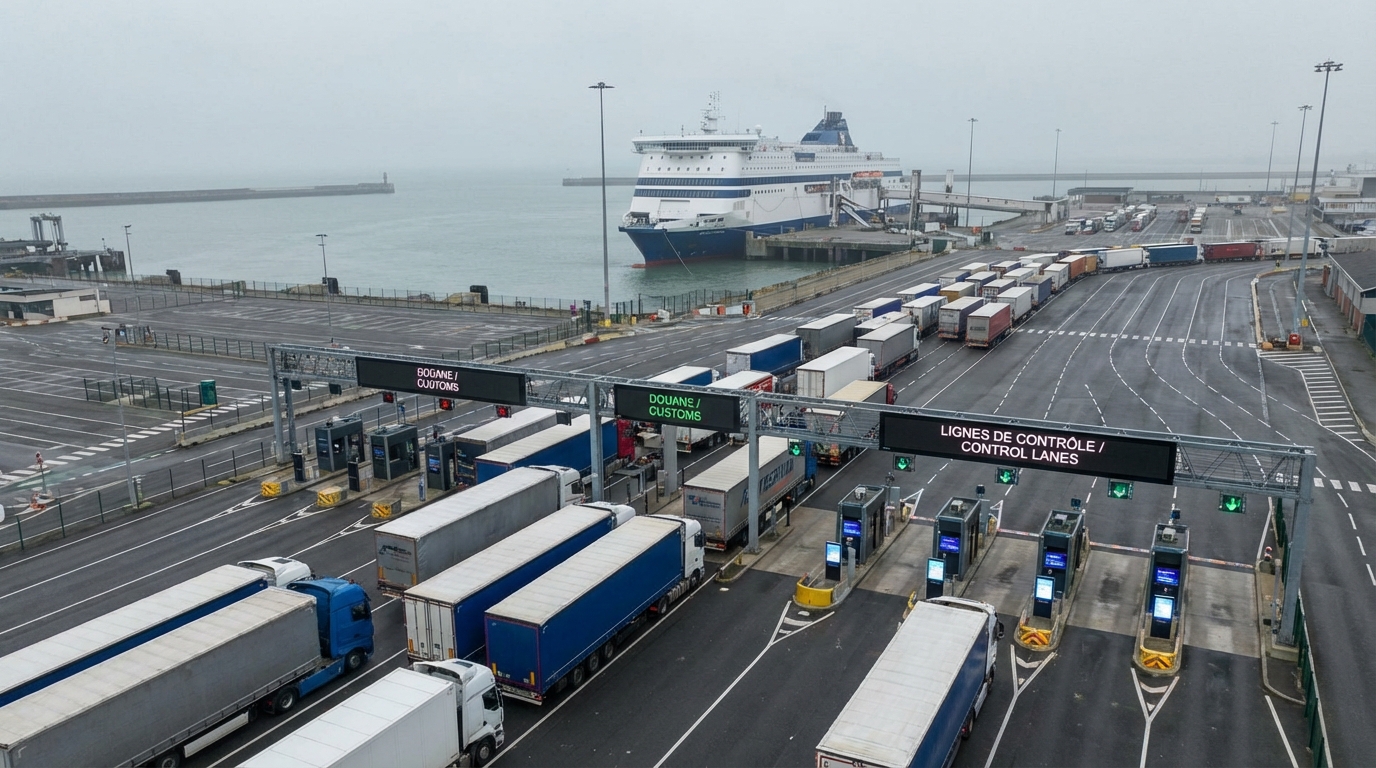
Od 20 April 2026 year every heavy goods vehicle crossing the border between France and Great Britain in the Ro-Ro system will have to prove its validity Obligatory Logistics Envelope - in brief ELO, or the Mandatory Logistics Envelope. This new requirement, implemented by the French Directorate General for Customs and Indirect Taxes (DGDDI) as part of the Smart Border system, represents nothing less than a revolution in cross-Channel customs clearance. Failure to present the required document will result in immediate denial of entry to a ferry or tunnel. This is a wake-up call for the transport, forwarding, and logistics industry: preparation time is measured in weeks, not months.
What is ELO and why is it changing the rules of the game across the English Channel?
System Logistics Envelope Obligations (ELO) is a digital aggregation tool developed by DGDDI that brings together all the documents required for border clearance of a truck in Ro-Ro traffic in one place. In practice, this means that import, export, and transit customs declarations, security data (Entry Summary Declaration (ENS) generated in the ICS2 system, and details about a specific vehicle and cargo are collected into one unique document. barcode assigned to a given transport unit.
Instead of engaging customs officers in multi-step verification of separate documents at various checkpoints, border services scan a single ELO code and obtain a complete picture of the customs status of a given vehicle in real time. A condition for allowing the vehicle to cross the border is confirmation that all required declarations have been submitted correctly and are in place. closed, approved status.
The tool is available free of charge via the portal douane.gouv.frUsing it requires the creation of a personalized user account, which can then be linked to legal entity identification numbers – for companies registered in France, this will be a SIRET or SIREN number. Foreign entities using the tool should follow the current DGDDI guidelines regarding registration from outside France.
Who is covered by the obligation – its scope is broader than you might think
The scope of application of the new regulations is exceptionally broad and leaves few loopholes. The requirement to have a valid ELO envelope covers all Ro-Ro operations on the France-UK route, regardless of the direction of travel. This applies in particular to:
- Transport with escort – when the semi-trailer is transported by ferry or tunnel together with the tractor unit and driver,
- Unaccompanied transport – when the trailer is left for independent ferry transport without a driver,
- Vehicles traveling in both directions – both from France to Great Britain and from Great Britain to France,
- Fully loaded and completely empty vehicles – the lack of cargo does not exempt from the obligation to have an ELO.
This last point deserves special attention. Many carriers might assume that an empty trailer returning from a delivery is exempt from customs requirements. This misconception, starting April 20, 2026, could result in the loss of a ferry seat or prolonged detention at the border.
It is also worth clearly defining what the regulations cover. do not include. ELO does not apply in the case of:
- Deep-water sea transport in the Lo-Lo system (lift-on/lift-off),
- Air transport,
- Standard intra-EU road transport, for example across the Belgian-French border.
This distinction is important for companies that ship to and from the UK via different routes and may be willing to optimize logistics to circumvent the new requirements. Switching to a Lo-Lo route or air freight can be an alternative in exceptional cases, but it usually involves higher costs and longer delivery times.
ELO does not replace UK Customs formalities – GVMS and GMR codes remain a separate obligation
Key information that must reach every logistics manager operating on the trans-Channel route: ELO is a purely EU instrumentThis system regulates the French (EU) side of border clearance and has no bearing on the requirements applicable on the British side.
Hauliers entering or leaving the UK are still required to comply with the UK system GVMS (Goods Vehicle Movement Service) and to have valid codes GMR (Goods Movement Reference)Both systems – ELO and GVMS – operate independently of each other, and neither relieves you of the obligations arising from the other.
This means that a well-prepared carrier or freight forwarder handling France-Great Britain traffic after 20 April 2026 must have:
- A valid ELO envelope with closed customs declarations and ENS on the French (EU) side,
- A valid GMR code generated in the GVMS system on the British side.
The absence of any of these elements will result in problems – regardless of which side of the channel the inspection occurs on.
Technical requirements: ICS2 as the foundation of the ELO system
The technical aspect of ELO implementation is fundamental and potentially the source of the most serious operational problems for companies that have not yet updated their customs systems.
Integration with the ELO platform is technically possible based solely on ICS2 standards – the new European Union import control system (Import Control System 2). The French customs authorities clearly state that Import Summary Declarations (ENS) generated in the older system ICS1 will not be accepted in the process of creating an ELO envelope.
In practice, this means that every entity in the supply chain that has not yet moved to ICS2 faces a dual problem:
- Without a valid MRN reference number (Master Reference Number) generated in the ICS2 standard, it is not possible to correctly complete and close the ELO envelope,
- A vehicle leaving without a closed ELO envelope will be stopped or turned away at the border.
It is worth emphasizing that the ELO envelope must aggregate all required declarations: import, export, transit, and ENS. Each must have a closed and valid status when the code is scanned at the border. Even a single required declaration missing or incorrect status will result in the entire envelope being considered incomplete.
Who can generate an ELO code?
The regulations are relatively flexible in this respect: the ELO code can generate any entity in the supply chain, which has all the necessary information at its disposal. In practice, this means that this task can be performed by:
- A freight forwarder coordinating the entire transport operation,
- Customs agency handling customs clearance,
- The carrier or logistics operator itself,
- The sender or recipient of the goods, if they have the relevant data.
It is crucial to clearly define in each operational process who is responsible for generating and delivering the driver's ELO code before leaving the transport baseFailure to provide sufficient information in this regard may result in a driver reaching the border without a valid document, with all the consequences that entails.
The "immutable at pairing" principle – immutability after pairing the vehicle
One of the most important technical aspects of the ELO system is the principle that DGDDI defines as "immutable at pairing"This means that when the ELO code is scanned during the initial entry check – i.e. at the moment of the so-called pairing of the vehicle with the envelope – no changes can be made to the envelope or its associated customs declarations.
This rule has fundamental operational implications. Any errors in declarations, missing documents, or incorrect statuses must be detected and corrected. before The vehicle will be registered for initial entry inspection. Once paired, there is no going back – you cannot update the data, amend the declaration, or add missing information.
In practice, this requires the implementation of robust verification processes at the stage of preparing transport documentation, before the vehicle leaves the base and heads towards the border.
Consequences of failure to comply with obligations – refusal of entry and suspension of the account
Sanctions for non-compliance with the new regulations are both immediate and long-term, and leave no doubt about the seriousness of the situation.
Immediate consequences:
- A vehicle with an incorrect, open or invalid ELO will be automatically directed to orange belt (orange lane), where it will undergo a tedious, physical customs inspection, generating significant delays,
- In the case of gross irregularities – simple refusal of entry to the border infrastructure (ferry or tunnel), which means the vehicle will have to turn back and the delivery deadline will be lost.
Long-term consequences:
- DGDDI officially warns that regular errors in submitted declarations or deliberately entering false data may result in complete suspension of access to the account on the French customs service portal,
- Suspending an account de facto prevents the generation of ELO envelopes and thus blocks the possibility of carrying out trans-channel transport in the Smart Border system.
For companies whose business model relies on regular cross-channel deliveries, the prospect of account suspension is a scenario that shouldn't be taken lightly. It's not just a delay in one shipment—it potentially paralyzes an entire line of business.
Preparedness Plan: What Logistics Managers Should Do Now
Assuming the April 20, 2026 deadline is met, companies operating between France and the UK should take concrete actions without undue delay. Below is the minimum that should be ensured:
- Customs systems audit: Verify that the systems used by your company or cooperating customs agencies support the ICS2 standard and are capable of generating MRNs in the new standard. If not, implement the update urgently.
- Registration on the douane.gouv.fr portal: Create an account and associate it with your business ID numbers. Ensure your account is active and tested before April 20, 2026.
- Process mapping: Clearly define who in the supply chain is responsible for generating the ELO envelope for each operation – the freight forwarder, customs agency, or carrier. A lack of clear responsibilities can lead to border problems.
- Driver and dispatcher training: Make sure drivers know what ELO is, why they need it and what to do if they encounter problems at the border,
- Verification of information flow: Establish procedures to ensure that the ELO code is provided to the driver (or uploaded to the vehicle systems) before leaving the base, and not only at the border,
- Tests and simulations: Test ELO envelope generation with real data before the system becomes mandatory. DGDDI can provide informationrodotest site – it is worth checking the current possibilities,
- Verification of contractors: Ensure that business partners (shippers, consignees, customs agencies) on both sides of the channel are aware of the new requirements and prepared to meet them.
Business Risk Perspective: What ELO Means for the TSL Industry
The introduction of the ELO system is part of a broader trend of digitalization and tightening border procedures after Brexit. The France-UK route is one of the most important trade arteries in Europe, with millions of tons of goods passing through the English Channel annually, handled by hundreds of carriers from across the continent.
From the perspective of assessing the risk of collaboration, it is worth paying attention to several key issues:
Operational risk: Companies that fail to adequately prepare for the new requirements will be at risk of vehicle detention, missed delivery dates, and contractual penalties from customers. Just-in-time supply chains are particularly vulnerable, where a delay in one shipment can halt production at the recipient's facility.
Reputational risk: Carriers and freight forwarders who regularly find themselves in the orange lane or—worse still—are denied entry will be perceived by their partners as having low operational credibility. In the TSL industry, reputation is the foundation of long-term partnerships.
Technology risk: Companies that haven't yet transitioned to the ICS2 standard face a dual challenge: they must update their customs systems while simultaneously implementing ELO-related processes. Any delay in ICS2 implementation directly translates into an inability to meet ELO requirements.
Supply chain risk: Even if the carrier is perfectly prepared, issues on the part of the shipper, consignee, or customs agency—for example, missing required declarations or their incorrect status—can prevent the ELO envelope from being closed. Risk management in this area requires close coordination across the entire supply chain.
Summary: deadline, preparations necessary
The Obligatory Logistics Envelope (ELO) system is the next stage in the post-Brexit adjustment of border procedures between France and the UK. 20 April 2026 year There will be no exceptions or transitional period for Ro-Ro vehicles – the lack of a valid ELO envelope means entry will be refused. Period.
This sends a clear message to risk managers and owners of transport companies: verification of operational and technical readiness should begin immediatelyThis applies to both their own systems and processes and the capabilities of their supply chain partners. Companies that ignore this obligation or postpone preparations until the last minute risk significant financial losses and loss of market position.
In the context of vetting business partners in the TSL industry, it's worth asking potential and current contractors about their ELO readiness—both in terms of IT systems and operational processes. A partner's lack of preparedness poses a real risk to your supply chain.