

GLS Group suspends deliveries to the Middle East and fights strikes in Italy – alarm for European exporters
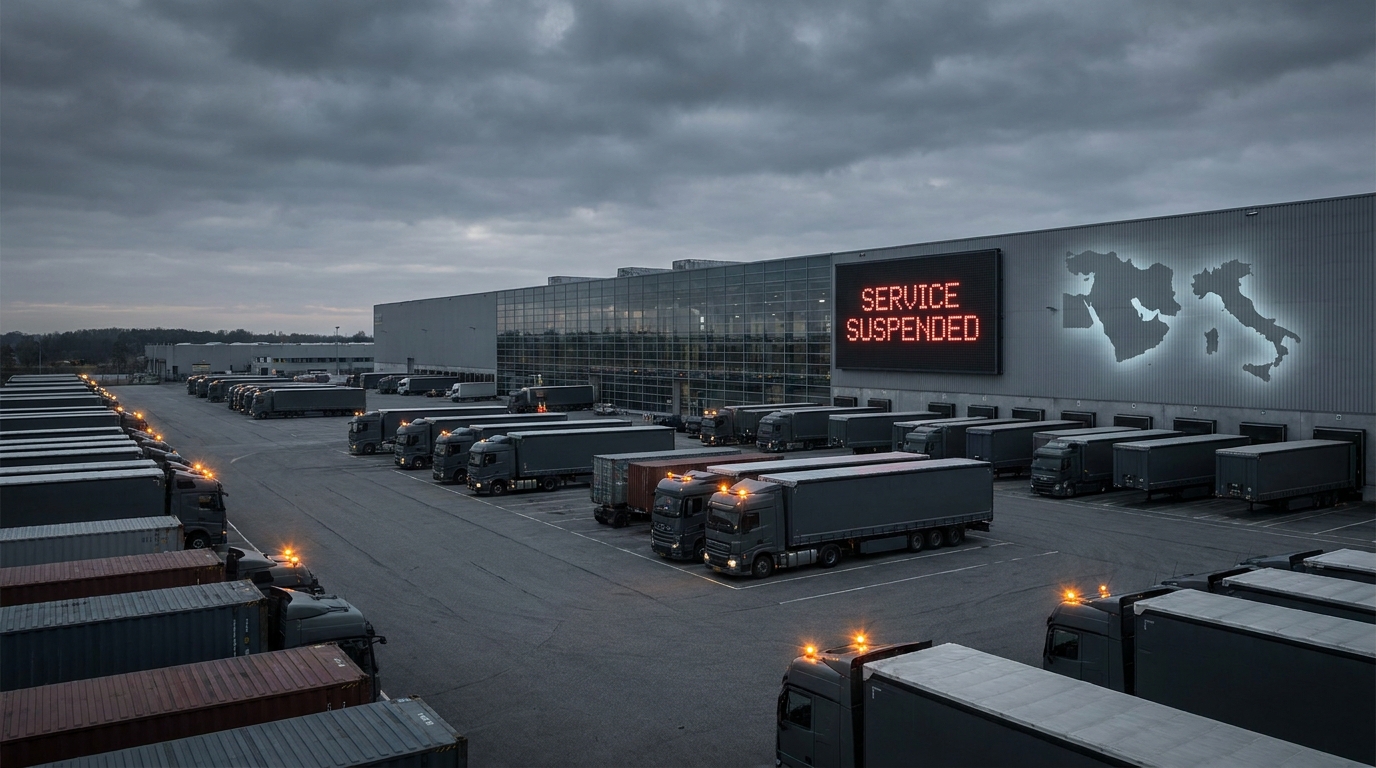
At the end of April 2026, logistics operator GLS Group, through its French subsidiary GLS France, published a series of operational announcements that should attract the attention of every risk manager and business owner operating in the export or import sector in Europe. The content of these announcements is clear and alarming: seven Middle Eastern countries have been subject to a complete suspension of logistics services, and prolonged strikes in the Italian Peninsula are paralyzing the Italian distribution network. Combined with structural problems on the British-Irish routes and new import regulations in the United States, this situation creates an exceptionally unfavorable situation.rodooperational environment for European supply chains.
Complete suspension of operations in the Middle East - a high-level alert
Without a doubt, the most dramatic news announced by GLS Group is the decision to suspend all transport services to a broad group of Middle Eastern countries. This unprecedented decision is driven by ongoing military operations in the region, the intensity and geographic scope of which prevent safe and efficient logistics operations. The list of countries affected by the suspension includes:
- Bahrain
- United Arab Emirates
- Iraq
- Iran
- Kuwejt
- Lebanon
- Qatar
The geographic scale of this suspension is impressive, encompassing both markets with relatively limited trade with Europe and absolutely crucial export destinations. The United Arab Emirates—with Dubai as a global re-export and finance hub—and Qatar constitute some of the most important non-EU markets for many European companies in the machinery, technology, pharmaceutical, and luxury goods sectors. Exports to these countries are often characterized by high unit values and long payment cycles, meaning that any disruption in supply carries proportionately significant financial consequences.
For European exporters, the reality of a supply disruption means, above all, an immediate freeze in working capital. Goods produced, packed, and ready for shipment remain in warehouses, generating storage costs while not triggering any cash flow. In a business model where an invoice is issued after delivery is confirmed or even after it physically reaches the recipient, a delay in the supply chain directly delays payment due—and therefore revenue does not appear within the planned financial window.
It's worth emphasizing that the escalation of the military conflict in the Middle East is not a temporary phenomenon that can be classified as an operational incident. We are dealing with a structural disruption that could persist for weeks or even months. For companies that have allocated a significant portion of their export portfolio to the region, and whose revenues from Arab markets exceed the safe diversification threshold—estimated by risk analysts at 20-25% of total revenue—this risks falling into a spiral of technical insolvency.
The impact of the Middle East blockade on the trade credit insurance market
GLS Group's decision to completely suspend its services is a signal that will reach—if it hasn't already—the desks of trade credit insurance underwriters. Trade credit insurance companies have their own early warning systems, but operational announcements from large logistics operators provide them with hard, market-driven confirmation of risk escalation. It's expected that in the coming weeks, leading companies in this sector—Euler Hermes (Allianz Trade), Coface, and Atradius—will begin reviewing credit limits granted to entities with significant exposure to Middle Eastern markets.
A reduction or complete withdrawal of a credit limit by a credit insurer means that the supplier loses its security for the given customer. In practice, the trade is no longer insured, and the supplier faces a choice: either continue selling without security (taking full credit risk) or suspend deliveries—thus exacerbating liquidity problems for both the company and the customer. This is a classic self-fulfilling liquidity crisis.
Strikes in Italy - paralysis at the heart of the European economy
In parallel to the dramatic events in the Middle East, the European logistics sector is facing a serious internal crisis. GLS Italy, the group's Italian subsidiary, has reported ongoing labor strikes, which are significantly disrupting the standard operation of its distribution network. The disruptions are affecting all key nodes of the logistics process: collection of shipments from shippers, physical delivery to end recipients, as well as loading and unloading operations at transshipment terminals. This is particularly important for companies operating internationally.rodoThe effects of the Italian strikes are not limited to the country's borders - they spread to European transit hubs, disrupting the flow of goods throughout the entire continental network.
Italy's role in the European supply chain is fundamental and often underestimated by companies from other markets. Italy is the third largest economy in the eurozone, with a strongly developed machinery industry (especially in the so-called MotorValley and the Milan-Turin-Genoa industrial triangle), a leading position in global fashion and design, and a dynamic pharmaceutical sector. At the same time, the Italian economy is closely integrated with the European "Just-in-Time" production model, particularly in its relations with Germany, France, and Central European countries.
The "Just-in-Time" model is based on a fundamental premise: components and subassemblies reach the production line precisely when needed, eliminating the need to maintain costly buffer stocks. Any disruption in delivery schedules, even a brief one, causes production to be halted—and thus generates losses many times greater than the value of the delayed shipment. In such cases, customers almost automatically initiate claims and contractual penalty procedures, which in turn leads to withholding payments for outstanding invoices. For a supplier operating on low margins and without significant cash reserves, such a scenario can escalate into a serious liquidity crisis within weeks.
Additional Risk Factors - Ireland, UK and US Regulations
The operational risk picture painted by GLS's announcements from late April 2026 extends beyond the Middle East and Italy. It's worth noting two additional problem areas that, while less dramatic, may be of significant importance to companies operating in specific markets.
Irish Route - Weather Sensitivity
The Republic of Ireland's logistics service has undergone a structural change: goods no longer transit through Great Britain, but are instead shipped directly by sea. This solution—initially implemented as a response to post-Brexit complications—is proving highly sensitive to weather conditions in the Irish Sea and St. George's Channel. Shipments stranded on ships during storms or closed ports generate delays that are difficult to predict and virtually impossible to compensate for by land-based means of transport.
From a financial perspective, shipping delays mean a shift in revenue recognition in the accounting records. For companies using delivery-date-based systems, a one-week shipment delay can mean a payment delay of an entire accounting period—especially for contractors with strict invoice approval deadlines.
New import regulations in the United States
GLS announcements also signal changes in import regulations applicable to the US market. The group pledges support for shippers in adapting to the new requirements, but every regulatory change—even a seemingly technical one—incurs real costs for exporters. The need to prepare additional documentation, certificates, or declarations of conformity increases the indirect costs of the trade transaction. In a model where the profitability of exports to the US is already limited by the exchange rate and intense price competition, additional regulatory burdens may determine the profitability of individual contracts.
The "Perfect Storm" Phenomenon - When Risks Accumulate
An analysis of GLS Group's announcements from the end of April 2026 leads to a disturbing conclusion: we are dealing with a rare but extremely dangerous phenomenon of the accumulation of independent risk factors in a short period of time. Military conflict in the Middle East, social unrest in one of the largest EU economies, structural changes on Atlantic routes, and new regulatory barriers to access to the American market – each of these events individually would be a serious challenge. Their simultaneous occurrence creates arodoa situation that risk analysts call a “perfect storm.”
In such conditions, liquidity pressures ripple through supply chains like a shockwave. Company A, unable to deliver goods to the UAE, fails to issue an invoice and receive payment. Company A thus delays its own obligations to Company B, a component manufacturer in Italy. Company B, already struggling with delays caused by strikes, loses further cash flow and begins to struggle to service its working capital loan with the bank. The bank, in turn, tightens financing conditions, which Company B experiences as a further liquidity squeeze. In this way, a local operational disruption transforms into a systemic payment crisis, encompassing entire sectors and value chains.
Business Risk Perspective - What Does It Mean for Your Business?
Operational announcements from large logistics operators like GLS Group are among the earliest and most reliable indicators of impending liquidity problems in the retail sector. They precede hard economic data—reports of payment delays, restructuring applications, and bankruptcies—by weeks or months. Therefore, they constitute an invaluable source of early warning information for companies providing trade credit and managing receivables.
In the context of the disruptions described, particular attention should be paid to companies that:
- Their portfolio includes receivables from debtors from the export sector, whose key markets include the Middle East countries – especially the UAE, Qatar and Kuwait
- They work with companies from the Italian automotive, fashion, machinery and pharmaceutical sectors that are directly affected by the strikes.
- They finance the operations of exporters serving the Irish market or exporting to the US, where regulatory changes may temporarily increase operating costs
- They provide trade credit to entities with a low level of geographical diversification of revenues and limited cash reserves.
For such counterparties, the likelihood of payment delays occurring within 30–60 days of the intensification of the described disruptions is significantly higher than their historical payment profile would suggest. Payment history, built in conditions of stable economic conditions and unobstructed trade routes, may prove to be an inadequate predictor of behavior in the face of a multifactorial operational crisis.
Recommendations for risk managers and creditors
In response to the described situation, we recommend taking the following preventive measures:
- Instant overview of your receivables portfolio in terms of the geographic exposure of key debtors. Identifying entities heavily dependent on Middle Eastern corridors or Italian supply chains should be a priority in the coming days.
- Verification of current credit limits with trade receivables insurers. It's worth contacting a broker or the insurer directly in advance to obtain their current position regarding limits on contractors with a higher risk profile.
- Accelerating soft debt collection procedures for debtors exposed to disrupted corridors. Courteous reminders, phone calls confirming deadlines, and advance payment schedule arrangements can significantly reduce the risk of long-term arrears.
- Revision of commercial terms in new contracts with contractors exposed to the described risk – considering shortening payment terms, introducing advance payments or requirements for securing transactions (letters of credit, bank guarantees).
- Monitoring operational messages major logistics operators as part of a routine early warning system for credit risk management. Information such as the GLS announcements discussed here is often publicly available and represents a valuable, free analytical resource.
- Dialogue with key debtors — It's worth proactively contacting business partners operating in affected sectors and learning about their assessment of their own liquidity situation. Transparent communication allows for advance planning of potential restructuring scenarios.
Summary
GLS Group's announcements from late April 2026 are not simply reports of ongoing operational difficulties. They are a symptom of a deeper, multifaceted crisis that—if not recognized early enough—could escalate into serious liquidity problems for many entities in the European retail ecosystem. The complete suspension of services to the Middle East and the paralysis of the Italian distribution network caused by strikes are events of such scope and gravity that they should be at the forefront of every risk and receivables management professional's attention.
The European transport and logistics sector is a barometer of economic conditions and a leading indicator of corporate financial problems. When a large, reliable logistics operator reports disruptions of this scale, it signals the time for preventative, not reactive, action. Companies that take steps today to secure their receivables and verify their loan portfolios will be in a significantly better position than those that wait for hard data on their contractors' insolvencies.










