

Border controls at Germany are costing the TSL industry up to €88 million per month. The risk of carrier bankruptcy is increasing.
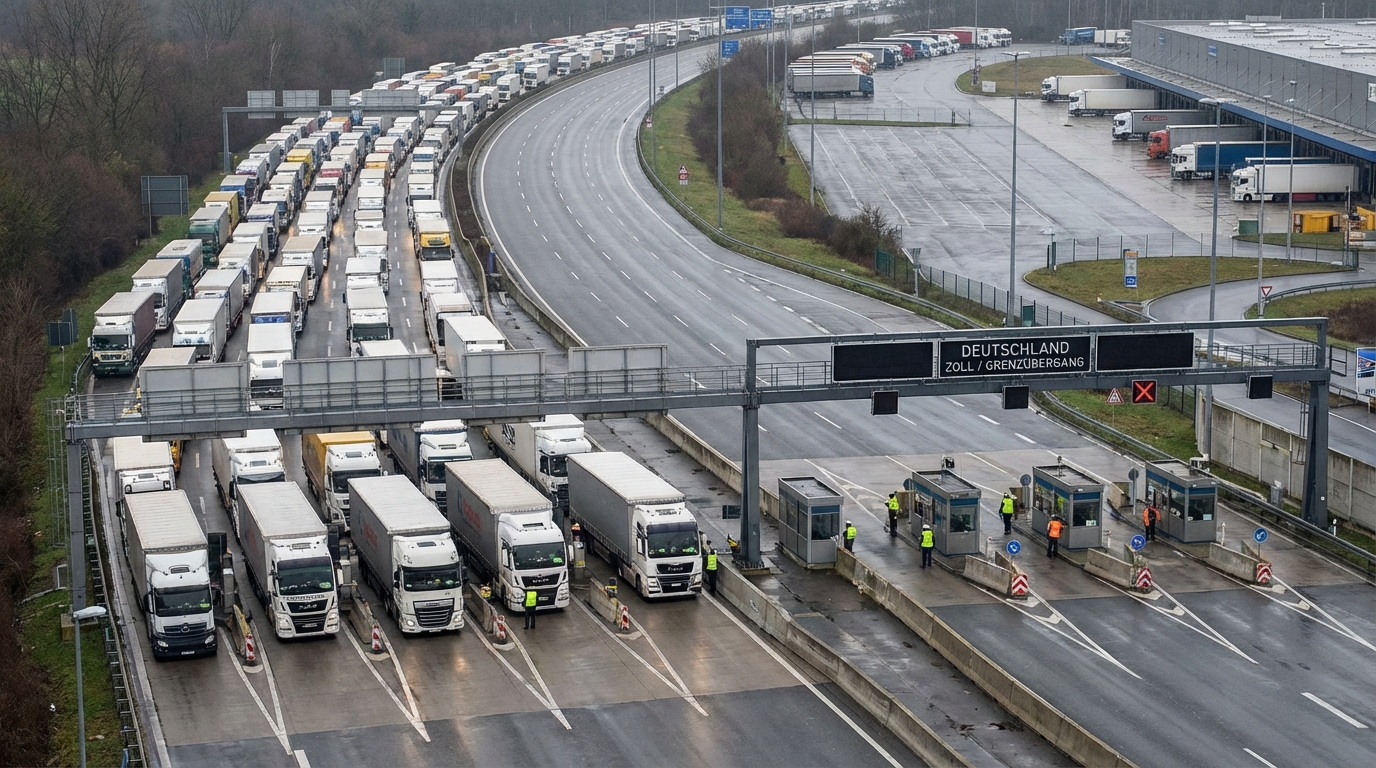
Germany is extending border controls until at least autumn 2026. For the European transport, forwarding, and logistics industry, this means a continuation of the crisis, which is already generating losses ranging from €60 to €88 million per month. The most at risk are Polish carriers—leaders of cross-border transport in Europe—whose margins are eroding under the impact of rising operating costs and shrinking freight rates. Risk analysts warn that the insolvency rate for companies serving the German route could rise significantly by the end of 2026.
Borders closed indefinitely – what is actually happening?
In the fall of 2023, the German federal government reintroduced controls at several land borders, citing the need to curb illegal migration. The decision was officially confirmed by Chancellor Olaf Scholz and then-Interior Minister Nancy Faeser. The restrictions affected border crossings with Poland, the Czech Republic, Austria, the Netherlands, Denmark, Belgium, and Luxembourg. Initially, these measures were intended to be temporary—which is consistent with EU law. The Schengen Borders Code allows for the reintroduction of internal controls only in emergency situations and for a strictly defined period, usually not exceeding two years in total.
Meanwhile, Berlin has announced an extension of the control regime until at least September 15, 2026, raising serious legal and political concerns. Luxembourg and Denmark have already filed formal complaints with the European Commission, citing a disproportionate infringement on the free movement of people and goods—one of the fundamental principles of the European single market. Germany defends its position with data: since the introduction of the controls, nearly 47 attempted illegal border crossings have been thwarted, nearly 2 people suspected of human smuggling have been arrested, and the number of asylum applications in 2025 has fallen by a third compared to the previous year.
The public safety arguments are politically clear, but from a market and fiscal perspective they do not compensate for the enormous losses that this policy generates in the European TSL sector.
Numbers that should alarm every risk manager
To properly assess the scale of the problem, it's worth recalling the situation before the tightening of controls. Germany, as the continent's largest economy and a hub for European supply chains, was the country through whose borders approximately 42 percent of all intra-EU road transport flowed—without any stops, continuously, and predictably. This fluidity was one of the foundations of Central Europe's logistical efficiency.
Today, the picture is dramatically different. Carriers are reporting massive congestion at almost all key border crossings. The Bundesverband Spedition und Logistik, the leading industry association for freight forwarders and logistics operators, estimates that losses resulting from extended transit times range from 60 to 88 million euros per monthThe data regarding the border with the Netherlands are particularly telling: the annual total of congestion generated at this single crossing exceeds 730 kilometers.
What lies behind these abstract figures in operational terms? Every hour of unplanned downtime for a truck combination costs a carrier between €75 and €100—including vehicle depreciation, driver costs, fuel consumption from idling, and the loss of the ability to complete the next order. With annual freight volume through Germany estimated at around 70 million tons, equivalent to over 3 million loaded trailers, the total losses for the entire European economy are now measured not in millions but in billions of euros.
Driver as a victim of the system - the human resources crisis deepens
The transport industry has been struggling with a chronic shortage of professional drivers for years. Various estimates place the workforce gap in Europe at 100 to 200 positions. In this context, every hour spent queuing at the border represents not only a financial cost but also a waste of scarce human resources.
Drivers are subject to strict regulations regarding driving hours and mandatory breaks, as set out in Regulation (EC) No. 561/2006 and regulated by digital tachographs. Waiting at the border exhausts permissible working hours, forcing unplanned stops and rest periods before reaching their destination. This has a double negative effect: it delays the execution of the current order and disrupts the carrier's entire operational schedule for the following days. Companies that incurred the costs of recruiting and training employees are now seeing their time efficiency dramatically reduced due to entirely external factors beyond their control.
The End of the Just-In-Time Era – Logistics Set Back a Decade
Perhaps the most serious, though difficult to quantify, consequence of the ongoing controls is the systemic disruption of advanced logistics models. For the past three decades, European industry—particularly the automotive sector, which remains the heart of the German economy—has built its competitiveness on the pillar of supply predictability.
models "just-in-time" (JIT) and "just-in-sequence" (JIS) systems deliver components precisely when they're needed on the production line, in the correct assembly sequence. This system eliminates the need to maintain costly warehouse inventories and allows for optimal management of production space. However, its foundation is unwavering delivery time predictability—something that has become an illusion today with border controls.
Enterprises are forced to make a painful adjustment to their strategies: they are moving away from cost optimization towards a costly model "just-in-case" (JIC), or maintaining buffer stocks in the event of delays. For manufacturing companies, this means tying up significant amounts of working capital in goods sitting in warehouses and increasing storage space costs. For logistics operators and freight forwarders, it means reserving additional warehouse space and maintaining larger fleets to absorb unpredictable delays.
Some carriers are seeking alternative routes to avoid traffic jams at major border crossings. One such workaround is to route cargo through Switzerland—a non-EU country with a different control regime. This solution, while operationally effective, is significantly more expensive: Switzerland charges some of the highest tolls in Europe, and the detour significantly lengthens the route, consuming additional driver hours and increasing fuel consumption.
Polish carriers at the center of the attack - risk assessment for the TSL sector
Poland is a leader in the European road transport market. Polish transport companies handle nearly a quarter of all cabotage and cross-border transport in the European Union. Germany—both in transit and as a destination market—is an absolutely crucial market for the Polish TSL industry. This makes Polish carriers particularly exposed to the risks arising from prolonged border controls.
The financial structure of many Polish transport companies is unique: they operate on relatively low operating margins, offsetting them with high order volumes. This model is effective in stable conditions, but extremely sensitive to external cost shocks. Rising operating costs resulting from border delays directly impact margins. Meanwhile, on the other side of the equation, intense pressure from shippers and large logistics operators limits the ability to raise freight rates sufficiently to offset the cost increases.
The situation of small and medium-sized carriers is particularly difficult. Unlike large transport groups, which have financial reserves, a diversified order portfolio, and sufficient bargaining power to renegotiate contracts, smaller entities:
- they do not have adequate financial buffers to absorb losses over a longer period of time,
- have limited ability to renegotiate rates with contractors,
- they more often operate in narrow geographical or industry niches, which prevents risk diversification,
- are more vulnerable to payment bottlenecks in the receivables chain,
- it is more difficult to obtain external financing (working capital loans, leasing) in conditions of deteriorating profitability.
Signals emerging from the B2B receivables market confirm that liquidity pressures in the transportation sector are mounting. Payment terms are extending, and the number of payment demands and debt collection cases is rising. Companies struggling with late payments from their contractors—and simultaneously falling behind on their obligations to fuel suppliers, lessors, and employees—are entering a debt spiral from which it is increasingly difficult to escape.
European Perspective – Is Change Possible?
At the EU level, the situation is legally complex. The European Commission finds itself in a difficult position: on the one hand, it is obligated to protect the integrity of the Schengen Area and the principle of free movement, while on the other, it has no direct instruments of coercion against a Member State that invokes grounds of public security and external border protection.
The complaints filed by Luxembourg and Denmark could become the basis for formal proceedings, but EU procedures are lengthy. Even if the Court of Justice of the EU ultimately rules that the extended checks are incompatible with the Schengen Borders Code, such a ruling could be issued after the planned end date of the restrictions—after autumn 2026. The TSL industry cannot count on a swift legal intervention that would resolve its current operational problems.
It's also worth considering the broader political context. The growing support for conservative and right-wing parties in Germany, for whom tightening migration policy is a key demand, is not conducive to a liberalization of border controls. Even after a potential change of federal government, the topic will remain politically sensitive—meaning that a scenario where border controls will be completed on time is possible, but not certain.
Recommendations for risk managers and business decision makers
Given the situation described, entities cooperating with companies in the TSL sector—banks, factors, lessors, credit insurers, as well as shippers using the services of smaller carriers—should urgently review their risk exposure in this segment. Here are some key recommendations:
- Tighter credit policy towards small and medium-sized road carriers, especially those strongly dependent on relationships with the German market. Analysis of their financial statements for recent quarters should take into account the impact of cross-border costs on operating results.
- Current liquidity monitoring contractors from the TSL industry. It's worth paying special attention to cash conversion cycle indicators—lengthening receivables alongside growing liabilities is a classic warning sign preceding solvency problems.
- Verification of contractual clauses in transport contracts. Shippers should consider whether their contracts with carriers include force majeure clauses or rate adjustment mechanisms in the event of extraordinary, systemic delays, such as border controls.
- Diversification of the portfolio of logistics suppliersThe supply chain's dependence on one or a few small carriers serving exclusively the east-west route via Germany constitutes a concentration point of operational risk.
- Tracking industry metrics: the number of bankruptcy applications in the transport sector, data on payment delays, freight indices and announcements from industry associations (including ZMPD, the Polish Association of Road Transport Employers and Bundesverband Spedition und Logistik).
Summary – Systemic risk, not episodic risk
Germany's persistent border controls are no longer a temporary inconvenience—they're becoming a structural trade barrier built into the European logistics system. The scale of financial losses, estimated at between €60 and €88 million per month, demonstrates that we are dealing with a systemic risk, not an isolated incident.
For the European transport industry, 2025 and 2026 will be challenging years. The companies that survive will be those that manage to build sufficient financial reserves, diversify their order portfolios and operational geographies, and negotiate fair cost-compensation mechanisms with shippers. Weaker players—without adequate buffers and bargaining power—will gradually be driven out of the market.
For risk analysts and financial institutions, the conclusion is clear: the transportation sector now requires exceptional caution in assessing creditworthiness and ongoing monitoring of the financial condition of entities. The portfolio of non-performing receivables in this segment will grow—the question is no longer it will happen, but when i in which specifically companies.










