

Strait of Hormuz Blockade: Thousands of Trapped Ships and a Wave of Risk for European Logistics
In April 2026, the Center for Eastern Studies published a comprehensive analytical report on the consequences of the escalating armed conflict in the Persian Gulf. The document's authors, Sandra Baniak-Stachowiak and Konrad Popławski, detail the mechanisms by which the regional military clash escalated into a global logistics crisis with potentially long-term economic consequences. For companies operating in the transportation, forwarding, and logistics sectors—and especially for trade finance and credit risk management institutions—the conclusions of this report are fundamental today.
The Persian Gulf on Fire: The Origins of the Crisis
The immediate trigger for the current turbulence were military attacks by the United States and Israel targeting Iranian strategic facilities. Iran responded with a move that analysts had been warning against for years, but which had long remained in the realm of theoretical war scenarios: the complete closure of the Strait of Hormuz to commercial shipping. This decision, taken as an instrument of geopolitical pressure, caused an immediate and unprecedented upheaval in global shipping markets.
The Strait of Hormuz is one of the most strategic points in global trade. Between 20 and 25 percent of global oil demand and a significant portion of liquefied natural gas exports from the Arabian Peninsula flow through this narrow maritime passage. Its blockage is not just an energy problem—it paralyzes the entire Asia-Europe trade system, which for decades has been the backbone of the global economy.
A Thousand Ships Trapped: The Scale and Mechanism of the Maritime Crisis
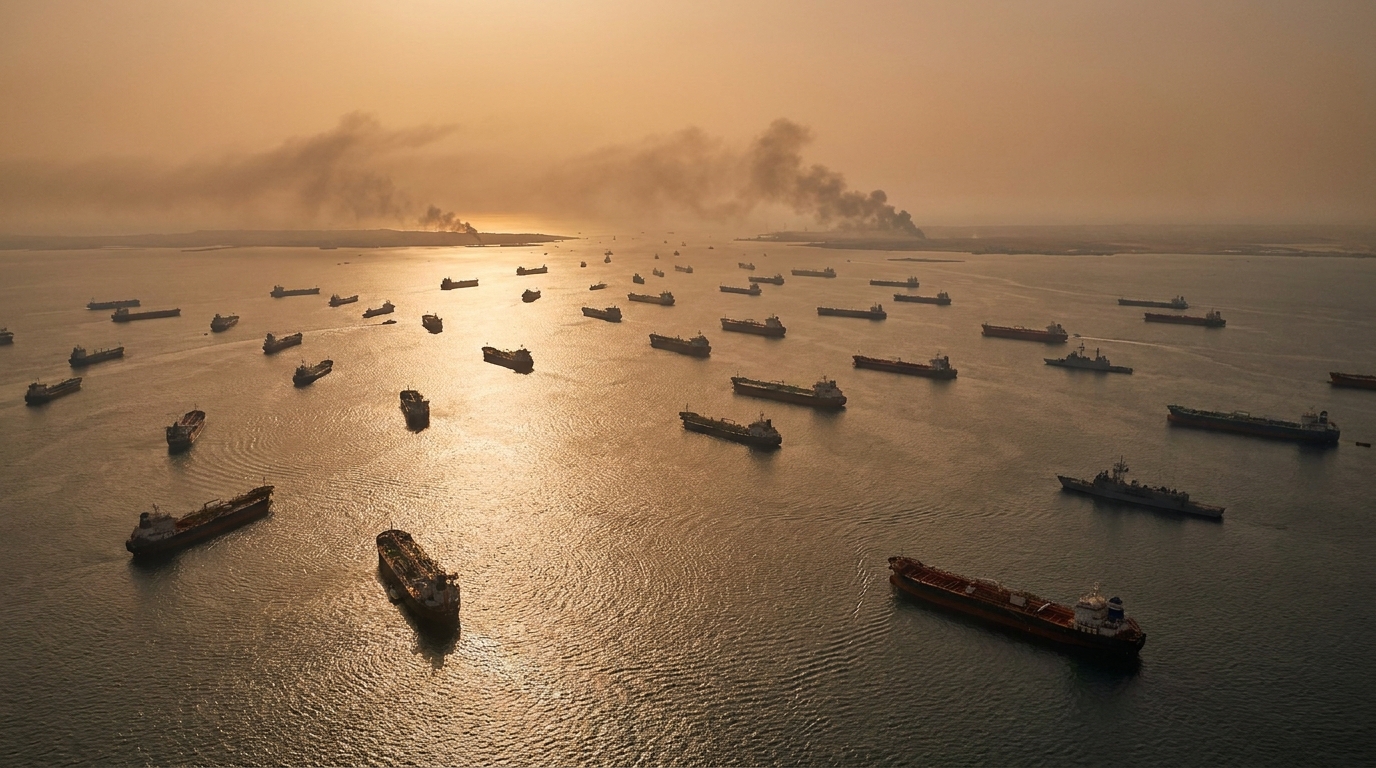
The immediate, measurable consequence of the blockade is the entrapment of nearly a thousand vessels in the conflict zone. These include both key tankers carrying crude oil and LNG, as well as container ships handling the exchange of consumer goods and industrial semi-finished products. For the companies managing these assets, this means capital being tied up for an unknown period, mounting financial liabilities, and a complete loss of operational control.
Shipowners whose ships escaped the trap were faced with a choice of only costly alternatives. Redirecting vessels around the Cape of Good Hope adds several days to the voyage, generating a dramatic increase in fuel costs. Cargo and hull insurance in war-risk areas—so-called war risk premiums—have reached levels not seen in decades, and in some market segments, insurers have refused to issue policies for transit routes through sensitive areas altogether.
The financial impact is immediate and severe. Freight rates, which had stabilized earlier this year after earlier fluctuations related to the Houthi crisis in the Red Sea, have skyrocketed. The rise in maritime transport costs is mechanically affecting the prices of imported goods, raising serious concerns about another wave of inflation in Europe—this time fueled not by post-pandemic disruptions but by the ongoing armed conflict.
Air cargo under pressure: closed airspaces
The effects of the conflict extend far beyond maritime navigation. The closure of airspace over much of the Middle East has forced airlines to designate alternative, much longer routes. The consequence is not only longer delivery times and increased operating costs for airlines, but above all, a spectacular decline in the capacity of the global air cargo market—estimated at 12 percent of all cargo traffic.
Air transport plays a crucial role in the delivery of high-value goods, electronic components, pharmaceuticals, and perishables. Its restrictions directly impact industries that cannot afford extended order fulfillment times—from pharmaceuticals to automotive to technology. For manufacturers operating on a just-in-time basis, every day of delay generates measurable financial losses and threatens to halt production lines.
Poland under particular pressure: 20 percent drop in capacity
Among European countries, Poland stands out for its particularly painful exposure to the current crisis. Financial news reports indicate that the country's logistics sector has seen a 20% decline in throughput—a figure that could mean the edge of profitability for many companies.
This is no coincidence. For years, Poland has consistently built its position as a strategic logistics hub in Central and Eastern Europe. Modern distribution centers, a dense network of expressways and highways, and a well-developed freight forwarding sector have made our country a key node in European supply chains, heavily dependent on imports of components and finished goods from Asia. This strategic position, previously a source of competitive advantage, is now becoming a liability in the face of disruptions on Middle Eastern routes.
Polish freight forwarding and logistics companies are simultaneously confronting several negative factors: contract terminations by contractors unable to meet delivery deadlines, rising costs of alternative routes and modes of transport, mounting delays in customs clearance, and—especially concerning—difficult access to financing amidst growing market uncertainty. With a 20% decline in turnover and simultaneous increases in operating costs, the TSL sector is in a bind, which could lead to a wave of bankruptcies among smaller and medium-sized operators.
Financial Markets and Credit Risk: New Threat Vectors
From the perspective of trade finance institutions and credit risk managers, the current situation presents a number of specific threats that require an immediate response.
Risk of insolvency of smaller shipowners
Many shipowners operate on a high-debt financing model. The sharp rise in operating costs, coupled with the fleet being frozen in conflict zones or having to incur enormous detour costs, dramatically worsens their liquidity ratios. For banks and funds financing the maritime fleet, this means an urgent need to review their loan portfolios and prepare restructuring scenarios.
Pressure on trade finance instruments
Letters of credit, bank guarantees, and export credit insurance—all of these instruments are vulnerable to unforeseen delays and claims arising from non-performance. Force majeure clauses will be invoked en masse by transaction participants, generating waves of legal disputes and insurance claims.
Operating Cost Inflation and EBITDA
Rising transportation costs directly burden the operating margins of companies trading with Asian suppliers. For companies with tight cost structures, even a 10-percent increase in logistics expenses can push EBITDA below the levels required by loan covenants, triggering accelerated repayment mechanisms or renegotiation of financing terms.
Alternative routes – salvation or illusion?
Faced with the crisis on traditional sea and air routes, global logistics players are turning their attention to alternative transport corridors. Of particular interest is the so-called Middle Corridor, which runs through Central Asia—via Kazakhstan, the Caspian Sea, Azerbaijan, and Georgia, and then on to European markets.
However, the OSW report rightly points out the fundamental limitations of this option. Despite significant investments in recent years, the infrastructure of the Central Corridor still falls far short of the processing capacity needed to absorb even a fraction of the volumes diverted by the Hormuz blockade. The capacity of Caspian ports, the quality of rail connections, and the efficiency of border checks all constitute bottlenecks that cannot be eliminated in the short term.
The long-term response to the crisis will have to take the form of a comprehensive reconfiguration of supply chains. nearshoring — moving production and supply closer to target markets — is emerging increasingly in industry debate, but its implementation requires years and billions of euros of investment. For the financial sector, this represents both a huge opportunity to participate in financing this transformation and the need to develop new models for risk assessment of logistics and production projects.
Long-Term Perspective: An Era of Persistent Uncertainty
OSW analysts draw a conclusion that should be treated as an alarm signal for all entities operating in the TSL and trade finance sectors: the Middle East Pandora's box is already open, and closing it – even in the event of an imminent ceasefire – will not automatically restore the previous logistics order.
Insurers will maintain elevated premiums for war risks on Middle Eastern routes for a long time. Shipowners and freight forwarders will design logistics strategies with the risk of further escalation in mind. Manufacturers and retail chains will diversify suppliers and supply routes, accepting higher costs as the price of operational resilience. All of this means a permanent—not temporary—increase in the costs of global trade.
For the Polish TSL sector, the long-term consequences may be ambivalent. On the one hand, the short-term shock is profound and could trigger bankruptcies among less capitalized operators. On the other hand, Poland—as a country with a developed logistics infrastructure, well connected to both Western Europe and Ukraine and Asia via eastern rail routes—could benefit from the long-term trend of shortening supply chains and relocating production to Europe. However, this requires weathering the current shock and maintaining operational and financial capacity.
Recommendations for risk managers
In view of the threats described, EURODEBT.eu recommends that entities operating in the transport and logistics industry and their creditors and financial partners take the following steps:
- Immediate audit of Middle East risk exposures — identifying contracts, routes and business partners linked to transit routes through the Strait of Hormuz or Middle Eastern airspace.
- Verification of contractors' financial capacity — special attention should be paid to smaller maritime operators, forwarding companies operating in the Asian segment and entities with a high share of variable operating costs in the financial structure.
- Review of contracts and contract clauses — analysis of provisions regarding force majeure, war risk, delays and contractual penalties in the light of the current geopolitical situation.
- Diversification of routes and suppliers — Development of contingency plans covering alternative transport routes, including rail options through Central Asia and air transport via routes that bypass closed airspace.
- Monitoring early warning indicators — tracking freight rates, war insurance indices, cash reserve levels of key business partners, and credit ratings of trade finance institutions.
- Verification of financial security — in the case of credit portfolios, exposure to entities from the maritime and logistics sector should be subjected to stress tests taking into account the scenario of a prolonged blockade and further escalation of the conflict.
Summary: Operational Alert for the TSL Industry
The OSW report, authored by Sandra Baniak-Stachowiak and Konrad Popławski, is one of the first comprehensive analytical studies to assess, from a European perspective, the scale of the risks stemming from the current destabilization in the Persian Gulf. The blockade of the Strait of Hormuz, the entrapment of nearly a thousand ships, a 12 percent decline in global air cargo, and a 20 percent decline in logistics capacity in Poland—these aren't statistics derived from abstract economic models. They are hard data describing the current operational reality of thousands of companies across Europe.
The TSL industry is entering a period in which flexibility, the ability to adapt quickly, and access to capital to cover rapidly rising operating costs will be valued. Companies without solid liquidity reserves, diversified routes, and war risk insurance face a serious existential challenge. For institutions financing the TSL sector, this is a time for exceptionally careful portfolio selection and active credit exposure management.
In an era where geopolitics is becoming a key variable in business risk models, the ability to monitor and price geopolitical risks is no longer a luxury reserved for the largest corporations – it is becoming a survival requirement for even mid-sized transport and logistics companies.










