

The collapse of Chambers and Cook and the summer wave of bankruptcies among British carriers – a wake-up call for European logistics partners
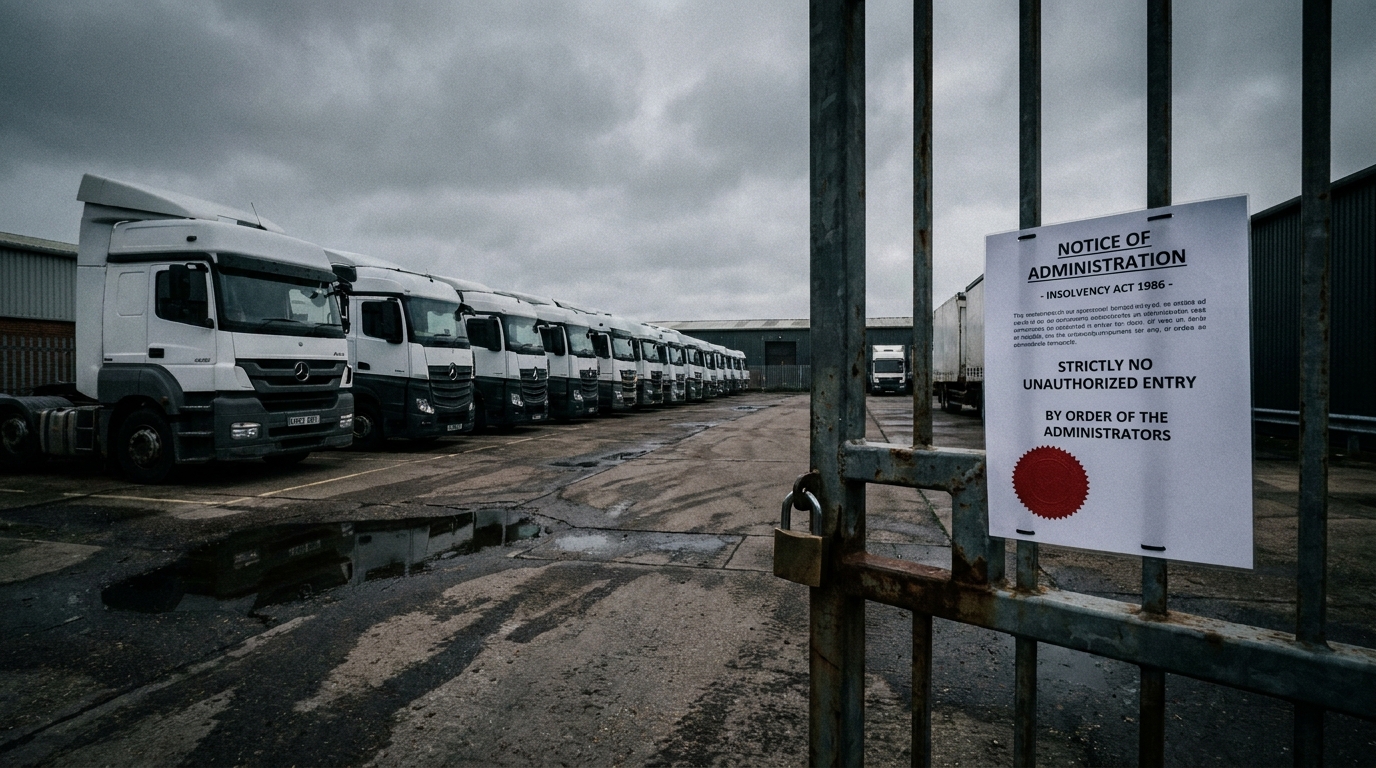
August 2026 will go down in the history of British road transport as an exceptionally difficult month. In a short window of time, several carriers from various corners of England declared bankruptcy or entered liquidation proceedings. The most emblematic case is the collapse of Chambers and Cook (Eastern) Ltd. of Immingham—a company with almost fifty years of history that could not withstand the loss of a key client. For European trading partners and risk managers, this is a clear warning sign: verifying the solvency of British transport subcontractors has ceased to be an option and has become a necessity.
Chambers and Cook (Eastern) Ltd: the end of almost 50 years of history
Chambers and Cook (Eastern) Ltd was incorporated in October 1978 and operated as an active participant in the British road haulage market for nearly half a century. Based in Immingham, a port town in Lincolnshire and a key logistics hub for the east coast of England, Chambers and Cook (Eastern) Ltd provided a semblance of stability, but in mid-summer 2026, the company permanently closed its doors.
On 13 August 2026, the High Court in Birmingham formally placed the company under receivership (Directors). Representatives of the consulting firm BK Plus took over as managers. The immediate cause of the collapse was not poor management or sudden market changes—at least not in the traditional sense. The cause was the loss of one contractor who generated as much as 80% of annual revenue When this key client pulled out of the contract, the company had no cushion to survive.
This is a classic, yet still surprisingly common example. customer concentration risk — one of the most dangerous risk factors in assessing the solvency of transport companies. No amount of years spent in the market can compensate for the structural weakness of a business model based on a single revenue pillar.
Disturbing signs preceding bankruptcy
A retrospective analysis of corporate events preceding the bankruptcy declaration reveals several characteristic signals that, if noticed in due time, could provide a basis for an earlier reaction by creditors and business partners.
- On August 7, 2026, Simon Roy Forrest, a longtime company official, resigned as company secretary. The departure of a key management figure so soon before bankruptcy is a red flag for any risk analyst.
- On August 11, just two days before the formal entry into receivership, two security charges were removed from the register (charges) on the company's assets. Such operations just prior to bankruptcy proceedings require particularly careful analysis in the context of the interests of unsecured creditors.
It is worth emphasizing an important structural issue: bankruptcy concerns only regional unit — Chambers and Cook (Eastern) Ltd. The remaining entities within the broader Chambers and Cook group continue to operate without disruption. However, this means that creditors and trading partners must clearly identify which company they are bound by their trading agreements with.
The domino effect: the August wave of bankruptcies in the TSL sector
The Chambers and Cook case is not an isolated one. August 2026 brought a series of concurrent bankruptcy and liquidation proceedings affecting carriers across England. Together, they paint a disturbing picture of systemic fracturing in the industry.
SBS Transport Ltd (Evesham)
On 17th August, SBS Transport Ltd of Evesham, Worcestershire, entered voluntary liquidation with its creditors (Creditors' Voluntary Liquidation, CVL). The lawsuit came as no surprise—in July, the British tax office HMRC filed a motion for compulsory liquidation against the company for tax arrears. The company's balance sheet at the time of bankruptcy was alarming: only £189 net assets with assets and liabilities of approximately £675. It employed six staff.
DAB Logistics Ltd (Staffordshire)
On the same day as Chambers and Cook—August 13th—DAB Logistics Ltd, a company in Staffordshire, went into liquidation. The latest available financial statements showed assets of £269 and liabilities of over £520. Negative equity reached 250 poundsThe company employed an average of 16 people, meaning its bankruptcy had a direct impact on individual families and the local economy.
Majestic Transport Ltd (Blackburn)
The day after Chambers and Cook, on August 14th, Majestic Transport Ltd of Blackburn, Lancashire, was liquidated. Again, the immediate trigger was a winding-up petition filed by HMRC a month earlier. The company's assets were just £68, with liabilities of £283. negative net assets reached 215 thousand pounds.
Other entities
In the same short timeframe, bankruptcy or liquidation proceedings also affected:
- Dan Sandu Trans Ltd — liquidation on August 13, 2026,
- MTN Drive Ltd from Leicester - liquidation 17 August 2026.
In total, at least six transport companies disappeared from the market in just a few days in August. This is a scale that requires a systematic interpretation, rather than treating individual cases as incidents.
Macroeconomic context: systemic poison for UK hauliers
The August wave of bankruptcies did not come out of nowhere. The British road transport sector has been operating in arodoin a field of extremely unfavorable conditions that cumulatively undermine the liquidity of even experienced operators.
Data from the British Insolvency Service agency shows that in July 2026, a total of 100,000 businesses declared insolvency in England and Wales. 1931 firm — 5% more than a month earlier. While this figure is 5% lower than in July 2025, the overall bankruptcy rate remains at levels comparable to the 2008-2009 crisis. This is not a temporary fluctuation, but rather a sustained, heightened pressure that has been ongoing since the second half of 2022.
UK hauliers face several simultaneous risk factors:
- Cost pressure — persistently high fuel prices, rising labor costs (the minimum wage has increased significantly in recent years) and expensive fleet maintenance and leasing.
- Tightening credit conditions — higher interest rates mean more expensive working capital and investment financing.
- Weakening demand — the slowdown in consumption and industrial activity translates into a smaller volume of transport orders.
- HMRC's aggressive policy — The tax office is increasingly using compulsory liquidation applications as a tool for collecting tax arrears. The mechanism works quickly: submitting an application to HMRC almost immediately triggers defensive procedures or accelerates the liquidation decision, eliminating liquidity-starved entities from the market.
For European trading partners, monitoring HMRC is crucial. In the cases of SBS Transport and Majestic Transport, the tax office's request preceded the formal liquidation by only a few weeks. Monitoring such requests (winding-up petitions) in British court records is one of the most reliable early indicators impending bankruptcy of the contractor.
Business risk from the perspective of European partners
The wave of bankruptcies in August has a direct impact on European participants in the logistics market – both those who actively cooperate with British subcontractors and those who are considering establishing such relationships.
Customer Concentration Risk - A Lesson from Chambers and Cook
The collapse of Chambers and Cook (Eastern) is a textbook example of how a lack of client portfolio diversification can destroy even a well-established business. 80% of revenues from one source This is a trap that is difficult to identify from the outside without access to detailed financial data – but it is precisely this information that risk management departments should consult before establishing or continuing cooperation.
Questions to ask potential or current transportation subcontractors:
- What percentage of revenue does your largest customer generate?
- Does the company have long-term contracts with multiple contractors or does it rely on spot orders?
- What is the structure of receivables – are they concentrated in one recipient?
Structural risk in capital groups
The Chambers and Cook case reveals another dimension of risk often underestimated by finance departments: the possibility selective bankruptcy within the capital group. When the Eastern entity collapsed, the rest of the group continued operations. This is good news for partners cooperating with other companies in the holding company—but disastrous for those whose contracts were with the Eastern entity.
Before entering into cooperation with an entity belonging to a holding company, it is always important to precisely identify the specific legal entity with which the contract binds us. Quality certificates, websites, or the group's long history can be misleading – contractual responsibility rests with the specific legal entity, not the brand or holding company.
HMRC requests as a wake-up call
As the cases analyzed show, HMRC's compulsory winding-up petitions are one of the most reliable and publicly available signals of impending bankruptcy. They are recorded in public databases and—crucially—can be monitored automatically by early warning systems.
Businesses using UK transport subcontractors should consider implementing alerts covering:
- applications for compulsory liquidation (winding-up petitions) submitted by HMRC or other creditors,
- changes in key positions on the management board or among company secretaries,
- deletions and modifications of security (charges) registered at Companies House,
- delays in submitting mandatory financial reports.
Recommendations for risk managers and finance departments
Based on the analysis of the August cases and the broader macroeconomic context, we recommend that European companies cooperating with the British TSL sector take the following actions:
- Instant overview of merchant limits for British transport contractors. The increased systemic level of bankruptcy justifies a conservative approach to credit exposure to UK entities.
- Audit of the subcontractor's client portfolio structure — especially in the case of partners that handle a significant portion of your transport volume. If you're a key customer, the risk of sudden service disruption is lower; if not, ask where the rest of their revenue comes from.
- Verification of financial condition through public registers — Companies House provides access to the financial statements of UK companies. Analyzing liquidity ratios, debt levels, and liability structure should be part of routine partner assessments.
- Monitoring court alerts — automatic tracking of winding-up applications in the court registers of England and Wales allows you to react before bankruptcy is formally declared.
- Diversification of the subcontractor base — dependence of one's own supply chain on one or two carriers operating in the current environmentrodomarket economy is an operational risk that is difficult to justify.
- Contractual clauses regarding service continuity — it is worth considering introducing provisions into contracts with subcontractors obliging them to inform about significant changes in the customer structure or financial situation.
Summary: This is not an anomaly, it is the new norm
The August wave of bankruptcies in the British road haulage sector is not an isolated incident, but the culmination of a years-long process of margin and liquidity erosion. Chambers and Cook (Eastern) Ltd.—a company with nearly 50 years of experience—has become emblematic of the risks that can affect any entity dependent on a single key source of revenue, regardless of its length of market history.
For European risk managers and logistics business owners, the message is clear: the state of the British road haulage market requires increased vigilance and active monitoring of trading partnersBankruptcy rates remain at historically high levels, HMRC is aggressively pursuing tax arrears, and cost pressures show no signs of abating.
Verifying the financial condition of subcontractors, analyzing concentration risk and monitoring public registers is not a cost in the current circumstances – it is an investment in the continuity of your own supply chain.










