

End of fuel tax relief in Germany from July 1, 2026: Alarm for Polish carriers and increased risk of bankruptcy in the TSL industry
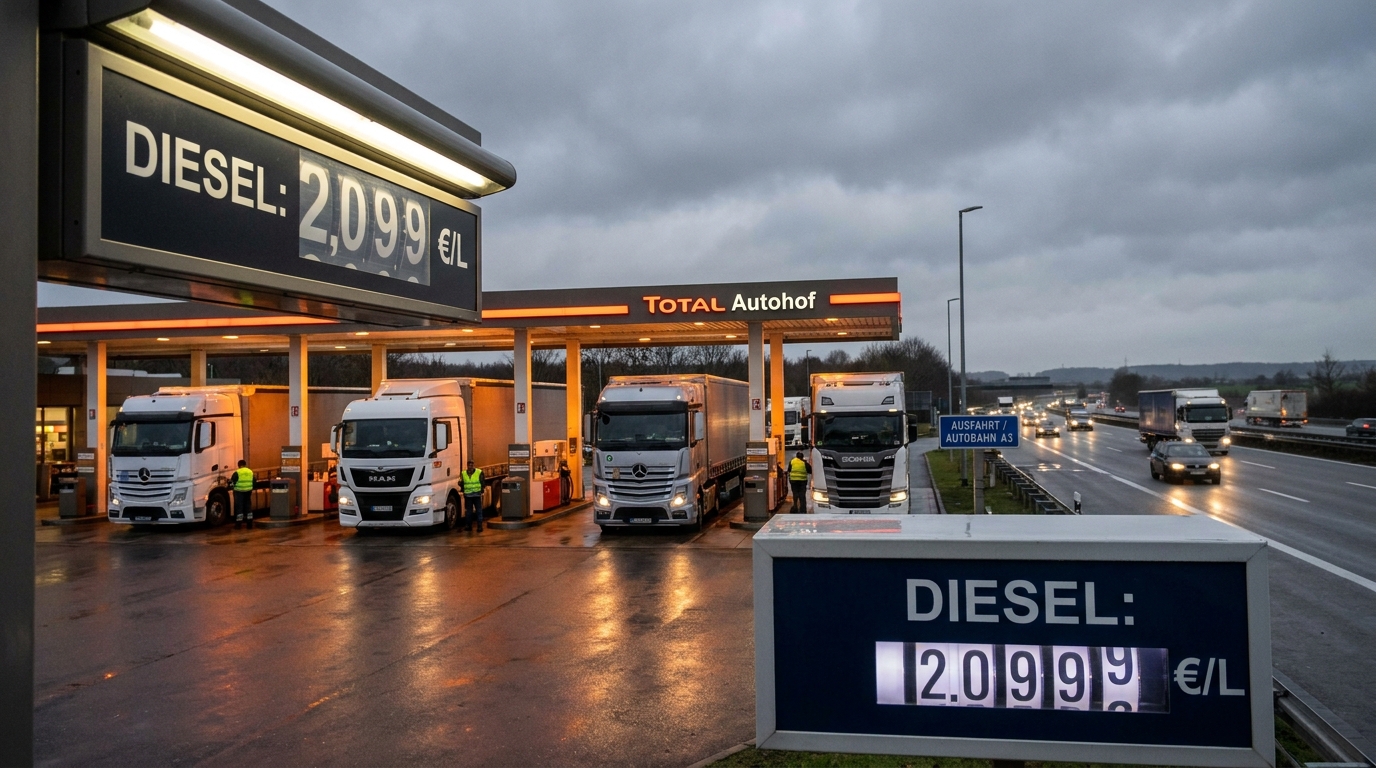
From July 1, 2026, the European road transport market will face one of the most significant fiscal shocks in recent years. In Germany—the continent's logistics heart and an absolutely crucial transit corridor for Polish TSL companies—a temporary reduction in the energy tax on fuels, introduced as a market relief, will expire. The effect will be immediate: diesel prices at stations across the western border will increase by an estimated 14–17 cents per liter. For the transport, forwarding, and logistics industry, operating on minimal margins and with tight working capital, this change is not just a statistical cost adjustment—it poses a real threat to the solvency of dozens of entities.
What exactly expires on July 1, 2026?
For the past few years, Germany has been temporarily reducing the federal energy tax (Energiesteuer) on gasoline and diesel. This mechanism was strictly time-bound—legislators never announced an extension beyond the designated cut-off date. Effective July 1, 2026, the applicable regulations reinstate the standard, significantly higher rates of this tax, without any transition period or phase-out.
The effect on the market will be felt immediately. Industry forecasts indicate a jump in the price of a liter of diesel fuel of 14–17 euro cents. Translating this into operational realities: a truck with a tank capacity of 700 liters, fully fueled on the German side, will cost in the first week of July from 98 to 119 euros more than a week earlier. Assuming the vehicle is refueled in Germany several times a month, the annual increase in fuel costs per vehicle could reach several thousand euros.
Why is Germany so crucial for Polish carriers?
Poland has long maintained its position as one of the leaders in the European road transport market. Polish TSL companies handle a significant portion of freight moving between Eastern and Western Europe, and Germany is an inescapable hub in this connection. Every route to France, the Benelux, the UK (via Calais or the Eurotunnel), or Scandinavia (via Denmark) passes through German territory or is dominated by German highway sections.
For the Polish transport sector, Germany performs three functions simultaneously:
- Destination country — direct recipient of goods in Polish-German trade, which is one of the largest trade relations in Europe;
- Transit country — mandatory corridor for deliveries to France, the Netherlands, Belgium, Luxembourg and the British Isles;
- Fuel base — Due to their infrastructure and historically competitive prices, German station operators have been a popular choice for internationalrodofleets of trucks.
The loss of the third of these functions—at least in terms of price attractiveness—combined with the inevitability of transit, places carriers in an exceptionally difficult bargaining position. They cannot simply "avoid" refueling in Germany if they operate on Western European routes.
Margins that have nowhere to shrink now
To understand the gravity of the situation, one must look at the cost structure of a typical small or medium-sized carrier. In the road transport industry, fuel accounts for 25 to 35 percent of all operating costs fleet. For companies operating exclusively in the FTL (full truckload) segment on Western European routes, this figure may be even higher. At the same time, pricing pressure from clients—large logistics operators, retail chains, and manufacturers—has meant that freight rates have not kept pace with rising costs for several quarters.
As a result, the net margins of many SME transport entities hover at a few percent, and in more challenging months, they drop to zero or even negative. In such a cost structure, a sudden increase in fuel costs by a dozen or so eurocents per liter cannot be absorbed without serious financial consequences.
Fuel Clauses: Protection Most Companies Don't Have
The institution that should theoretically protect carriers against this type of fluctuations is the so-called fuel clause (BAF—Bunker Adjustment Factor or its road equivalent). This mechanism, built into the transport contract, allows for automatic recalculation of the freight rate based on current fuel prices. In practice, however, such clauses are the domain of large players—corporate logistics operators—who have the negotiating power to force such provisions from customers.
Smaller transport companies, entering into contracts with more powerful contractors, often accept the terms imposed by the ordering party—no fuel clauses, no indexation, but with rigid deadlines and penalties for delays. As costs rise, the carrier, as the weaker party to the contract, bears all the financial risk. Given the July price spike in Germany, such entities will find themselves under enormous liquidity pressure.
Liquidity Gap: Fuel Today, Payment in 90 Days
The cost crisis has another structural dimension that is often overlooked in credit risk analyses. The transportation industry is characterized by a unique cash flow pattern: costs are incurred immediately (fueling, highways, drivers' wages), while revenues arrive with a delay of several weeks or monthsPayment terms in the TSL sector often reach 60 or even 90 days – despite regulations combating payment backlogs.
The increase in fuel prices from July 1st means that carriers will incur increased cash expenses in the first week of the month, but will not see revenue covering these costs until September or October. During this time, they must finance the liquidity gap from their own or external resources. For SMEs, this means:
- increased use of factoring (which costs money and reduces margins);
- increasing debt on credit lines and current accounts;
- delaying payments to own suppliers – subcontractors, workshops, tire and parts suppliers;
- in extreme cases, suspension of order execution due to lack of funds for fuel.
The latter scenario is particularly dangerous for the company's reputation and health, as it leads to contractual penalties, loss of customers and a spiral of debt.
A Confluence of Unfavorable Circumstances: Summer 2026 with Many Question Marks
The rise in fuel prices in Germany does not occur in a vacuum – it coincides with a number of other factors that burden the transport industry during the same time window.
Summer truck traffic bans
Traditionally, July and August are the months with the most restrictive truck traffic bans in Europe. In 2026, these will affect, among others:
- Czech — weekend and holiday bans on key transit routes;
- Austria — particularly stringent restrictions in the Tyrol, Salzburg and Brenner crossing areas, which are a mandatory corridor for traffic to Italy and the Balkans;
- Bulgaria and Romania — extraordinary heatwave-related prohibitions, introduced ad hoc and complicating operational planning;
- German — increased technical inspections on motorway bridges, resulting in queues and downtime.
For a carrier, every downtime is a cost: the driver collects a daily allowance and salary, the vehicle sits idle, and the order is delayed. Summer closures pose a logistical challenge every year, but combined with the spike in fuel costs, they create an exceptionally toxic mix for operating budgets.
New road tolls in the Netherlands
The Netherlands has implemented new regulations on road tolls for heavy goods vehicles. This represents another burden on routes running through the Dutch logistics hub—one of the busiest in Western Europe—and another cost item that cannot be easily passed on to customers without renegotiating contracts.
Losses on the eastern borders
The ZMPD organization is warning of losses reaching half a billion euros generated by lengthy queues and waiting times at the eastern borders, especially in the context of transport to Ukraine. Companies involved in this route are suffering losses resulting from queuing—unproductive time that, however, costs drivers money and depreciates the vehicle.
Business Risk Perspective: Who is Most at Risk?
From the point of view of assessing payment credibility and the risk of insolvency, several categories of entities can be identified that are particularly exposed to the consequences of the July increase in fuel costs:
Small and medium-sized carriers (1–20 vehicles)
Companies of this size typically lack fuel clauses in their contracts, have limited cash reserves, and are more dependent on individual clients or principals. A few percent increase in fuel costs can impact the profitability of an entire month. These entities pose the highest risk from a credit perspective.
Companies with a large share of Western European routes
Carriers for whom routes through Germany account for 60–80 percent of their fleet's operational work will feel the cost increase proportionally more acutely. They are unable to diversify their destinations in the short term—expanding routes to other markets requires new contracts and certifications.
Subcontractors of large logistics operators
This group is particularly vulnerable: they work for one or a few large clients who dictate rates, deadlines, and terms. They have no negotiating power or the ability to quickly transition to another market segment. Cost increases after July 1st will directly impact their margins, and the coming months could bring a cumulative increase in liquidity problems.
Warning signs that risk managers should pay attention to
For companies collaborating with road carriers—both as transport service providers and credit counterparties—the coming months require increased vigilance. What should we pay particular attention to?
- Sudden extension of payment deadlines from transport companies towards your company - may indicate liquidity problems;
- Requests for advance payments or payment in advance — uncharacteristic for a given partner, may indicate a lack of funds for current operating costs;
- Increased fleet turnover and sale of vehicles - a signal of disposal of assets to obtain cash;
- Cancellation of routes or orders in the absence of rational justification, the company may not be able to finance the implementation costs;
- Delays in order fulfillment for non-operational reasons (not traffic jams or traffic bans, but lack of funds for fuel or breakdowns resulting from negligent servicing).
In this context, regular monitoring of the financial condition of contractors from the TSL sector using verification platforms is becoming not an optional tool, but a standard for risk management in the supply chain.
Market consolidation: who will survive and who will be taken over?
From a macroeconomic and structural perspective, cost increases after July 1, 2026, could catalyze the consolidation processes that analysts have long predicted would inevitably affect the European road transport market. A market with an excessive number of small entities operating at the edge of profitability is susceptible to waves of bankruptcies and takeovers whenever an external cost shock occurs.
Stronger players—large transport and logistics groups with access to affordable financing, fuel clauses in contracts, and a geographically diversified revenue base—will not only survive but can also capitalize on the turbulence, acquiring customers and resources (rolling stock, contracts, certificates) from entities that cannot withstand the pressure. The history of the European TSL industry shows that every major cost shock results in a reduction in the number of players and an increase in market concentration.
For SME carriers themselves, this means the need to make quick, pre-emptive strategic decisions: renegotiating contracts, reviewing routes in terms of profitability, implementing fuel clauses where still possible, and assessing whether the current scale of operations provides a sufficient buffer to absorb upcoming costs.
What should TSL companies do before July 1?
The time until the end of June 2026 is limited, but sufficient to take risk mitigation measures. Priority steps for fleet and transport contract managers include:
- Contract audit in terms of the existence or possibility of introducing fuel clauses - each contract without such security is an open exposure to cost risk;
- Scenario modeling the impact of the increase in the price of diesel fuel by 14–17 ct/l on the profitability of individual routes and customers – these data are the basis for talks with contractors about rate adjustments;
- Fuel Policy Review — analysis of where the fleet refuels and whether there is a possibility of geographical optimization (e.g. refueling in Poland before entering Germany, if the tank capacity and mileage allow it);
- Securing credit lines — increasing available factoring and credit limits before July, when banks and factors will see a deterioration in industry indicators and may tighten criteria;
- Verification of contractors' solvency — both clients (will they be able to pay on time?) and subcontractors (will they keep their obligations to your company?).
Summary: High industry risk in the second half of 2026
The expiration of the fuel tax credit in Germany on July 1, 2026, is not a market event, but a systemic increase in operating costs for the entire European road transport sector. Given tight margins, the lack of common cost indexation mechanisms in contracts, and a structural liquidity gap in the industry, an increase in diesel prices by just a few cents per liter will have consequences far beyond simple fuel calculations.
For risk managers and logistics business owners, the key takeaways are: monitoring of the financial condition of transport partners should be intensified, actively manage your own supplier risk exposure (single-sourcing is a particular risk), and any long-term contracts concluded in the coming weeks should unconditionally include fuel clauses or other cost risk-sharing mechanisms.
We forecast that the SME road transport segment in Poland and Central Europe will see a significant increase in payment backlogs, debt restructurings, and formal bankruptcy proceedings in the second half of 2026. Companies that conduct a thorough risk analysis and implement protective measures today will be in a much better position to emerge from the coming period without significant losses. Those that ignore warning signs will pay a double price.










