
The end of AREX, new customs regulations in France: what do sanctions of up to €50,000 per single transport mean for Polish carriers?
French customs authorities have just presented the entire European TSL industry with one of the biggest regulatory challenges in recent years. Decree No. 2026-724, published on August 2, 2026 in the French Official Journal, abolished the AREX system, in force since 2016, and replaced it with a much more demanding, fully digital customs supervision regime. The regulations came into effect almost immediately—the very next day, August 3, 2026. Transport and logistics companies operating in France had no time to prepare for the new reality. For Polish road carriers, which constitute one of the pillars of the European freight market, this change could have far-reaching operational and financial consequences.
What was AREX and why is it being abandoned?
The AREX system, in operation for a decade, was a relatively narrow tool. It focused primarily on express and postal shipments, primarily transported by air on specific cross-border trade routes. It was a reactive model, with customs authorities analyzing data after the fact or randomly checking selected shipments at the border. For the vast majority of companies transporting freight by road through France—both full truckloads (FTL) and groupage (groupage)—the AREX system was virtually unnoticeable in their daily operations.
The new regulations radically break with this philosophy. The digitalization of logistics, the growing threat of smuggling, and the European Commission's ambitions to tighten the customs system have led the French administration to take a bold step forward. The new system is designed to be proactive, algorithmic, and real-time—meaning it doesn't wait for a truck to reach a checkpoint, but analyzes data before the vehicle crosses the border or leaves the warehouse.
Four fundamental changes that are revolutionizing the industry
1. Direct access to TMS and WMS systems
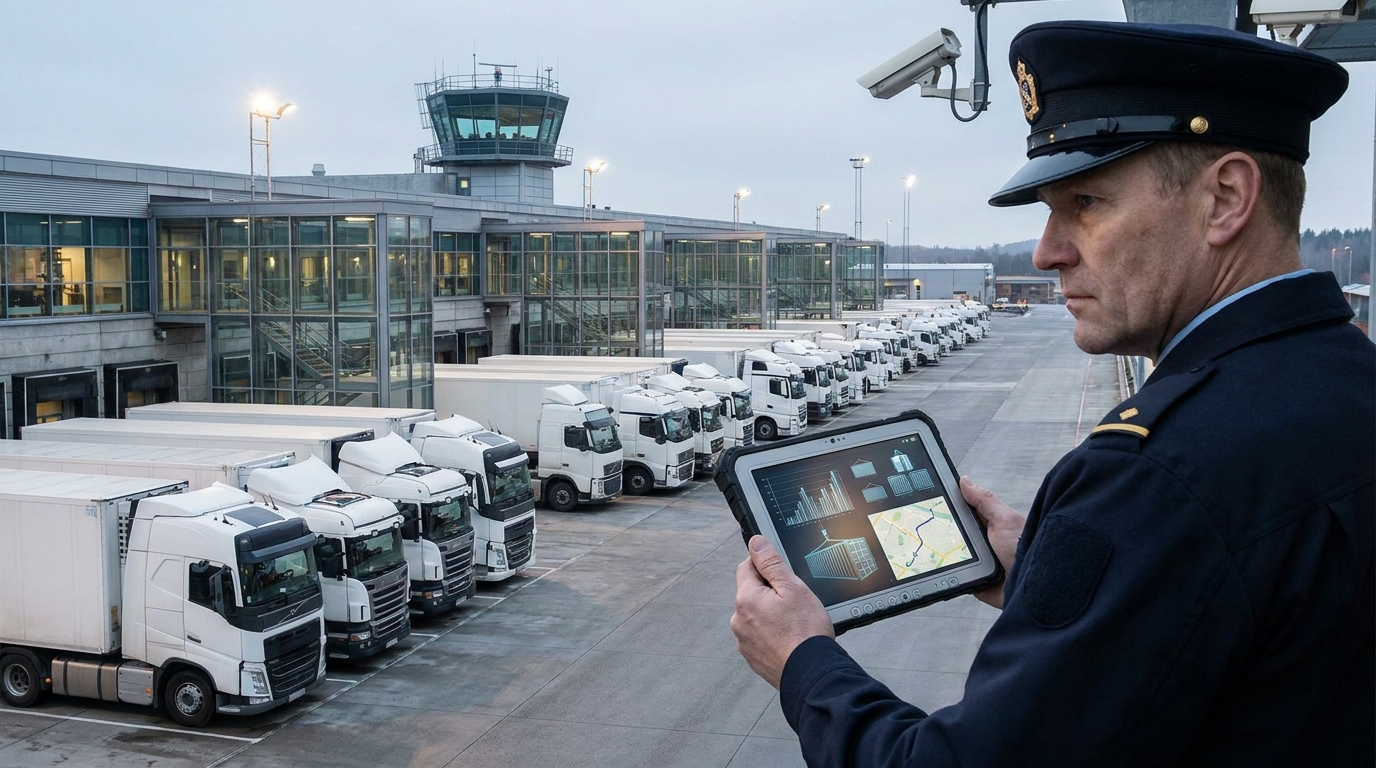
The first and most controversial change concerns the obligation to open the internal IT systems of transport companies to customs services. Pursuant to Article R. 412-3 of the new decree, Road hauliers are obliged to provide French customs officers with direct, automated access to their transport management systems (TMS) and warehouse management systems (WMS), as well as vehicle fleet geolocation tools.
This is a fundamental shift in the control philosophy. Previously, carriers were inspected incidentally—customs officers stopped the vehicle, verified CMR documents, and inspected the goods. Now, customs officials themselves access the company's internal data infrastructure. This means that customs officials can, at any time, check order history, shipper and recipient data, routes, loading and unloading times, and even the current location of each vehicle in the fleet.
For companies using modern, integrated TMS platforms, such as those offered by leading European vendors, adapting to new requirements may require both technical changes to the system architecture and new agreements with software vendors. Companies still managing transport records in spreadsheets or older, non-integrated systems face the challenge of urgently modernizing their IT infrastructure.
2. The end of the division between express freight and traditional road transport
The second key element of the decree is the full equalization of the status of all modes of road transport. The regulations eliminate any distinction between express shipments and standard freight transport. Regardless of whether the company performs full truckload (FTL) transport, groupage loads, courier services or last mile deliveries — all data relating to the traceability of goods is now subject to automated collection by the customs administration.
The data to which the services gained access includes: the origin of the goods and their destination, the physical parameters and value of the cargo, full transport documentation and information about all entities involved in the supply chain - from the manufacturer, through the forwarder and carrier, to the end recipient.
In practice, this means that no transport within France is beyond the reach of digital customs supervision. Whether a company is a Polish logistics giant operating hundreds of routes daily or a family-owned carrier operating several trips to Paris per week, the requirements are identical.
3. Rigorous identification of drivers and staff
The third significant change concerns the sphere of personal data. Pursuant to Article R. 412-2 (paragraph 4) of the Decree, Customs authorities have gained the right to formally collect and process detailed identification data of drivers and support staff associated with a given transport. This data includes: marital status, contact details, and numbers and information from identity documents.
This data must be linked to a specific waybill or cargo manifest, allowing authorities to build profiles and detect irregularities. The new regulations create a detailed database not only about goods but also about the people transporting them.
From the perspective of transport companies, this raises serious questions in the field of personal data protection law (RODO). Employers must ensure that they have the appropriate legal basis to transfer detailed employee data to foreign government authorities, and employees should be properly informed of this fact. It is worth emphasizing that violations of the regulations RODO while fulfilling new customs obligations could generate additional legal risk for the employer.
4. Sanctions up to 50,000 euros for each transport - the most serious financial risk
The fourth change, which has direct and potentially disastrous financial consequences for logistics companies, is a new, extremely strict system of administrative sanctions introduced by article R. 412-9 of the decree. The penalty for violating the regulations may amount to up to 50,000 euros for each individual transport in which a deficiency was found.
Sanctions may be imposed by the minister responsible for customs in the following cases:
- refusal to provide access to IT systems to customs authorities,
- failure to transmit the required data within the specified time or in the required format,
- failure to comply with the information obligation towards customers regarding the processing of their data by the customs administration,
- providing incomplete or false data.
The penalty procedure involves the preparation of a report by customs and a one-month appeals period during which the company can challenge the findings. However, even with this procedural protection, the structure of the regulations is particularly dangerous due to the multiplicative nature of sanctionsA company that has completed 20 transports in a month without providing the required access to the TMS system could theoretically face a total fine of up to one million euros.
The perspective of Polish carriers: why does it matter so much?
The Polish transport industry plays an absolutely dominant role in the European freight market. Polish companies are the largest force in road freight transport on the continent, and France remains one of the key destinations and transit markets for Polish trucks. It is estimated that Polish vehicles annually cover tens of millions of tonne-kilometers in France, handling both orders for major European manufacturers and small, regular deliveries between local contractors.
In the face of new regulations, Polish transport companies must urgently answer several key operational and legal questions:
- Do we have a TMS system that can be integrated with the French Customs API? Companies that do not have such systems or are using outdated solutions must take immediate modernization measures.
- Is our documentation complete and meets the new identification requirements? Every waybill must now include the driver's full identification details, and failure to do so can result in a fine.
- Have we informed customers and employees about the new scope of data transferred to customs? Failure to comply with the information obligation is one of the grounds for administrative sanctions.
- Do our insurance policies and contracts with contractors take into account new regulatory risks? The potential €50,000 fine for transport may in many cases exceed the value of the order itself.
Small and medium-sized transport companies, which constitute the backbone of the Polish TSL industry, are particularly vulnerable to risk. Companies with just a few or a dozen vehicles often lack extensive IT infrastructure, and their financial resources would not allow them to absorb even a single €50,000 fine without serious consequences for their financial liquidity.
Implications for the entire supply chain and freight forwarding market
The new regulations have implications that extend far beyond road hauliers. They impact the entire supply chain ecosystem serving France:
Freight forwarders and logistics operators must rethink their contracts with transport subcontractors. If a transport they commission is penalized due to the subcontractor's failure to meet digital requirements, the question of financial liability between the client and the contractor could become a source of serious legal disputes.
Producers and exporters Those shipping to or through France should ensure their logistics partners are fully prepared to operate under the new regime. Delays, transport blockages, or carrier sanctions could directly disrupt their own supply chains.
Banks and financing institutions The transport sector, in turn, should take into account new regulatory risks when assessing the creditworthiness of transport companies. Potential liability resulting from non-compliance with Decree 2026-724 could, in extreme cases, pose a significant risk to the debtor's solvency.
Risk assessment from a EURODEBT perspective
From the point of view of the analysis of credibility and financial risk in the TSL industry, Decree No. 2026-724 introduces a new class of regulatory risk, which has not yet been incorporated into standard models for assessing the health of transport companies. Previous metrics—payment timeliness, debt level, and debt collection history—were sufficient to assess current creditworthiness. It is now necessary to supplement these models with an assessment of the company's technological readiness and compliance.
Warning signs that analysts and creditors should pay particular attention to include:
- No confirmation of possession or implementation of a TMS system that meets the digital requirements of the new decree,
- A sudden increase in the operating costs of a transport company related to urgent IT modernization or legal consultations,
- Information on ongoing administrative proceedings initiated by the French customs services,
- Change in route structure - sudden reduction of operations in France without market justification,
- Difficulties in retaining management staff due to new identification requirements.
Companies that successfully adapt to the new regulations can gain a real competitive advantage. Automated communication with customs authorities can, in the long run, speed up customs processing and reduce the number of physical roadside inspections, resulting in higher operational efficiency.
What should a transport company do now?
Time is running out—the regulations come into effect on August 3, 2026, meaning that any transport carried out in France from that date onward is subject to the new regulations. The first and most important step is to conduct an internal audit of the company's technical and documentary readiness. It is also urgent to consult with a lawyer specializing in customs law and international transport regulations.rodove, preferably with experience in French administrative law.
In parallel, companies should contact their TMS and WMS vendors to learn about planned updates that enable integration with the new system requirements. Industry organizations such as the International Association ofrodoRoad Carriers (ZMPD) in Poland, should be an important source of up-to-date information and support in the adaptation process.
Finally, companies should review and possibly update contracts with subcontractors and principals so that the issue of liability for possible customs sanctions is clearly regulated in a way that protects the interests of all parties.
Summary: A new era of customs supervision in Europe
Executive Order No. 2026-724 is not just another minor regulatory change that can be safely postponed. structural transformation of the customs control model, which is a game-changer for the entire transport and logistics industry operating with France. The symbolic replacement of the outdated AREX system with a new, fully digital surveillance regime signals the direction in which customs regulations are heading across Europe.
Companies that take this decree seriously and quickly adapt their processes and systems will minimize the risk of sanctions and gain legal certainty in conducting operations in France. Those that ignore the new regulations or underestimate the pace of implementation risk severe financial consequences that—given the multiplicity of penalties—could threaten their very existence as a business entity.
For risk analysts, creditors and business partners in the TSL industry, verifying the compliance readiness of transport companies in the context of Decree 2026-724 is now becoming an essential element of due diligence before establishing or continuing cooperation.