
Brenner under scrutiny by the CJEU: Advocate General questions Austrian truck bans. What does this mean for Polish carriers?
The Advocate General of the CJEU has challenged three major Austrian bans on truck traffic through the Brenner Pass, finding them contrary to the principle of the free movement of goods in the EU. The opinion is a milestone in the long-running dispute between Italy and Austria, in which Italy is supported by the European Commission. However, the final judgment in case C-524/24 will not be delivered until the end of 2026 — until then, the transport, shipping and logistics sector, including numerous Polish carriers, must expect all existing restrictions to remain in place on this key Alpine logistics corridor.
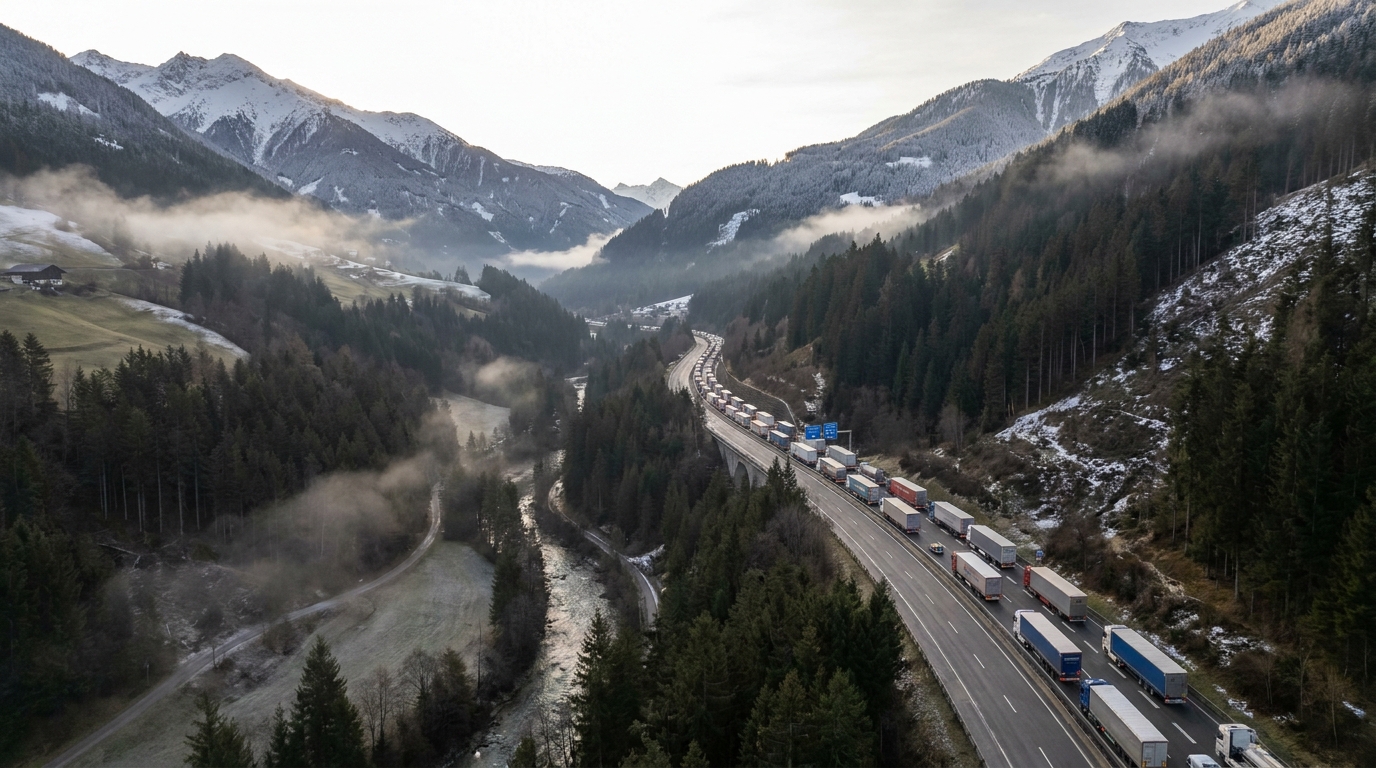
One of Europe's most important Alpine transport corridors has found itself at the center of an unprecedented legal dispute. The Advocate General of the Court of Justice of the European Union has issued an opinion declaring three key Austrian restrictions on truck traffic through the Brenner Pass to be contrary to EU law. This is a potentially groundbreaking moment for thousands of carriers serving north-south routes in Europe—including Polish companies with a significant presence on this route. However, a final decision is still a long way off, and until then, the transport industry must expect existing disruptions to persist.
Brenner – the heart of European logistics under pressure from regulation
The Brenner Pass, through which the Austrian A12 Inn Valley and A13 motorways pass, is much more than just a mountainous stretch of road. It's one of the main arteries for goods flowing between Italy, Germany, and the entirety of Central, Eastern, and Northern Europe. An estimated 2,5 million trucks travel this route annually, transporting everything from steel and timber to food and industrial machinery. For Polish logistics companies serving the Italian, Spanish, and southern French markets, the Brenner corridor is often the only economically viable transit option.
For many years, the authorities in the Austrian Tyrol have been systematically tightening the regulations regarding the movement of goods over 7,5 tons. Vienna's argument is consistent: protection of the environmentrodos, reducing nitrogen dioxide emissions, ensuring air quality in closed Alpine valleys, and managing road infrastructure capacity. Restrictions accumulated over the years have led to a situation that industry analysts describe as a regulatory trap—trucks can effectively move freely only 46% of the time during the week. The rest is made up of bans, time windows, sector limits, and seasonal lockdowns.
Italy vs. Austria: an unprecedented case before the CJEU
The growing frustration of Italian businesses and the government in Rome led to a move in 2024 that has few precedents in the history of EU law. Italy filed a direct complaint against Austria under Article 259 of the Treaty on the Functioning of the European Union—a provision that allows one Member State to sue another for violating EU law. The accusation is fundamental: Austria is violating the principle of the free movement of goods, one of the pillars of the European single market.
Of particular importance for the entire case, Italy's position was supported by the European Commission. Brussels, as guardian of the treaties, found that the Austrian regulations went beyond what is proportionate and justified under EU law. The case, under reference number C-524/24, was referred to the Court of Justice, where the first breakthrough occurred on July 16, 2024.
Opinion of the Advocate General: three prohibitions challenged
CJEU Advocate General Manuel Campos Sánchez-Bordona presented a legal opinion questioning three main pillars of the Austrian restrictive regime. Although this opinion is not a binding judgment—it merely serves as a recommendation to the Court's panel—in practice, CJEU judges follow the Advocate General's reasoning in the vast majority of cases. Below, we discuss each of the contested measures from the perspective of its impact on the transport industry.
Night ban - the illusion of protectionrodowiska
The first measure challenged is the nighttime truck traffic ban. Austria argues that the quiet hours in the Alpine valleys protect residents from noise and emissions. Meanwhile, the Advocate General pointed out a fundamental logical flaw in this solution: the nighttime ban neither reduces the total number of vehicles nor encourages carriers to transfer freight to rail. In practice, it merely causes a buildup of vehicles waiting for the opening of the time window—with gigantic morning traffic jams as a side effect.
From the operational perspective of Polish and other European transport companies, this meant scheduling schedules that took into account long downtimes, which drastically reduced fleet efficiency and generated additional costs—both financial and related to compliance with driver working time regulations. The Ombudsman also pointed out that the exemptions provided for local Austrian transport discriminated against foreign carriers.
Sectoral ban - good idea, flawed implementation
The second challenged mechanism is a sectoral ban covering specific cargo categories—timber, paper, steel, motor vehicles, and several other commodity groups. Austria directed these to rail transport, pushing the concept of a so-called modal shift, or shifting cargo from road to rail. The very idea of shifting heavy transport to rail is consistent with European climate policy goals and is generally supported by the European Commission.
The problem, however, lies in proportionality. The Advocate General noted that nitrogen dioxide concentrations in the region have been improving since 2020, yet the scope and stringency of the sectoral bans have not been revised in light of current data.rodoMaintaining drastic restrictions without ongoing verification of their justification violates the principle of proportionality under EU law. For carriers handling precisely these categories of goods—and there are quite a few of them in Poland, considering the export of steel, paper, and timber to Italy—this is a potentially crucial change.
Winter Saturday ban - selective discrimination against transit
The third challenged element is the Saturday truck traffic ban introduced during the winter season, officially justified by the need to manage increased tourist traffic. The Advocate General assessed this measure as openly discriminatory against international transport.rodoThe regulation blocked almost exclusively transit traffic—trucks traveling through Austria to or from Italy—while domestic transport could continue. This is a classic example of indirect discrimination, contrary to the fundamental principles of the EU single market.
What's left: the block traffic metering system
Not all Austrian solutions were negatively assessed by the Ombudsman. The system of blocking trucks from the German border in Kufstein—so-called traffic metering, which involves admitting convoys of vehicles at specific intervals—was considered a potentially permissible traffic management tool. However, the Ombudsman emphasized that its use must meet specific proportionality requirements and cannot de facto serve as a quantitative restriction on imports. This element of the ruling can be interpreted as a partial success for the Austrian side, providing Tyrol with certain tools for managing traffic flow even if the main bans are lifted.
What the Ombudsman's opinion means in practice - and what it doesn't mean
This brings us to an issue that industry risk managers must understand precisely. The Advocate General's opinion is a significant legal recommendation—but not a judgment. The final ruling of the CJEU in Case C-524/24 is not expected until the end of 2026. Until then, all contested bans remain in force. Transport companies that choose to ignore them while waiting for a favorable judgment risk administrative penalties from Austrian road inspection authorities.
This means that the TSL sector will continue to operate under the current, highly restrictive regulatory environment for over two years. Therefore, for managers planning operations on north-south routes, nothing changes for the current operating year. It is still necessary to consider time windows, sector bans, and winter restrictions when planning schedules, pricing services, and assessing contractual risk.
Risk Perspective: What Might Happen After 2026
Even assuming that the CJEU issues a judgment in line with the Ombudsman’s opinion – which is the baseline scenario, although not certain – the industry should prepare for several possible reactions from Austria and Tyrol.
- Regulatory adaptation: Tyrol has a wide range of legal tools at its disposal and can relatively quickly develop new regulations, this time based on a more solid basis of data.rodoand more precisely tailored in line with the case law of the European Court of Justice. The annual external costs of transport through the Inn Valley are estimated at €2,1 billion – the pressure to reduce heavy traffic will not disappear after the court ruling.
- Acceleration of railway investments: The CJEU ruling could spur Tyrol and Austria to intensify their efforts to build the Brenner Base Tunnel (BBT), which, once completed, is expected to dramatically increase rail capacity. Paradoxically, Austria could use its defeat in court to argue for faster EU funding for the project.
- New non-transport barriers: Increased technical inspections of vehicles, stricter emission requirements based on new Euro standards or restrictions related to the amended air quality directives – these are areas in which Austria has a wide margin of autonomy, even with the CJEU ruling against the current bans.
The TSL sector should treat the possible CJEU judgment not as a definitive solution to the Brenner problem, but as one of the links in a long-term regulatory process.
Impact on Polish carriers and logistics companies
Poland is one of the largest exporters of road transport services in Europe. Thousands of Polish-registered vehicles regularly operate on routes to Italy, Croatia, France, and Spain—and for a significant number of them, the Brenner route is a daily occurrence. The accumulation of Austrian bans translates directly into several tangible operating costs:
- Driver's standstill time: Waiting for the time window to open takes hours that directly translate into disruptions to delivery schedules and contractual tensions with end customers.
- Extended transit times: Difficulties in meeting delivery deadlines generate claims from clients and, in extreme cases, contractual penalties.
- Higher fuel and fleet maintenance costs: Unnatural detours – via Tarvisio, Gotthard or Fréjus – increase mileage, fuel consumption and toll costs.
- Pressure on fleet management: Operations planning that requires taking into account variable time windows increases the complexity of dispatch management and promotes operational errors.
For small and medium-sized transport companies, which constitute the core of the Polish TSL industry, financial margins are so narrow that even a delay of a few hours on one route can disrupt the profitability of the entire weekly schedule.
Risk Assessment for Collaboration and Financing Managers
From the perspective of assessing the financial credibility of contractors—a key area of EURODEBT.eu's operations—the Brenner route should be treated as a risk factor when analyzing the condition of transport companies that operate extensively with Italy. Operational difficulties may contribute to a deterioration in the financial liquidity of smaller carriers, which lack sufficient buffer reserves to absorb systemic downtime.
When verifying contractors from the TSL industry, it is worth paying attention to:
- Route diversification: Does the company have flexible operating plans to operate connections via alternative routes (Tarvisio, Swiss tunnels) when the Brenner is unavailable or restricted?
- Contract clauses: How does the company address delays resulting from administrative restrictions in its customer contracts? Does it have adequate force majeure or force majeure clauses in the context of road regulations?
- Operational history: Does the carrier have a proven track record of managing restricted routes and not generating excessive customer claims?
- Sector exposure: Is your company particularly dependent on categories of goods covered by sectoral bans? Carriers specializing exclusively in a single cargo industry (e.g., timber or steel transport) are more vulnerable to the effects of restrictions than operators offering a diversified portfolio of services.
Summary: Breakthrough in Court, Status Quo on the Road
The opinion of the Advocate General of the European Court of Justice (CJEU) represents a symbolic and legal breakthrough in the long-standing dispute over the freedom of transit across the Brenner Pass. For the first time, the highest-ranking EU body has so clearly indicated that Austria has exceeded the limits of proportionality, violating the foundations of the single market. This is a signal to all of Europe that restrictions on freight traffic—even those justified by genuine concern for the environment—are unacceptable.rodovisko — they must respect the rules of the EU game.
For the transport and logistics industry, however, this is primarily a signal of the future. The next two years will be marked by existing restrictions, regulatory uncertainty, and the need for meticulous planning of operations on this corridor. The CJEU ruling—when finally issued—could open a new chapter in the history of Brenner transit. It could also trigger a new wave of regulatory innovations from Tyrol.
One thing is certain: the Brenner Pass remains and will remain one of the most regulatory-complex sections of the European road network. Transport companies that treat it as a permanent part of their operational landscape—and adapt their risk management strategies accordingly—will be better prepared for any scenario. Those expecting swift normalization following the CJEU ruling may be unpleasantly surprised by the real complexity of what will happen after 2026.