

The debt of Polish transport companies has exceeded PLN 1.32 billion. A report reveals the scale of the crisis in the transport industry
The debt of the Polish road freight transport sector has reached a record level of 1.32 billion złoty, and the number of companies with overdue liabilities has exceeded 23,700. The crisis is driven by rising fuel costs, freight rates in long-term contracts that have not been adjusted and chronic late payments — 92 percent of carriers do not receive payment on time. The situation is a serious warning for all companies using the services of Polish transport operators.
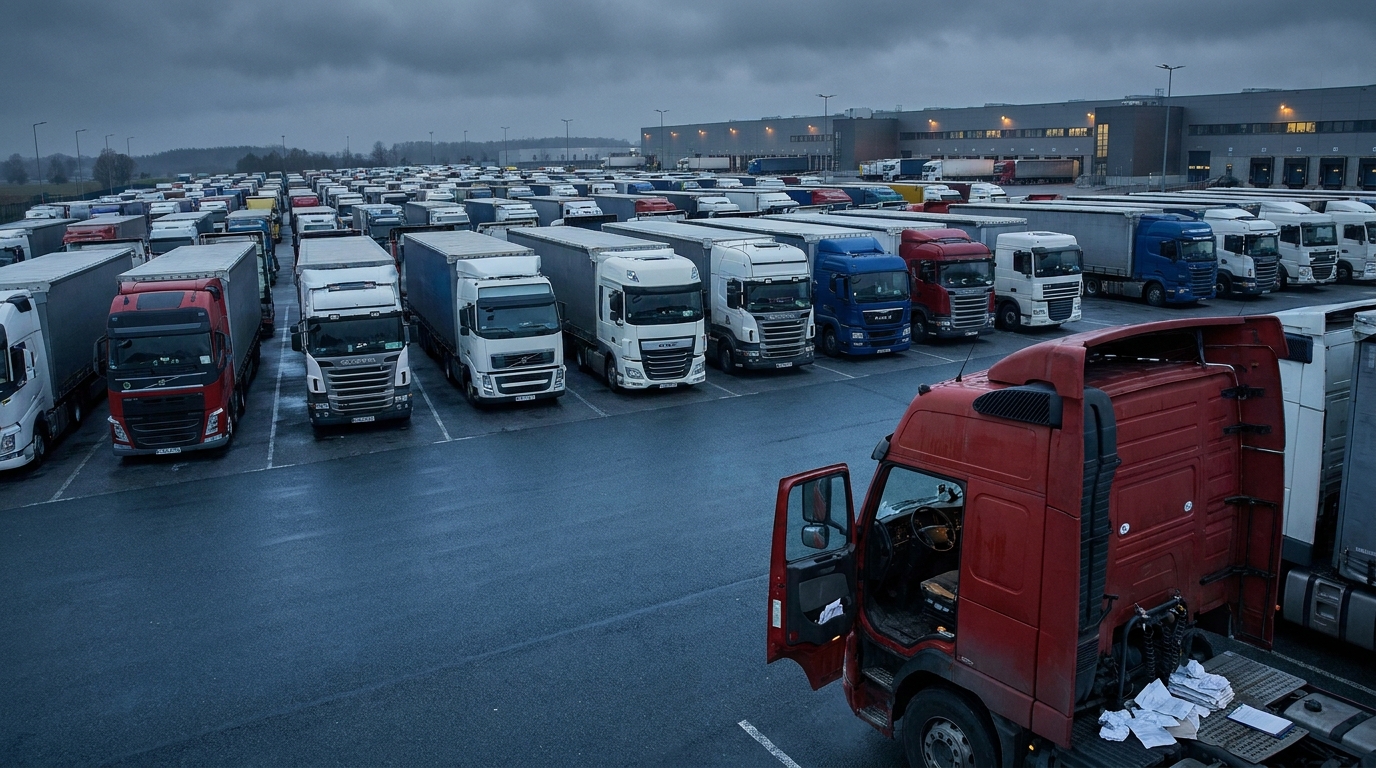
The total debt of Poland's road freight sector reached an alarming level of PLN 1.32 billion in November 2026. Data from the National Debt Register indicate that more than 23,700 companies are struggling with overdue financial obligations. This is a clear signal that the condition of one of the pillars of European logistics is steadily deteriorating — and the risk for companies working with Polish carriers is growing month by month.
The scale of debt: figures that should concern every risk manager
According to the latest National Debt Register report, the number of transport businesses with overdue obligations increased by more than 700 companies year on year, an increase of approximately 3.1 percent. The increase in the number of debtors alone would be a worrying signal — but combined with total debt exceeding PLN 1.32 billion, the picture becomes unequivocally alarming.
Importantly, average debt per company has fallen slightly and now stands at 55,700 PLN. On the surface, this might signal an improvement — but in reality, the figures merely indicate that the crisis is affecting an increasingly broad range of businesses, not that individual companies are doing better. The total remains at a record high, and the number of companies at risk is the highest in years.
KRD President Adam Łącki stresses that this is a systemic problem, not a wave of isolated difficulties. Carriers are not so much losing the ability to meet their obligations because of their own management errors as falling into a trap set by the structure of the market: rising operating costs, freight rates that are not keeping pace with cost inflation, and chronic payment delays by clients.
Fuel and contracts: a trap ensnaring thousands of companies
The main driver of the crisis is an unfavourable combination of rising fuel prices and the absence of appropriate contractual mechanisms to protect carriers against this risk.
Data from the International Road Transport Union (IRU) for the second quarter of 2026 show that diesel prices across the European Union rose by an average of 12 percent. This is a huge burden for companies in which fuel accounts for anywhere from the mid-teens to over thirty percent of all operating costs, depending on the type and scope of transport operations.
In most cases, companies operating on the spot market were able to pass this increase on to order prices — one-off rates rose by about 11 percent. The problem, however, lies in long-term contracts, where freight rates rose by just 6 percent — half as much as fuel costs themselves. The result is a steady erosion of operating margins for carriers that have based their business models on contracts lasting several months with large shippers.
A particularly destructive effect comes from the absence of fuel clauses in a significant proportion of long-term transport contracts. Such clauses allow freight rates to be adjusted automatically in response to changes in fuel prices, a standard cost-risk management tool in mature logistics markets. Where clauses are absent, carriers must absorb the cost difference themselves — at the expense of their own liquidity.
For most companies, contract renegotiations prove to be a dead end. Large shippers — retail chains, manufacturers and warehouse operators — have a much stronger negotiating position than small and medium-sized carriers. In practice, transport companies face a choice: accept unfavourable terms and hope to survive, or give up the contract and risk losing a steady stream of orders.
Payment delays: 92 percent of companies do not receive money on time
Payment delays are an equally serious problem — and for many companies even more painful than fuel costs. A survey conducted by Keralla Research for Bibby Financial Services reveals shocking data: 92 percent of Polish transport companies regularly receive payments after the contractual due date.
The median value of overdue receivables has risen from 75,500 PLN to 90,000 PLN. This means that the average Polish carrier is waiting at any given time for invoices totalling more than 90,000 zlotys to be paid — while still having to meet its own ongoing obligations.
This is the heart of the liquidity problem in transport. The industry's business model is characterised by a fundamental cash-flow asymmetry: costs — refuelling, drivers' wages, vehicle lease instalments, insurance premiums and servicing expenses — must be incurred in advance. Revenue, meanwhile, arrives with a considerable delay, often 30, 60 or sometimes even 90 days after the service is provided.
When prolonged payment delays by clients are added to this asymmetry, the result is a ready-made recipe for a debt spiral. To maintain operational continuity, carriers turn to working-capital loans or factoring — generating additional financing costs that further burden their already weakened margins. Those who lack access to external financing or do not want to incur its costs begin delaying payments to their own suppliers — creating secondary payment delays throughout the supply chain.
Who is most at risk? Debtor profile and geographic risk map
KRD data make it possible to identify precisely which market segments are bearing the greatest burden of the crisis.
Business structure: micro-entrepreneurs under the greatest pressure
Nearly two thirds of all indebted transport businesses are individuals operating as sole proprietors. Their total number exceeds 15,000, and their combined arrears reach 750 million PLN. These carriers — often owners of one or a few trucks — operate without a financial cushion in the form of capital reserves, access to capital markets or corporate group support. Every week's delay in payment by a client can leave them unable to pay a lease instalment or insurance premium on time.
Two cases stand out among the most indebted businesses: a carrier from Otwock County with debt close to 7 million PLN and a transport company from Nowy Tomyśl with arrears reaching 7.6 million PLN. Both cases illustrate that extreme liquidity problems affect both small operators and companies operating on a somewhat larger scale.
Geographic map of debt: three provinces under scrutiny
Geographically, the largest concentration of carrier debt is found in three regions, which are also Poland's largest logistics and transport hubs:
- Mazovia — total debt of 260.6 million PLN involving 4,608 companies. This region has the largest number of transport businesses, translating into absolute dominance in the debt ranking.
- Silesia — debt of 190.1 million PLN. Importantly, this is where the highest average debt per company is recorded, exceeding 67,000 PLN — clearly above the national average. The strong concentration of industry and logistics generates a high number of long-term contracts which — as shown above — prove to be a trap when operating costs rise.
- Greater Poland — arrears of 180.5 million PLN, a region that has for years been one of the engines of Polish logistics, particularly for routes to the west.
Companies considering starting or continuing cooperation with carriers from these provinces should exercise particular caution and implement more in-depth procedures for verifying their partners' solvency.
Creditors and debtors: who loses the most?
The transport crisis is not just a problem for carriers themselves — it has a far-reaching impact on other industries and financial institutions.
The largest creditors of Polish transport companies are financial and insurance institutions — banks, leasing companies and debt collection firms. Their total claims against the transport sector amount to 884.6 million PLN. This amount reflects the extent to which the transport industry depends on external financing for vehicles and operations. When carriers lose liquidity, lessors and banks are the first to feel the impact.
In second place is the fuel sector, with claims of approximately 241.2 million PLN. Fuel stations and diesel distributors extend trade credit to carriers — and increasingly find themselves waiting in vain for repayment. This is why so many stations and distributors are tightening credit terms or requiring cash payments from companies whose financial condition is in question.
At the same time, carriers themselves are victims of a chain of unpaid obligations. The transport industry is waiting for 170 million PLN from its own debtors — primarily trading companies, industrial businesses and construction firms. This is clear evidence that payment delays are systemic and cascading: delays at one stage of the supply chain quickly spread to subsequent links.
A shrinking market: warning signs for European logistics
The liquidity crisis described is beginning to have a direct impact on the structure and capacity of the Polish transport market. Data from the Chief Inspectorate of Road Transport (GITD) show that in just six months the number of companies licensed for international transport fell by 644 businesses. This rate significantly exceeds natural market turnover resulting from business closures, mergers or acquisitions.
At the same time, market research indicates that nearly half of transport companies have completely suspended all investment and development plans. Instead of modernising their fleets, investing in new technologies or expanding their operational reach, these companies are concentrating all their resources solely on surviving the current period. Over the next several months, this means ageing fleets, rising servicing costs and declining competitiveness for Polish carriers in the European market.
The Polish transport fleet is one of the largest and most important components of the European logistics system. Polish trucks carry out a huge share of transport within the EU, and Polish drivers are among the largest groups of professional drivers on European roads. The shrinking of this capacity — through bankruptcies, licence withdrawals or frozen investments — directly affects the availability of transport capacity across Europe, which in turn affects freight prices and supply chain reliability.
Business risk perspective: what should companies working with Polish carriers do?
For risk managers and logistics company owners across Europe, the KRD report carries several key practical implications.
Strengthen counterparty verification processes
With more than 23,700 companies carrying overdue obligations, a standard check in a single register or one credit report may be insufficient. It is worth using multi-source verifications — combining data from KRD, the GITD Register, leasing databases and payment histories in industry information systems. Particular caution is required with micro-entrepreneurs (sole proprietorships) and companies registered in Mazovia, Silesia and Greater Poland, where the concentration of debt is highest.
Monitor counterparties continuously, not just once
The financial condition of transport companies can change rapidly — especially amid fluctuating fuel prices and seasonal swings in freight demand. A one-off creditworthiness check conducted when a contract is signed does not protect against risks that materialise several months later. Continuous monitoring mechanisms are recommended — alerts about new debtor entries or changes in a carrier's licence status.
Account for fuel risk in contract structures
Companies that enter into long-term agreements with carriers and want to retain stable, solvent logistics partners should consider introducing fuel clauses as a standard feature. A mechanism that automatically adjusts rates to changes in fuel prices protects both parties — the shipper from sudden renegotiations and the loss of a carrier, and the carrier from margin erosion leading to bankruptcy. In the longer term, contracts without fuel clauses are a ticking time bomb that creates risks for both the service provider and the recipient.
Diversify the transport supplier base
With nearly one in eight transport companies carrying overdue obligations, dependence on one or two carriers becomes a serious operational risk. Delivery disruptions resulting from the sudden bankruptcy or licence suspension of a key partner can have catastrophic consequences for supply chain continuity. Building a diversified portfolio of transport suppliers — with adequate reserve capacity and alternative routes — is an essential part of logistics risk management in current market conditions.
Summary: an industry at a crossroads
The situation of Poland's road transport sector in November 2026 is the result of several overlapping adverse factors: record operating costs, inadequate freight rates in long-term contracts, chronic payment delays by clients and the structural weakness of thousands of micro-entrepreneurs without financial safety buffers.
Debt of 1.32 billion PLN, involving nearly 23,800 companies, is not a statistical curiosity — it is a real risk for every company that commissions transport from Polish operators or is part of a supply chain served by Polish trucks. The shrinking number of licensed carriers, frozen investment plans and growing debt spirals paint a picture of an industry that, without deeper structural changes — in contract law, payment policy and access to financing — could find itself in an even deeper crisis in the coming quarters.
For risk managers and logistics companies across Europe, the above data send a clear signal: it is time to strengthen transport partner verification procedures, diversify the supplier base and consciously manage contractual risk in the supply chain.




