

Marelli Europe in Chapter 11: What does the restructuring of the automotive giant mean for European suppliers and logistics?
The Marelli Group — one of the world's largest suppliers of automotive components — is undergoing an advanced phase of Chapter 11 bankruptcy proceedings before a court in Delaware. Court documents dated November 4, 2026 confirm the continuity of operations of its European and Polish subsidiaries, including the plants in Sosnowiec and Bielsko-Biała. Key procedural deadlines — the creditors' vote by November 23 and the plan confirmation hearing on December 8, 2026 — mark a turning point for hundreds of the group's European business partners.
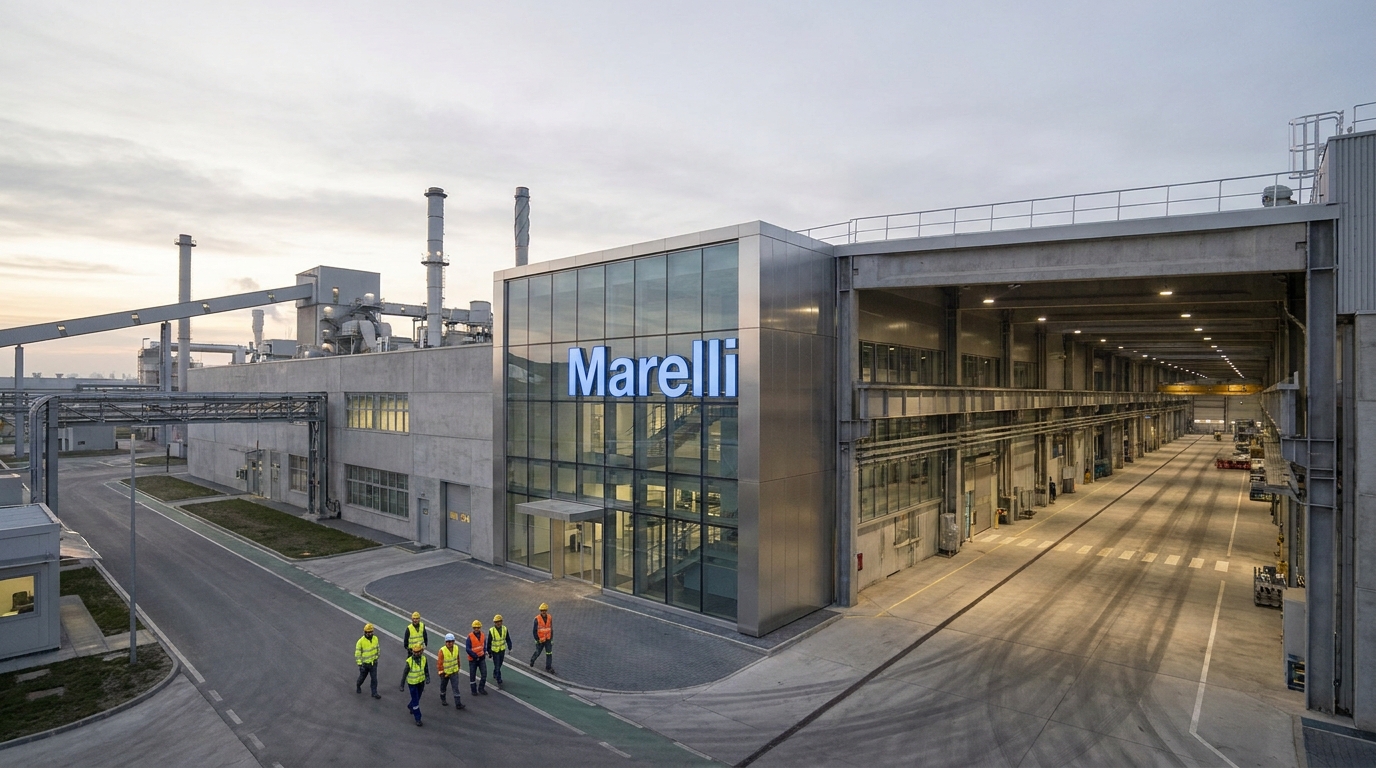
One of the world's largest independent suppliers of automotive components — the Marelli Group — is going through a critical phase of Chapter 11 bankruptcy proceedings under US law. Court documents filed on 4 November 2026 with the United States Bankruptcy Court for the District of Delaware confirm that European companies in the group — including Marelli Europe S.p.A., Marelli España S.A. and Polish subsidiaries — continue to operate, but remain under close court supervision. For risk managers and counterparties across the continent, this is a signal to monitor the situation with heightened attention.
Marelli — who is it and why does this case matter for Europe?
Before examining the court documents, it is worth recalling how significant a player we are dealing with. Marelli is a global automotive conglomerate formed from the merger of Japanese company Calsonic Kansei and Italian company Magneti Marelli, acquired from the FCA Group (now Stellantis). The company manufactures a wide range of components — from exhaust systems and lighting systems to onboard electronics and suspension systems — for virtually all major car manufacturers in Europe, Asia and North America.
The scale of Marelli's operations in Europe is enormous. Manufacturing plants operate in Poland (Sosnowiec, Bielsko-Biała), Italy, Germany, France (Strasbourg), Spain, the United Kingdom, the Czech Republic (Jihlava), Slovakia (Kechnec), Romania (Cluj-Napoca, Ploiești) and several other countries. Employment runs into the tens of thousands. This means that the financial problems of this giant directly affect the supply chains of hundreds of smaller companies — sub-suppliers, carriers, logistics and service companies serving Marelli plants across the continent.
Origins of the crisis: $4.9 billion in debt and the road to court
The Chapter 11 proceedings were initiated on 11 June 2025 by the parent company Marelli Holdings Co., Ltd. and dozens of subsidiaries. The case is being heard by the United States Bankruptcy Court for the District of Delaware under case number 25-11034, and is presided over by Judge Craig T. Goldblatt.
The immediate reason for filing was accumulated long-term debt, estimated at approximately $4.9 billion. This amount resulted from several overlapping factors: an aggressive acquisition strategy in 2019–2020, global supply chain disruptions caused by the COVID-19 pandemic, a sharp rise in raw material and energy prices, and a slowdown in the automotive market resulting from the transition to electric mobility. Marelli was not the only supplier to come under financial pressure in recent years — similar problems affected Premy, Plastic Omnium and the supplier divisions of many other European industrial groups, among others.
The choice of Chapter 11 proceedings (rather than immediate liquidation) is significant. This form of proceeding, rooted in US federal law, gives a company time and tools to restructure while protecting it against enforcement of claims by creditors. In European legal terminology, it can be compared to rehabilitation or arrangement proceedings, although the mechanisms differ in important details.
DIP financing and the agreement with creditors — what is an RSA?
To sustain operations during the court proceedings, Marelli obtained so-called DIP (debtor-in-possession) financing of $1.1 billion. This is a special type of lending available exclusively to entities under Chapter 11 protection, which takes repayment priority over existing obligations. Obtaining such a substantial amount of DIP financing indicates that lenders believe the restructuring plan is viable.
At the same time, the company entered into a Restructuring Support Agreement (RSA) — a restructuring agreement joined by approximately 80% of existing lenders. This is a key indicator: such a high level of support among financial creditors significantly reduces the risk of a prolonged court dispute and provides grounds to expect a smooth exit from the proceedings.
Marelli consistently states that the US court proceedings do not disrupt its ongoing operations. On its dedicated Marelli Forward website, the company says it is meeting its obligations to employees, key suppliers and business partners as they fall due. This narrative is characteristic of so-called pre-arranged bankruptcy or pre-negotiated bankruptcy — proceedings in which restructuring terms are agreed with major creditors before a formal court filing.
Documents of 4 November 2026 — what do the operating reports reveal?
The operating reports filed on 4 November 2026 through restructuring agent Verita Global (Kurtzman Carson Consultants, LLC) cover the period through 30 September 2026. Filing Monthly Operating Reports (MOR) is a formal obligation for every company covered by Chapter 11 — these reports give the court and creditors regular insight into the financial and operational condition of individual entities.
For procedural purposes, the lead company in the proceedings is Marelli Automotive Lighting USA LLC, but the reports cover all key European entities, including:
- Marelli Europe S.p.A. — Italian holding company for European operations
- Marelli España S.A. — operations on the Iberian Peninsula
- Marelli EPT Strasbourg — plant in France
- Marelli Germany GmbH — German entity
- Automotive Lighting UK Limited — operations in the United Kingdom
From the perspective of Polish and Central European participants in the logistics and transport market, the reports concerning plants located in our region are particularly important:
- Marelli Sosnowiec Poland Sp. z o.o. (court filing no. 2969)
- Marelli Bielsko-Biała Poland Sp. z o.o. (court filing no. 2948)
- Marelli Aftermarket Poland Sp. z o.o. (court filing no. 2987)
The reports confirm that the Polish manufacturing plants are operating without disruption as part of the global restructuring strategy. Similar documents were filed for entities in the Czech Republic (Marelli Automotive Lighting Jihlava s.r.o.), Slovakia (Marelli Kechnec Slovakia s.r.o.) and Romania (Marelli Cluj Romania S.R.L. and Marelli Ploiești Romania S.R.L.).
The filing of operating reports by such a broad group of companies — covering virtually Marelli's entire manufacturing footprint in Central and Eastern Europe — confirms that the restructuring is coordinated and comprehensive, rather than selective. This is important information for the suppliers and counterparties of these plants.
Court schedule — key dates for the market
The proceedings have entered a decisive phase. On 20 October 2026, Judge Craig T. Goldblatt approved the adequacy of the Disclosure Statement, meaning in practice that the court considered the information presented by Marelli sufficient for creditors to make an informed decision when voting on the restructuring plan.
The following key procedural deadlines have been set:
- 23 November 2026, 16:00 ET — deadline for voting on the restructuring plan and filing formal objections (Voting and Plan Objection Deadline)
- 8 December 2026, 10:00 ET — hearing to confirm the reorganisation plan (Confirmation Hearing)
These dates are of fundamental importance not only to Marelli's financial creditors, but also to the entire ecosystem of companies connected with the group. The result of the 23 November vote and any court order on 8 December will be a signal determining the subsequent actions of counterparties, trade credit insurers and institutions financing transactions with Marelli Group entities.
Industry perspective: why are Tier-1 restructurings so disruptive for logistics?
Marelli belongs to the category of suppliers known in the automotive industry as Tier-1 — entities that supply components directly to car manufacturers' assembly lines (OEMs). Their particular position in the supply chain means that financial problems at such companies have a ripple effect several levels down.
In practice, this means that Marelli's crisis directly or indirectly affects:
- Road carriers and logistics operators making regular deliveries of components to and from Marelli plants — both domestically and in international transit
- Suppliers of raw materials and materials (Tier-2 and Tier-3), who may have outstanding receivables from group companies or be concerned about the fulfilment of future orders
- Companies leasing and financing machinery and the fleet used by Marelli or its subcontractors
- Trade credit insurers, who may adjust exposure limits for group entities
- Freight forwarders and customs agents handling flows of goods from Marelli plants outside the EU, including to Japan and the US
It is worth emphasising that Marelli's manufacturing plants in Poland play an important export role. The Sosnowiec plant manufactures exhaust system components, among other things, while the Bielsko-Biała plant specialises in components for premium vehicles. Both locations are deeply embedded in the supply networks of groups such as Stellantis, BMW Group and Honda. Disruption to their operations — even for a few weeks — would generate supply chain costs amounting to tens of millions of euros.
Risk assessment: what should a risk manager know and do?
From a business risk management perspective, Marelli's situation is not unambiguously alarming, but it requires systematic monitoring and procedural caution. Below we present a practical risk assessment across several dimensions:
Operational risk (low to moderate)
DIP financing of USD 1.1 billion and support from 80% of creditors for the RSA provide strong grounds to conclude that Marelli's European manufacturing plants are not directly threatened by sudden closure. The company actively manages its communications and emphasises operational continuity. Operational risk should be assessed as moderate — real, but not immediately critical.
Legal and contractual risk (elevated)
Being under Chapter 11 protection means that enforcement of trade receivables against group entities may be difficult or temporarily suspended (automatic stay). Counterparties with outstanding invoices owed by Marelli companies should consult lawyers about the possibility of pursuing these claims within the court proceedings. New commercial contracts with group entities should be concluded with increased caution — especially regarding payment terms and security.
Reputational risk and due diligence (worth monitoring)
Companies for which Marelli is a key counterparty (e.g. a principal customer accounting for more than 20–30% of revenue) should transparently inform their own creditors, investors and banking partners about their exposure to this entity. In reputational risk management, a lack of such communication may be viewed more negatively than the exposure itself.
Post-restructuring risk (low to moderate)
If the court confirms the reorganisation plan in December 2026, Marelli will emerge from the proceedings with a substantially deleveraged balance sheet. A reduction in debt by several billion dollars should fundamentally improve the group's operational and credit capacity over a 12–36-month horizon. This is the baseline scenario indicated by the proceedings to date.
Recommendations for counterparties and risk managers
Based on an analysis of the available court documents and market context, we propose the following actions for companies directly or indirectly connected with the Marelli Group:
- Identify your full exposure to the group — check which entities covered by Chapter 11 are your direct counterparties. The list of companies covered by the proceedings is publicly available in the case records for 25-11034.
- Monitor court deadlines — the results of the creditor vote (by 23 November 2026) and the confirmation hearing (8 December 2026) are milestones that can change the risk assessment in real time.
- Review your trade credit insurance terms — some insurers may already have reduced or suspended limits for Marelli Group entities. The absence of a current policy means full exposure to the risk of uncollectable receivables.
- Consult a lawyer about outstanding receivables — if you hold invoices against group companies that have entered Chapter 11 proceedings, the deadline for filing a claim (proof of claim) may already have passed or be approaching. Act without delay.
- Do not automatically suspend cooperation — a hasty halt to deliveries or cooperation with Marelli plants may expose you to contractual claims and block the recovery of current receivables. Consult your legal department about every decision.
- Watch for signals from OEMs — car manufacturers using Marelli components (Stellantis, BMW, Honda and others) may launch support programmes for key Tier-1 suppliers to ensure production continuity. Such programmes may indirectly stabilise the situation of Marelli's European plants.
Summary: restructuring rather than collapse — but vigilance is advised
The Marelli Group's Chapter 11 proceedings are one of the largest and most complex industrial restructuring cases in the automotive sector in recent years. The scale of operations — dozens of subsidiaries, thousands of employees and hundreds of counterparties worldwide — makes this an event of systemic importance for the European automotive and logistics industries.
The proceedings to date — support from 80% of creditors for the RSA, securing USD 1.1 billion in DIP financing, the timely filing of operating reports and court approval of the Disclosure Statement — point to a controlled restructuring path, rather than a chaotic collapse. This is an important distinction from the perspective of risk across the entire value chain.
Nevertheless, until the court formally confirms the reorganisation plan (scheduled for 8 December 2026) and Marelli effectively exits Chapter 11, all entities working with the group should maintain heightened vigilance, document all transactions with due care and follow subsequent court filings in the case record.
The EURODEBT.eu platform will keep updating the risk assessment for Marelli Group entities — particularly after the creditor voting results are announced and after the December confirmation hearing is decided. We encourage you to sign up for alerts about this case.




