

Crisis in Polish road transport: 15% more bankruptcies in 2026 and billions in debt in the TSL sector
Data for the third quarter of 2026 reveal the most severe crisis in Poland's transport, shipping and logistics sector in over a decade: the number of bankruptcy proceedings rose by 15 percent year on year, the sector's total debt exceeded 1.32 billion zlotys, and more than 1,200 companies quietly exited the market in a single quarter. The main causes are high debt servicing costs, Germany's structural economic problems and mounting regulatory pressure. For business partners working with Polish carriers, this means an immediate need to tighten credit risk policy.
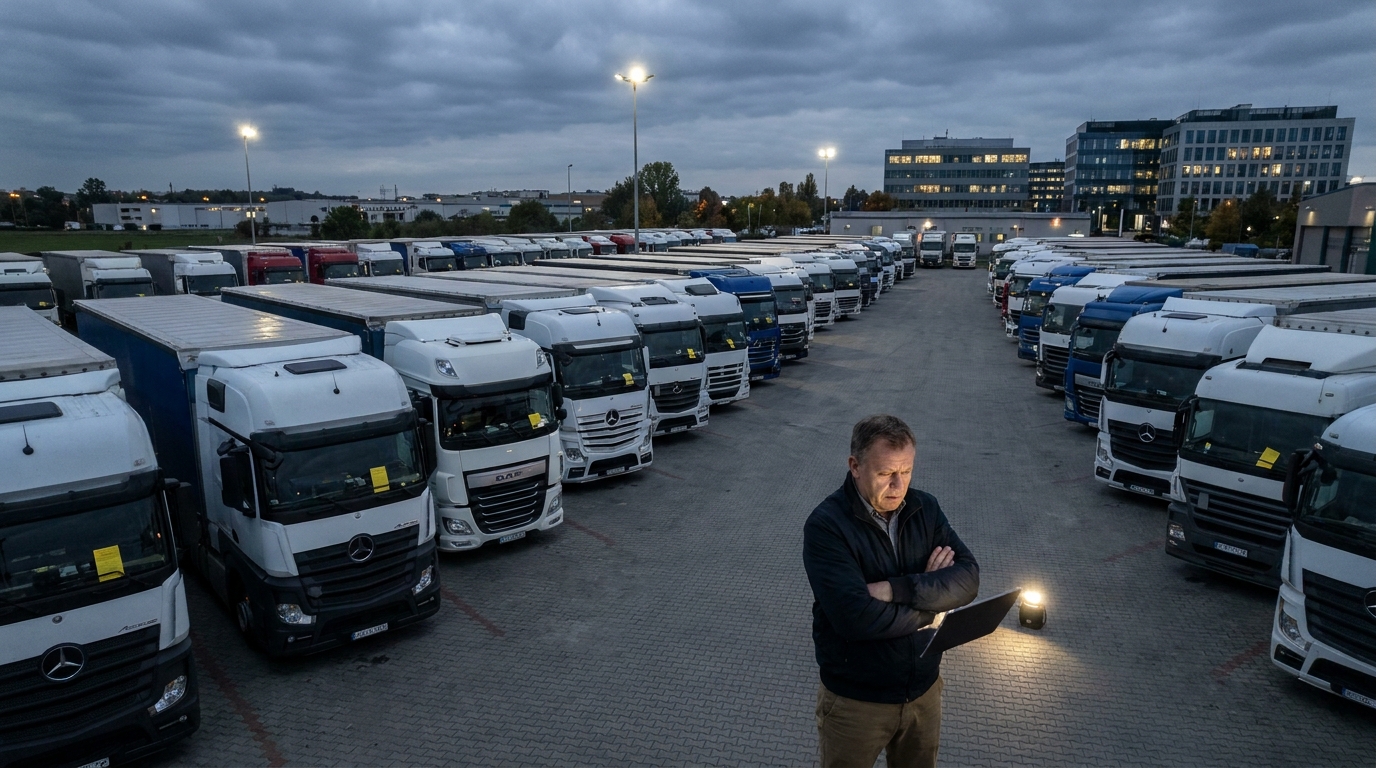
Polish transport companies are facing their most difficult financial situation in more than ten years. Data for the third quarter of 2026, collected by leading industry publications and verified by EURODEBT.eu analysts, leave no room for doubt: the Transport, Freight Forwarding and Logistics (TFL) sector is undergoing a deep structural crisis whose consequences will be felt not only by carriers themselves, but above all by their business partners — shippers, freight forwarders and service providers across the continent. The number of formal bankruptcy and restructuring proceedings rose by 15 percent year on year, the industry's total debt exceeded 1.32 billion złoty, and more than 1200 entities left the market in just one quarter. For risk managers and business owners working with Polish carriers, the time to act is now.
The scale of the problem: numbers that speak for themselves
The TFL industry has for years been regarded as one of the engines of the Polish economy and a key element of European supply chains. Poland's truck fleet is one of the largest on the continent, and domestic carriers handle a significant share of transport volumes between Eastern and Western Europe. Yet this seemingly strong market position did not protect the sector from a wave of financial difficulties that accelerated dramatically in the past two quarters.
Statistical data from the third quarter of 2026 indicate a 15-percent increase in the number of bankruptcy and restructuring proceedings compared with the same period of the previous year. This increase exceeds the worst-case scenarios formulated by analysts at the beginning of the year. Moreover, an estimated around 24 thousand transport companies registered in Poland are experiencing problems maintaining current liquidity — and thus not only those that have formally filed for bankruptcy or opened remedial proceedings, but also tens of thousands of companies teetering on the brink of insolvency.
A particularly worrying development is the sharp rise in so-called silent exits from the market (English: silent exits). In the third quarter of 2026 alone, more than 1200 transport companies suspended or completely ceased operations — without high-profile announcements, without media reports, often without warning their business partners. For creditors, such disappearances are particularly dangerous: amounts owed under unpaid invoices are lost or become part of the bankruptcy estate, from which recovery is minimal.
Causes of the crisis: a combination of adverse factors
The current difficulties in Polish transport are not the result of a single event. They are the result of an accumulation of several overlapping macroeconomic, market and regulatory problems that together create an exceptionally destructive operating environment.
High debt-servicing costs and margin erosion
Most Polish transport companies finance their operations — particularly the purchase and modernisation of their fleets — with bank loans and leases. In an environment of elevated interest rates that has persisted for several years, the cost of servicing these obligations has risen dramatically. At the same time, price pressure in the freight market has steadily squeezed operating margins. The result is easy to predict: companies that were comfortably able to service their debt from operating revenue just a few years ago are now forced to draw on cash reserves — reserves that are dwindling at an alarming rate.
Combined with mounting payment backlogs along supply chains — a situation in which a freight forwarder is waiting for payment from a shipper while itself owing overdue payments to a carrier — a domino effect emerges, particularly dangerous for smaller and medium-sized entities without a financial cushion.
Structural crisis in the Western market, especially in Germany
The Polish transport industry built its competitive advantage on serving routes between Western and Eastern Europe, and Germany historically generated the largest volume of orders for Polish trucks. Unfortunately, the economy across the Oder is struggling with structural problems that extend far beyond the business cycle. The crisis in the automotive and machinery industries in Germany translates directly into fewer goods being produced and, consequently — a drastically reduced supply of freight to be transported.
The result is a fundamental imbalance between available cargo capacity and actual demand. A devastating price war has broken out in the spot market, with freight rates per kilometre plunging below the break-even point. To keep their drivers working and pay lease instalments, transport companies accept orders at prices that de facto generate operating losses — hoping that the situation will improve. In most cases, that hope proves unfounded.
Fuel cost volatility
Although diesel prices in European wholesale markets have fluctuated somewhat, from the perspective of Polish carriers these fluctuations have not provided enough relief to improve profitability. Fuel remains one of the most important components of variable costs in road transport, and its unpredictability makes effective financial planning and the negotiation of long-term contracts that protect margins more difficult.
Unprecedented regulatory pressure
Legal requirements layered on top of operational problems create an additional challenge. The Mobility Package, whose successive provisions came into force in recent years, has limited the cost optimisation options used by some carriers. Cabotage rules, the requirement for vehicles to return to their country of registration and regulations concerning the posting of drivers have translated into real increases in operating costs.
Another major regulatory change looms on the horizon: the inclusion of road transport in the CO₂ emissions trading system (ETS2). Although full implementation of the system is being phased in, companies must already plan investments in more modern, greener fleets — at a time when their balance sheets are deep in the red. For many carriers, this is a burden they cannot bear without external financing, access to which is increasingly difficult — owing to deteriorating creditworthiness ratings.
Geopolitics and access to capital
Persistent geopolitical instability in Central and Eastern Europe has negatively affected financial institutions' appetite for committing capital to the transport industry. By increasing collateral requirements and tightening credit criteria, banks and leasing companies are effectively cutting smaller and medium-sized carriers off from the working capital needed for day-to-day operations. Companies that once refinanced their debt without difficulty now hit a wall — and consequently end up in debtor registers or restructuring courts.
Risk to business partners: what shippers and freight forwarders should know
The crisis in Polish transport is not just a problem for carriers themselves. Every entity that works with a Polish TFL company — whether a shipper, logistics operator, customs agency or vehicle repair shop — bears measurable financial risk. Below we present the key areas requiring particular attention.
- Risk of losing advances and prepayments: Companies in financial difficulty may accept orders and advances without being able to fulfil them. If bankruptcy is declared, recovering such funds is exceptionally difficult.
- Supply chain disruptions: A carrier's sudden disappearance from the market — including the silent exits mentioned earlier — can cause serious problems with order fulfilment, particularly for time-sensitive cargo.
- Growing freight risk: During a crisis, some carriers may neglect cargo insurance or fail to pay premiums, meaning that a shipper may receive no compensation in the event of damage.
- Low debt recovery rates: In Polish bankruptcy and remedial proceedings, unsecured creditors typically recover a fraction of what they are owed. In conditions of widespread bankruptcies in one industry, this becomes even more difficult because the assets available for distribution are limited and the queue of creditors — long.
The EURODEBT.eu perspective: how to manage risk in current conditions
In the face of such rapidly deteriorating conditions in Poland's TFL sector, immediate review and updating of risk policy towards business partners in the industry is essential. Below we present practical recommendations for risk managers and business owners working with Polish carriers.
1. Tightening credit limit criteria
Existing credit limits granted to transport companies should be reviewed without delay on the basis of current financial data for each business partner. We recommend obtaining up-to-date financial statements, monitoring entries in the National Court Register and checking the company's status in debtor databases. Entities for which current data cannot be obtained should be treated as higher risk until verified.
2. Shortening payment terms and strengthening security
The standard 30- or 60-day payment terms that were the industry norm for years should now be considered an excessively long exposure period. Where possible, negotiate shorter payment terms or payment on delivery. For higher volumes of business, consider requesting additional security: bank guarantees, letters of credit or registered pledges over fleets.
3. Closer monitoring of receivables and rapid escalation
Any payment delay of 7 to 14 days should be treated as a warning signal and immediately escalated in the debt collection process. In a liquidity crisis, such delays are rarely the result of an accidental oversight — they are most often the first sign of more serious problems. A swift response increases the chances of recovering receivables before the company enters formal proceedings.
4. Regular checks on a business partner's condition
A one-off business partner verification at the start of a relationship is now decidedly insufficient. We recommend periodic — at least quarterly — monitoring of key warning signals: the appearance of entries in a debtor register, changes in ownership structure, fluctuations in employment or applications for entries in the National Court Register concerning restructuring proceedings.
5. Diversifying the carrier base
From a strategic perspective, it is worth reviewing the degree of concentration of business with one or a few carriers. Dependence on an entity that may suddenly leave the market creates operational risk that in the longer term may prove more costly than a temporary lack of price optimisation.
Outlook for the coming quarters
Will the crisis in the Polish TFL industry end soon? Analysts are cautious about optimistic forecasts. The structural problems of German industry will not disappear overnight, and the correction of the excessive supply of fleet capacity in European markets may take several more quarters. At the same time, the approaching implementation of ETS2 will force further investments that most financially weaker players will be unable to bear.
A positive scenario would be a gradual recovery in freight demand which — if it occurs — will most likely begin in the contract segment and only later improve conditions in the spot market. However, even in an optimistic scenario, the market adjustment cycle will take more than a year. During this time, further bankruptcies, further market consolidation and a further increase in credit risk associated with carriers should be expected.
The sector has entered a phase of deep natural selection. Companies with healthy balance sheets, diversified order portfolios and efficient cost management will survive. The others — and there may be more of them than current official statistics indicate — will swell the growing list of entities in court proceedings.
Summary: protecting your own liquidity as a priority
Data for the third quarter of 2026 should serve as a warning signal for every entity doing business with the Polish transport industry. A wave of bankruptcies, widespread silent exits from the market, debt in the billions and destructive price pressure create an environment in which standard risk management procedures may prove insufficient.
Protecting your own liquidity — through careful verification of business partners, reducing the duration of credit exposure and responding quickly to warning signals — must become an absolute priority. In a crisis, the only effective form of defence is a proactive risk policy, not reactive debt collection.
The EURODEBT.eu platform monitors the financial condition of European transport and logistics companies in real time. We encourage you to verify your business partners in the TFL sector before starting or continuing a business relationship — particularly at such a sensitive market juncture as the one we face in the second half of 2026.




