Brenner under the scrutiny of the CJEU: A judgment that could change the face of road transport in Europe
The Court of Justice of the EU will hear Italy's complaint against Austria over transit restrictions at the Brenner Pass — a key transport corridor on the North-South axis. The case concerns a system of sectoral bans, block clearance measures and nighttime restrictions which, according to the complainants, violate the EU principle of free movement of goods. The judgment, expected in 2026, could fundamentally change the operating conditions of European road freight transport and directly affect the financial health of thousands of transport companies.
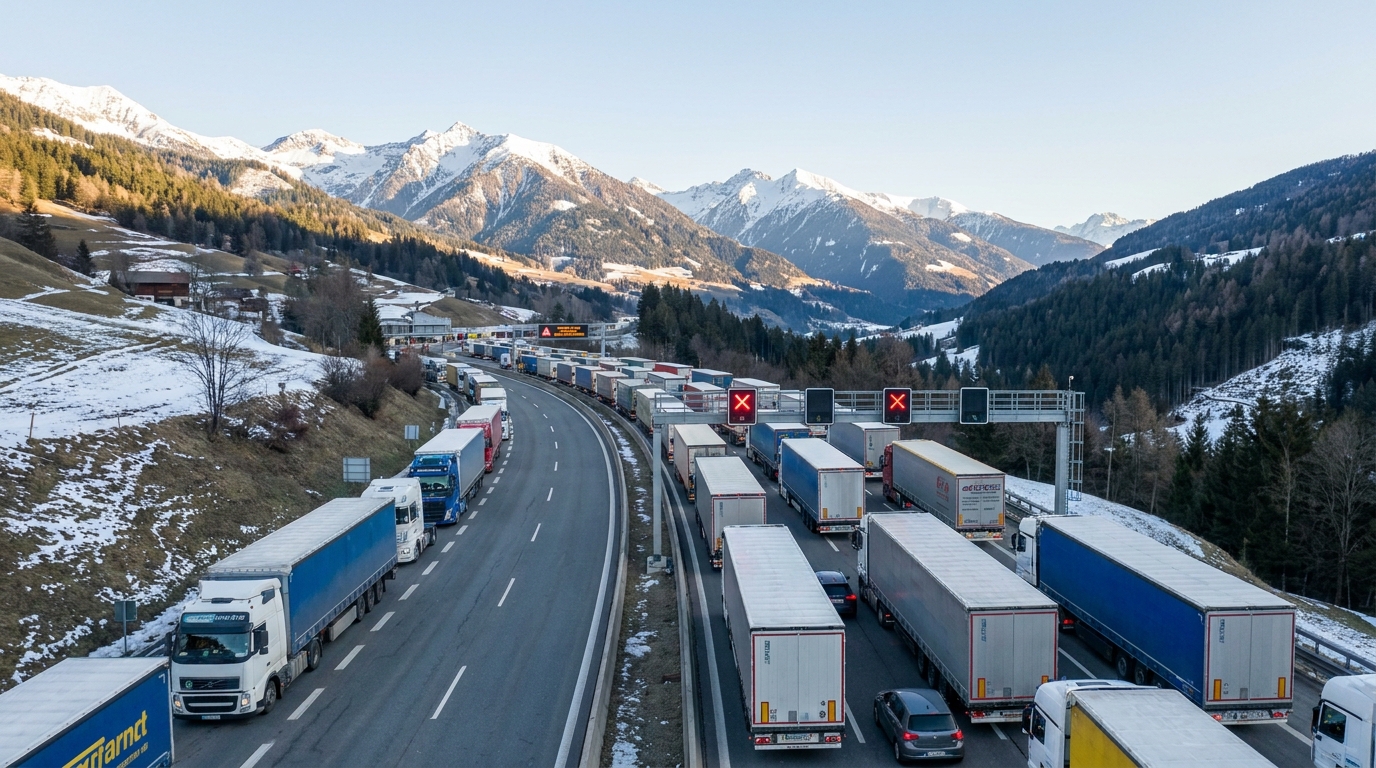
The Court of Justice of the European Union (CJEU) will face one of the most challenging legal dilemmas in the history of European transport. The case concerns a complaint filed by Italy against Austria regarding the transit restrictions in force on the Brenner Pass—the most important Alpine North-South transport corridor. The oral hearing, scheduled for April 21, 2026, could define the legal framework within which road freight transport in Europe will operate for the next decade. For transport companies, risk managers, and logistics providers, the stakes are exceptionally high.
Brenner: The Heart of European Supply Chains
The Brenner Pass is more than just a picturesque spot on the Alpine map. It's a strategic hub through which millions of tons of goods flow each year, connecting the markets of Germany, Austria, and Italy—and, more broadly, the entirety of Northern and Southern Europe. The Brenner Motorway (A13/A22) is one of the few year-round Alpine routes accessible to trucks, making it absolutely crucial for the transport, logistics, and logistics industry.
Over the years, the Tyrol region has come under enormous pressure due to the steady growth in road transport volumes. Tens of thousands of trucks per week generate noise, exhaust emissions, and infrastructure degradation, provoking justifiable protests from residents. In response, the Tyrolean authorities implemented an extensive system of restrictions, which is currently the subject of proceedings before the EU's highest court.
What are Brenner restrictions? Anatomy of a restriction system
To properly assess the significance of this case, it's worth taking a closer look at the mechanisms employed by the Austrian side. The Tyrolean transit restriction system encompasses several layers of regulations, which together create one of the most restrictive truck traffic regimes in Europe.
Block checks (Dosierampeln)
The most widely discussed tool is the so-called block check—a system of metering capacity for trucks entering Austria from the Bavarian border. Trucks are stopped at traffic lights on the German side and allowed into Austria in controlled batches. This results in regular, kilometers-long queues on the A8 motorway on the Bavarian side, paralyzing not only transit but also local alternative routes.
Sectoral driving bans
Equally controversial are bans on the transport of specific categories of goods. The list of those excluded from industrial transit includes, among others, the transport of steel, timber, and waste—materials absolutely crucial to the construction, processing, and circular economy industries. These bans affect specific industries, forcing carriers to make costly detours or seek alternative modes of transport.
Extended night and weekend bans
The third layer of the system is nighttime and weekend driving bans, which—though common in many European countries—are applied with particular consistency in Tyrol and cover a wider range of hours than in most EU countries. For carriers operating in just-in-time mode, this means costly time slot planning and an increase in overall travel time.
Rights versus rights: The heart of the legal dispute before the CJEU
The case before the Court of Justice of the EU is in fact a clash of two equally important treaty values, which makes it exceptionally difficult to resolve even for the best European lawyers.
Austria bases its defense on the treaty articles on the protection ofrodoTyrol is a region with an exceptionally sensitive Alpine ecosystem, where air pollution, noise, and vibrations generated by heavy transport have a particularly severe impact on the quality of life of residents and the state of the environment.rodoVienna emphasizes that the restrictions introduced are proportionate and justified by overriding reasons of public interest — a classic line of defense allowed by EU case law.
Italy, supported by the European Commission, takes a diametrically opposed stance. They believe the Austrian restrictions violate one of the four fundamental freedoms of the European Union—the free movement of goods. Instead of proportionate measures to protect the environment,rodovisa, Rome sees the Tyrolean system of restrictions as a de facto non-tariff barrier that in practice discriminates against Italian carriers and hinders trade between member states. By supporting the complaint, the European Commission is sending a clear signal: EU institutions treat this matter as fundamental to the integrity of the single market.
Industry Voice: "The Situation Is Absolutely Unacceptable"
ŚrodoTransport organizations across Europe are watching the proceedings closely. Industry organizations, including the German associations BGL (Bundesverband Güterkraftverkehr Logistik und Entsorgung) and VVWL, as well as the Arbeitskreis Alpentransit initiative, have made no secret of their expectations of the Luxembourg court.
In statements submitted before the hearing, these organizations categorically support the lifting of restrictions, describing the current situation as unacceptable and incompatible with the requirements of modern logistics. Their arguments have a concrete economic basis:
- Extended delivery times — many hours of waiting in queues at the border directly translate into failure to meet the agreed delivery time windows.
- Rising operating costs — drivers' working time wasted in traffic jams are real costs that transport companies must bear.
- Contractual penalties — Delays in deliveries result in financial penalties being charged by clients for violating service levels (SLA), which directly affects carriers’ profitability.
- Additional fuel costs — long stops with the engine running or the need to take a detour increase fuel consumption and CO₂ emissions, ironically deepening the problem ofrodowiskowy.
The problem particularly affects small and medium-sized transport companies—Polish, Italian, Romanian, Bulgarian, Hungarian, and Czech enterprises—which form the backbone of the European road transport sector. For them, every day spent waiting at the border poses a real threat to their financial liquidity.
Risk Perspective: What do restrictions mean for carriers' financial health?
From the perspective of assessing credit risk and the financial credibility of transport companies, the Brenner route is a factor that analysts should consider when assessing the exposure of individual entities. There are several mechanisms through which Brenner restrictions translate into a deterioration in the financial situation of carriers.
Erosion of operating margins
Road transport is an industry with historically low margins – in Europe, typical EBITDA margins in the sector range between 3 and 8 percent. In such conditions, any additional, unplanned cost – such as waiting in a queue for hours at the border – drastically reduces the profit from a given order, sometimes rendering it unprofitable. Carriers serving routes across the Brenner Pass are exposed to systematic margin erosion, which they cannot fully compensate for with freight rate increases.
Risk of losing key customers
Customers who value predictable deliveries—especially in just-in-time industries like automotive, electronics, and pharmaceuticals—may decide to switch carriers or shift their cargo to rail if their road partners are unable to guarantee reliability on Alpine routes. The loss of key contracts could dramatically worsen the situation for small and medium-sized businesses.
Pressure on working capital
Delays in order fulfillment also mean delays in invoicing and cash receipts. For companies with tight cash balances, a delay of several days or weeks in the billing cycle may mean the need to seek more expensive external financing or—in extreme cases—difficulty settling current liabilities to fuel suppliers, leasing companies, or employees.
Two sentencing scenarios and their consequences
Regardless of the final outcome, the CJEU's ruling in this case will be precedent-setting and will have implications far beyond the Brenner Pass itself. It's worth considering both possible scenarios.
Scenario I: The CJEU upholds Italy's appeal
If the Court finds that the Austrian restrictions infringe EU law on the free movement of goods and are disproportionate to the declared objectives of therodorestrictions, Austria will be obliged to revise or abolish the current system of restrictions. This would mean:
- Gradual unblocking of the Brenner corridor and restoration of predictable supply on the Munich-Verona axis.
- Reducing operating costs for the tens of thousands of carriers using this route annually.
- A strong precedent limits the possibility of introducing similar local barriers by other transit regions – in France, Switzerland or the Balkans.
- Serious political tensions in Tyrol, where the topic of protecting residents from the nuisance of transport is extremely sensitive and has a strong social base.
Scenario II: The CJEU finds the Austrian measures proportionate
If, however, the Court sides with Austria and confirms that the Brenner restrictions fall within the limits of the exceptions permitted by EU law,rodothe consequences will be equally far-reaching, but of a completely different nature:
- Maintaining the status quo on the Brenner Pass, and in the long run — a possible tightening of existing restrictions.
- Green light for other regions and countries to introduce their own truck traffic regulation systems under the banner of environmental protection.rodowiska.
- Potential fragmentation of the EU single transport market, with a network of local barriers and exceptions hindering the free movement of goods.
- Growing interest in rail transport as an alternative to Alpine routes – which could accelerate investment in the Brenner Base Tunnel (BBT), which is scheduled for completion in the late 2030s.
The broader context: Brenner and the future of Alpine transit
The case before the CJEU falls within the broader context of European transport policy, which is facing a fundamental question: how to reconcile the freedom of trade with the protection of the environment.rodoand quality of life of inhabitants of transit regions?
For years, the European Union has been promoting the idea of modal shift—that is, shifting as much freight as possible from road to rail or inland waterways. In the Alps, where the possibilities for building new rail infrastructure are limited geographically and cost-wise, this strategy takes on particular importance. The ongoing Brenner Base Tunnel project, which aims to create a low-emission, underground railway connection between Innsbruck and Fortezza, is a symbol of this policy.
Nevertheless, for the next 15-20 years, road transport will remain the dominant mode of freight transport in Europe. Until rail infrastructure reaches sufficient capacity, trucks will be forced to use Alpine passes—and the question of how this is done remains absolutely relevant.
Recommendations for transport companies and risk managers
Regardless of the outcome of the CJEU proceedings, transport companies and their financial partners should take adaptive action today. Here are the key recommendations from the perspective of operational and financial risk management:
- Monitoring the proceedings of the CJEU — The judgment in the Italy v. Austria case should be on the analytical calendar of every risk manager in the TSL industry. April 21, 2026, is a turning point, but the judgment itself could be announced several months after the oral hearing.
- Scenario-based route planning — Companies regularly using the Brenner corridor should develop alternative routing plans via the Gotthard Pass (Switzerland) or the Tauern, taking into account higher costs and longer travel times.
- Verification of contractual clauses — contracts with customers should include force majeure clauses covering administrative transit bans, protecting the carrier from penalties for delays not attributable to it.
- Portfolio Exposure Analysis — Factoring companies, trade credit insurers and banks financing the transport sector should verify what percentage of their portfolios are entities strongly dependent on Alpine routes.
- Dialogue with industry organizations — active participation in pressure groups such as BGL, VVWL or the International Association ofrodoRoad Carriers (ZMPD) will allow companies to keep up to date with regulatory changes and participate in shaping transport policy.
Summary: A treatise not to be missed
The Italy v. Austria case before the Court of Justice of the EU is much more than a technical legal dispute between two neighboring member states. It is a test of the fundamental principles of the European single market—and whether the protection ofrodowiska can legitimize trade restrictions that in practice harm the competitiveness of entire industries.
For the transport and logistics industry, the ruling will have almost constitutional implications. If the CJEU confirms states' right to impose stringent transit regulations, companies must prepare for long-term regulatory uncertainty and the potential fragmentation of the European transport network. If, on the other hand, the Court orders the liberalization of the Brenner Pass, it will open up an opportunity to restore predictability and cost-effectiveness on one of the continent's most important trade routes.
One thing is certain: this decision will define the landscape of European road transport for years to come. Companies that invest now in understanding its potential consequences and develop adaptation strategies will be in a much better position than those that are caught unprepared by the ruling.