

Germany: Business insolvencies rise by 4,9% - transport and logistics sector in highest risk zone
The Federal Statistical Office of Germany (Destatis) published data indicating a 4.9% increase in the number of corporate insolvencies in January 2026 — to 1919 cases. The transport and logistics sector recorded the second-highest insolvency rate across the entire economy: 8.6 per 10 000 active entities. For Polish companies in the transport, shipping and logistics sector working with German partners, these data signal the need to immediately tighten receivables management policies and verify the solvency of business partners.
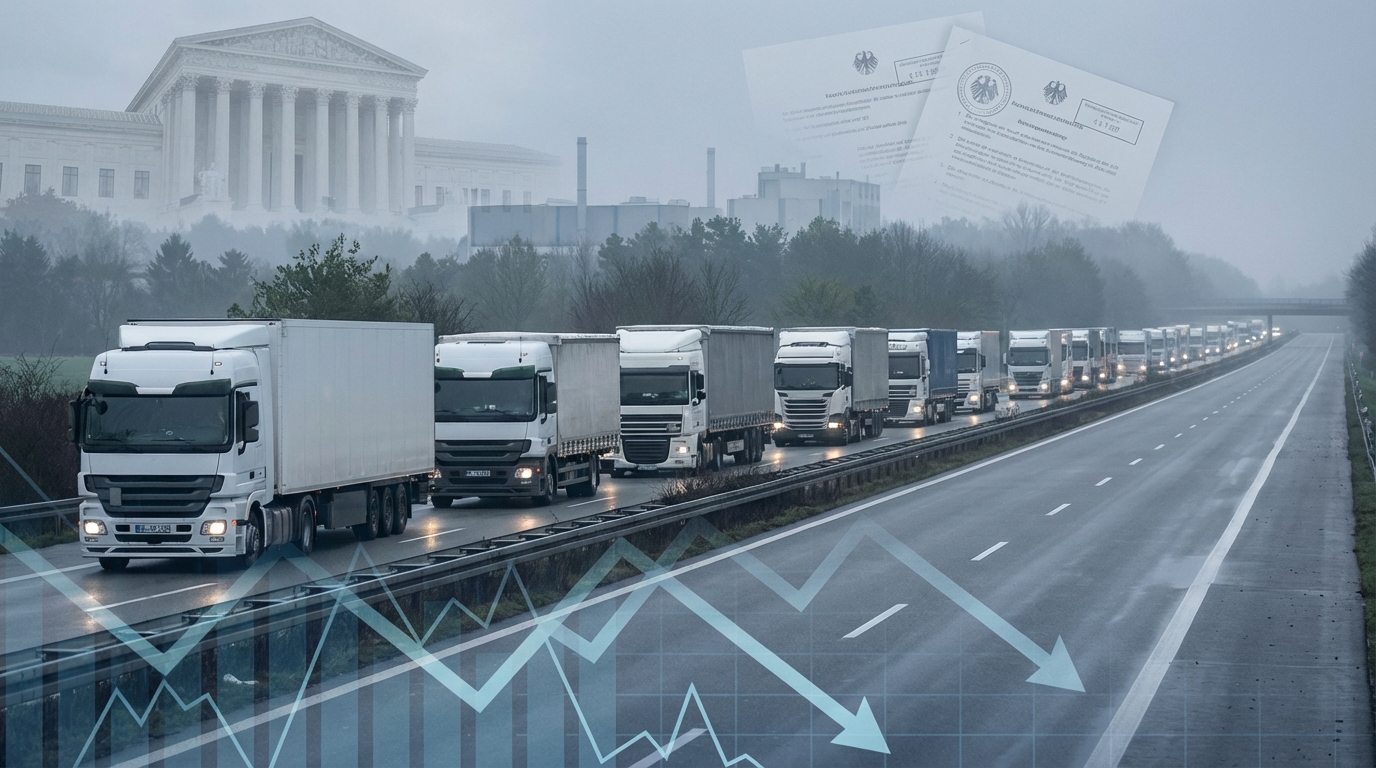
According to the latest data published by the Federal Statistical Office of Germany (Destatis) in mid-April 2026, the first month of this year brought another deepening of the unfavorable trend in the German economy. The number of corporate bankruptcy filings increased by 4,9% year-on-year in January 2026. In absolute numbers, the local district courts – Amtsgerichte – registered a staggering 1919 formal insolvency cases. For European companies cooperating with German partners, and especially for Polish entrepreneurs in the TSL and construction sectors, this data should serve as a clear alarm and an impetus for an immediate review of lending policies.
Growing bankruptcies despite the stock market boom
At first glance, the outlook for the German economy in the first months of 2026 seems ambiguous. The DAX index successfully broke through the historic 24,000-point mark, and official economic reports are not without optimism. Meanwhile, in the real world—in the daily operations of small and medium-sized enterprises—the situation is much less rosy. The rising number of bankruptcies confirms that stock market prosperity does not automatically translate into the financial health of all market segments. This discrepancy should prompt risk managers to exercise particular caution: the mere fact that large corporations are performing relatively well provides no guarantee of the stability of smaller suppliers and carriers that form the daily fabric of supply chains.
The profile of the bankrupt is changing - the risk is dispersed
Particularly noteworthy is the shift in the structure of bankruptcy, as documented by Destatis data. Although the number of bankruptcies has increased, the total value of claims filed by creditors has fallen dramatically—from approximately €5,3 billion in January 2025 to only around €3,1 billion a year later. This apparent paradox actually carries significant implications for risk management.
The explanation is as follows: the current wave of bankruptcies is primarily affecting the small and medium-sized enterprise sector. Fewer large, prominent corporations are declaring bankruptcy, while a growing number of smaller entities are taking their place. For foreign contractors, this poses a significant operational challenge. While the bankruptcy of a major market player is usually widely reported in the industry media and relatively easy to detect, the sudden disappearance of a small carrier or regional freight forwarder can catch trading partners completely unprepared.
Credit risk is thus dispersed, becoming more difficult to manage and requiring more advanced tools for monitoring the receivables portfolio. Classic methods based on observing press releases or stock market reports prove clearly insufficient in such circumstances.
Transportation and logistics – the second highest bankruptcy rate in the entire economy
From the perspective of the European transport market, the industry data contained in the Destatis report is particularly significant. The average bankruptcy rate across the German economy during the period under review was 5,4 cases per 10,000 active companies. Meanwhile, in the transport and warehousing sector (German: Verkehr und Lagerei) this indicator was at the level of as much as 8,6 bankruptcies per 10,000 companies — over 59% above the economy-wide average.
This means that among all major industries, transport and logistics ranked second in terms of bankruptcy risk, even ahead of the construction sector. Only the hotel and catering industry (Hospitality) recorded a higher rate of 9,1 per 10,000 entities. The full industry risk hierarchy is as follows:
- Hotel and catering industry: 9,1 bankruptcies per 10,000 companies
- Transport and warehousing: 8,6 bankruptcies per 10,000 companies
- Construction: 7,8 bankruptcies per 10,000 companies
- Average for the entire economy: 5,4 bankruptcies per 10,000 companies
For Polish logistics, freight forwarding, and transport companies operating with partners across the Oder River, these figures represent a direct operational warning. Germany is Poland's largest trading partner, and the TSL sector handles a significant portion of this exchange. A loss of liquidity by a German client or carrier can quickly translate into real financial losses for the Polish subcontractor.
Why do January bankruptcies mirror the crises of the fall?
When interpreting the above data, it's important to keep in mind an important methodological aspect, highlighted by Destatis himself. Official bankruptcy statistics record the moment the court issues the first formal procedural decision, not the moment the debtor files the petition. In practice, this means that approximately three months typically pass between the time a company actually decides to file for bankruptcy and the time it is recorded in the statistics.
The January 2026 data therefore largely reflects the difficulties German entrepreneurs faced in the fall of 2025—particularly in the fourth quarter, marked by rising operating costs, pressure on wage increases resulting from subsequent rounds of collective bargaining, and limited access to external financing amid restrictive bank lending policies. For receivables management companies, this provides a clear conclusion: the problems visible today in court statistics are not the peak of the current crisis—they are an echo of a crisis that has already been ongoing for several months.
Consumer situation as a mitigating factor
Amidst the troubling corporate data, the situation in the consumer bankruptcy sector offers some balance. In January 2026, 6142 individual insolvencies were recorded in Germany, a slight decrease of 1,3% year-on-year. These data suggest that German households remain relatively financially stable, which could sustain retail demand in the long term and partially cushion the impact of the difficulties in the corporate sector.
However, this signal shouldn't be overstated. Consumer resilience can be fragile and could be undermined at any time by rising unemployment caused by another wave of restructuring in the SME sector—which, in turn, would complete the vicious cycle of a deepening slowdown.
Practical recommendations for risk managers in the TSL industry
The data published by Destatis leaves no doubt: managing counterparty risk in relationships with German transport and logistics companies today requires a proactive approach and specific organizational measures. Below, we present a set of recommendations that should be on the agenda of every risk manager responsible for exposure to the German market:
- Verification of solvency before each order: The bankruptcy rate of 8,6 per 10,000 companies in the transport sector means that the scale of the problem is large enough to justify routinely checking the financial health of even long-term trading partners.
- Increased vigilance towards small and medium-sized carriers: The changing profile of bankruptcies—more and more bankruptcies among SMEs, fewer and fewer among large corporations—is making media and industry alerts less effective as early warning systems. It's essential to utilize specialized databases and credit monitoring services.
- Shortening payment terms or implementing security measures: In higher-risk industries, renegotiating commercial terms should be considered – shortening payment terms, implementing advance payments or insuring receivables.
- Regular review of the receivables portfolio: A three-month delay between the actual moment of the crisis and its statistical reflection means that the company may already be in serious trouble before information about it reaches its contractors through formal channels.
- Monitoring the subcontracting chain: In logistics and freight forwarding, the domino effect is particularly dangerous. The failure of one link in the supply chain can bring down an entire network of interconnected entities.
The Wider Context: Germany as a Barometer of European Logistics
The challenging situation in the German transport sector is not an isolated phenomenon. Germany is the center of European logistics corridors, with some of the busiest road and rail routes on the Old Continent running through its territory. The financial health of its transport operators directly impacts the availability and pricing of transport services throughout Central and Eastern Europe.
The growing number of bankruptcies among German carriers may lead to market consolidation in the coming months, limiting the supply of transport services, and consequently, upward pressure on freight rates. Polish logistics companies, currently suffering from bad debts from bankrupt contractors, may also benefit to some extent from reduced market competition. However, this is a long-term prospect and is fraught with considerable uncertainty.
In the short and medium term, financial liquidity remains the dominant risk. Every Polish transport or freight forwarding company with exposure to the German market should conduct an audit of its receivables today and assess the realistic probability of their recovery if the observed trends deepen.
Summary: Time to act before the statistics reach the court
Destatis data for January 2026 is clear: company bankruptcies are on the rise in Germany, with the transport and logistics sector among the hardest hit. With a rate of 8,6 bankruptcies per 10,000 companies and the dominant role of small and medium-sized enterprises in this wave of difficulties, European trading partners have limited options for relying solely on classic risk monitoring methods. Implementing a systematic approach to receivables management, in-depth customer verification, and flexible response to early warning signals are now becoming not an option, but an operational necessity for every company doing cross-border business with Germany.




