

Maersk and Hapag-Lloyd return to the Suez Canal – fourth service launched, but mass return of the fleet still distant
Since 10 August 2026, the Gemini Cooperation alliance (Maersk and Hapag-Lloyd) has resumed operating a fourth route through the Suez Canal – the AE19 service connecting Asia with Europe via the Red Sea. Despite a reduction in transit time of approximately four weeks, shipping lines are ruling out a large-scale return of their fleets to this route, fearing a sharp collapse in freight rates caused by excess shipping capacity. For European logistics companies, this means a difficult period of asymmetric supply chains and increased planning uncertainty.
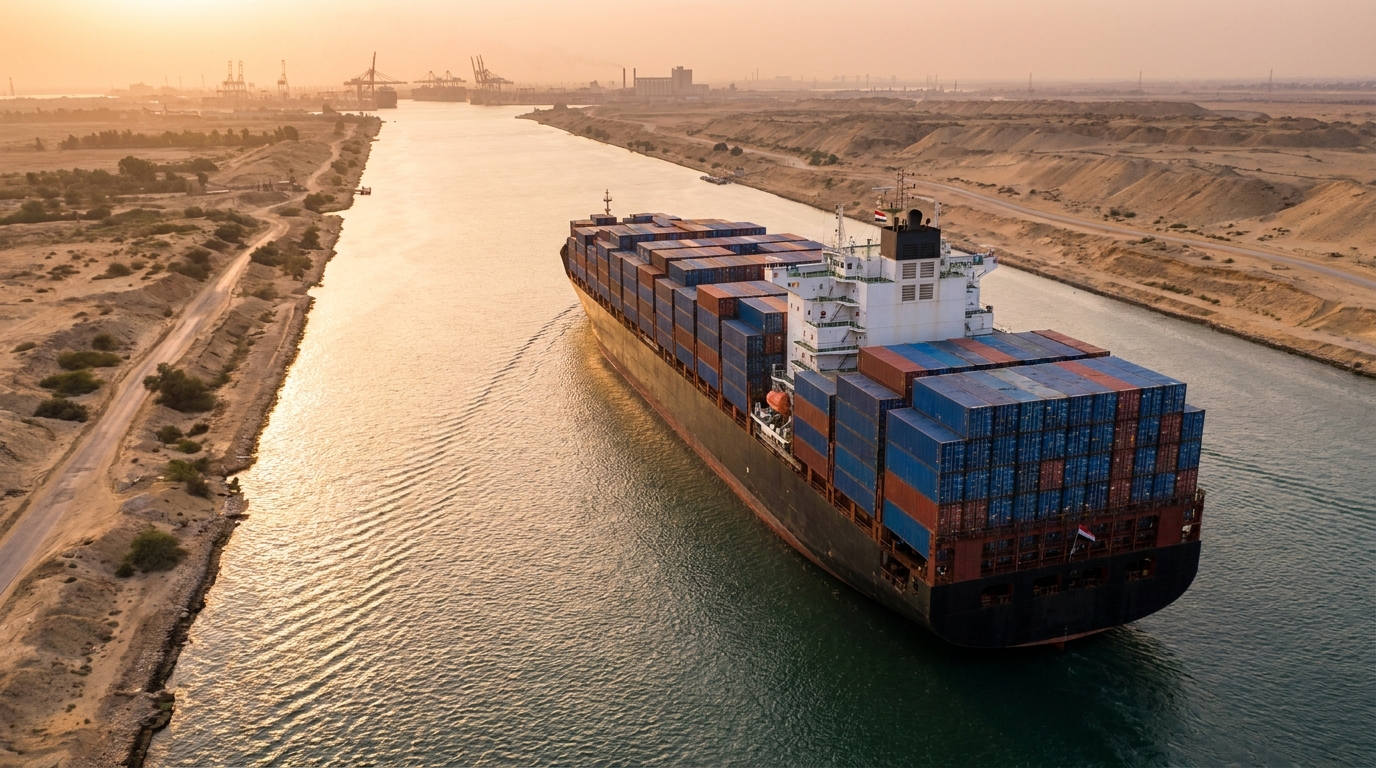
As of August 10, 2026, the global shipping market is experiencing another sign of cautious normalization: the Gemini Cooperation alliance, which brings together Danish giant Maersk and German carrier Hapag-Lloyd, has resumed service on the AE19 route through the Red Sea and Suez Canal. This is the fourth line to return to this route since the beginning of July 2026. While this decision is significant, both shipowners and leading industry analysts are tempering their enthusiasm – a mass return of the fleet to this route will not happen quickly, and the risk of a sharp decline in freight rates remains one of the most serious threats to the stability of the entire TSL sector in the coming quarters.
The fourth step on the long road back
For Gemini Cooperation, returning to the Suez Canal route isn't a sudden or impulsive move. The alliance of the two largest global shipping companies is methodically, service by service, testing the possibilities of resuming regular transit through the waterway, which just a year and a half ago was practically closed to large container ships due to the threat of attacks by Yemen's Houthi militants.
The AE19 service, which was the fourth in line, was preceded by the AE15 service, the WAF6 service to West Africa, and the MECL service connecting ports in the Middle East and India with the East Coast of the United States. Each of these returns was carefully analyzed for both safety and economic efficiency before the next step was decided.
The inaugural voyage of the modernized AE19 westbound route was undertaken by the container ship Berlin Maersk – a vessel built in 2025 with an impressive capacity of 17,480 TEU. The vessel departed Malaysia, including stops in Jeddah, Saudi Arabia, and Egyptian ports, en route to European destinations. The AE19 service connects Southeast Asia with the Mediterranean, Saudi Arabia, and Europe, bypassing the previous, extended route around the Cape of Good Hope.
The practical implications of this change are hard to overestimate: using the Suez Canal instead of the African route shortens transit times by approximately four weeks.rodoIn a market where inventory management and on-time delivery directly translate into companies' financial results, such a difference means real operational savings for shippers.
Caution as a strategy – why shipowners are not rushing back
Despite the positive signals, both Hapag-Lloyd and Maersk are communicating their decisions with marked restraint. Hapag-Lloyd explicitly called the resumption of the AE19 service a "targeted realignment"—a term that, in corporate parlance, clearly signals: this is not a strategic shift, but a precise tactical maneuver.
The essence of this caution lies in two overlapping risk factors. The first is geopolitical and operational in nature. The European defense mission EUNAVFOR Aspides, conducted continuously for 30 months, is yielding tangible results: numerous attacks have been successfully repelled, numerous combat drones and missiles have been neutralized, and over 2260 merchant ships have been escorted or supported. Nevertheless, the Red Sea region is not a completely safe zone. Incidents—particularly those targeting vessels linked to Saudi Arabia or LNG carriers—continue to occur. In this situation, shipowners apply the principle of selectivity: vessels carrying lower-value cargo or those serving routes that are secondary to their overall portfolio are allowed through the Suez Canal.
Key arteries connecting Asia with Northern European ports – including Rotterdam, Hamburg, and Antwerp – still use the Cape of Good Hope route. These routes generate the largest volumes and revenues, and their security is a top priority.
The Economics of the African Route – The Paradox of the Beneficial Bypass
The second factor preventing shipowners from fully returning to the Suez Canal is purely economic and is often overlooked in mainstream industry discourse. Simon Heaney, senior analyst at renowned consultancy Drewry, highlights a paradox that defines the current market situation: the circum-Africa route, while more expensive and time-consuming, plays a key role in regulating supply in the global shipping market.
The mechanism is simple, but its consequences are enormous. The longer route via the Cape of Good Hope requires significantly more vessels to maintain a consistent weekly frequency. In other words, the same trade capacity—the same number of containers delivered to Europe each week—demands more vessels than the Suez Canal route.
In this context, another global trend should be considered: shipyards around the world, fulfilling orders placed during the peak of the pandemic logistics boom, are delivering record numbers of new container ships to the market. If the entire fleet were to suddenly shorten its routes at the same time, returning to the Suez Canal, a massive overcapacity would appear in the market. The effect would be immediate and painful: a sharp, cascading decline in freight rates, impacting the profitability of all market participants.
Carriers are fully aware of this. Managing the return to the Suez Canal must therefore be slow, controlled, and gradual—so as not to undercut their own revenues at a time when the market is already struggling with the pressure of an oversupply of new tonnage.
Two-speed logistics – a challenge for European importers
For European companies importing goods from Asia, the current situation creates a new, complex planning challenge that can be described as "two-speed logistics." Traders using restored Suez Canal services, such as the newly launched AE19, can expect deliveries up to four weeks faster than alternative routes around Africa.
This is seemingly good news. Shorter transit times mean the possibility of reducing costly safety stocks, better cash flow management, and greater operational flexibility. However, these benefits only apply to those who find the right service at the right time.
The problem arises across the company's entire supply chain: two containers loaded in the same week at the same Asian port can reach their European recipient up to four weeks apart, depending on the carrier and service selected. This asymmetry drastically complicates logistics forecasting, production planning, warehouse management, and sales scheduling.
Logistics and purchasing departments at European companies must therefore constantly monitor which services operate through the Suez Canal and which bypass the region—and adjust their orders, inventory buffers, and supplier contracts accordingly. In practice, this translates into higher coordination costs and a greater risk of planning errors than under a fully predictable, uniform network of connections.
Egypt awaits the return of ships – revenue from the canal is crucial to the economy
The crisis in the Red Sea has had a significant impact not only on global supply chains but also on the Egyptian economy. The Suez Canal is one of Cairo's most important sources of foreign exchange, and the months-long avoidance of this route by major shipping companies has meant enormous losses in transit fees.
The Suez Canal Authority (SCA), led by Admiral Osama Rabie, is actively seeking to expedite the return of carriers. The incentives include attractive discounts on transit fees and operational improvements for vessels opting for the crossing. Egyptian authorities also point to the example of French shipping company CMA CGM as proof that the return is possible and profitable – the company independently completed 104 crossings through the Canal between January and May 2026.
Despite these efforts, full normalization of traffic through the Suez Canal remains a scenario dependent primarily on the political and military situation in the Middle East. No amount of economic incentives will replace the fundamental requirement of safe navigation in the region.
Risk perspective for transport and logistics companies
Observing the changes described, risk managers and owners of companies in the TSL industry should pay special attention to several key risk areas in the coming quarters.
Risk of destabilization of freight rates
Although the gradual return to the Suez Canal is being controlled, any unexpected acceleration in this process—due to, for example, a sudden improvement in the security situation or competitive pressure among shipowners—could trigger an avalanche. A massive reduction in routes combined with a simultaneous influx of new tonnage from shipyards would create conditions for a sharp decline in rates. Logistics companies operating under long-term freight contracts should review their market rate indexation clauses and assess how any drastic reductions would impact their operating margins.
Risk of supply chain unpredictability
The aforementioned "two-speed logistics" is not only an operational challenge but also a source of contractual risk. Companies that have committed to specific delivery dates or inventory levels with their customers may encounter difficulties in meeting these obligations if their chosen shipping service suddenly changes its route or schedule. It's worth reviewing force majeure clauses and liability for delays in contracts with contractors.
Geopolitical and security risks
The situation in the Red Sea region is still far from stabilized. Companies that choose to use services through the Suez Canal—either directly or indirectly as cargo owners—should ensure that their insurance policies cover current war and terrorism risks in this waterway. War and risk insurance rates in this region can differ significantly from standard terms and require individual analysis.
Partners' financial liquidity risk
The prolonged crisis in the Red Sea has strained the financial health of many smaller logistics operators, freight forwarders, and port service providers. It's important to conduct ongoing reviews of the financial situation of key supply chain partners—especially those operating in regions directly affected by the crisis—to ensure they can meet their obligations in the event of further disruption.
What's next? Scenarios for the coming months
Shipping market analysts are outlining several possible scenarios for the second half of 2026 and early 2027. The baseline scenario assumes a continuation of the current, cautious approach by shipowners: gradually adding additional services via the Suez Canal, while maintaining the main Asian-European connections on the African route. In this scenario, freight rates remain relatively stable, although under gradual pressure from new tonnage from shipyards.
The optimistic scenario – full normalization of security in the region and a mass return to the Suez Canal – brings both opportunities (lower transport costs for importers, shorter transit times) and serious threats to the sector (risk of a price war between shipowners, pressure on the margins of logistics operators).
The pessimistic scenario assumes an escalation of the conflict in the Middle East and a renewed closure of the Red Sea routes, which would take the market back to the worst moments of the crisis at the turn of 2024 and 2025.
Each of these scenarios requires logistics companies to maintain high operational readiness and contractual flexibility – which in practice means avoiding excessive dependence on a single carrier, a single route or a single operating model.
Summary – time for cautious optimism, not euphoria
The return of the AE19 service through the Suez Canal is a positive sign and demonstrates the gradual normalization of global container shipping. Reducing transit times by four weeks is a real and tangible benefit for the entire supply chain. However, both the scale and pace of change are being deliberately limited by the shipowners themselves—and for good reason.
The market is facing a rare situation where too rapid an improvement could prove as destabilizing as a prolonged crisis. The oversupply of transport capacity, caused by the simultaneous shortening of routes and the influx of new tonnage, is a systemic threat that could severely impact the entire TSL industry – from large shipowners to small freight forwarders and logistics operators.
For risk managers and owners of transport and logistics companies, the key message is the need to maintain vigilance and operational flexibility. Monitoring the security situation in the Red Sea, tracking shipowners' decisions regarding the reinstatement of subsequent services, and regularly reviewing the financial health of supply chain partners – these are actions that could determine competitive advantage or protect against costly surprises in the coming months.
The Suez Canal is slowly reopening. But it is reopening slowly and selectively – and for now, this rhythm is the safest for global logistics.




