

Stellantis suspends production at four factories in France. Over 8000 employees furloughed – what does this mean for logistics and the supply chain?
Stellantis has announced a temporary suspension of production at four factories in France (Sochaux, Rennes, Mulhouse, Poissy), placing more than 8000 employees on mandatory furlough. The official reasons are problems with battery supplies from ACC and the need to reduce excess inventory to protect financial liquidity. For the European transport and logistics sector, this means a sudden loss of transport volumes and a real risk of payment delays throughout the automotive supply chain.
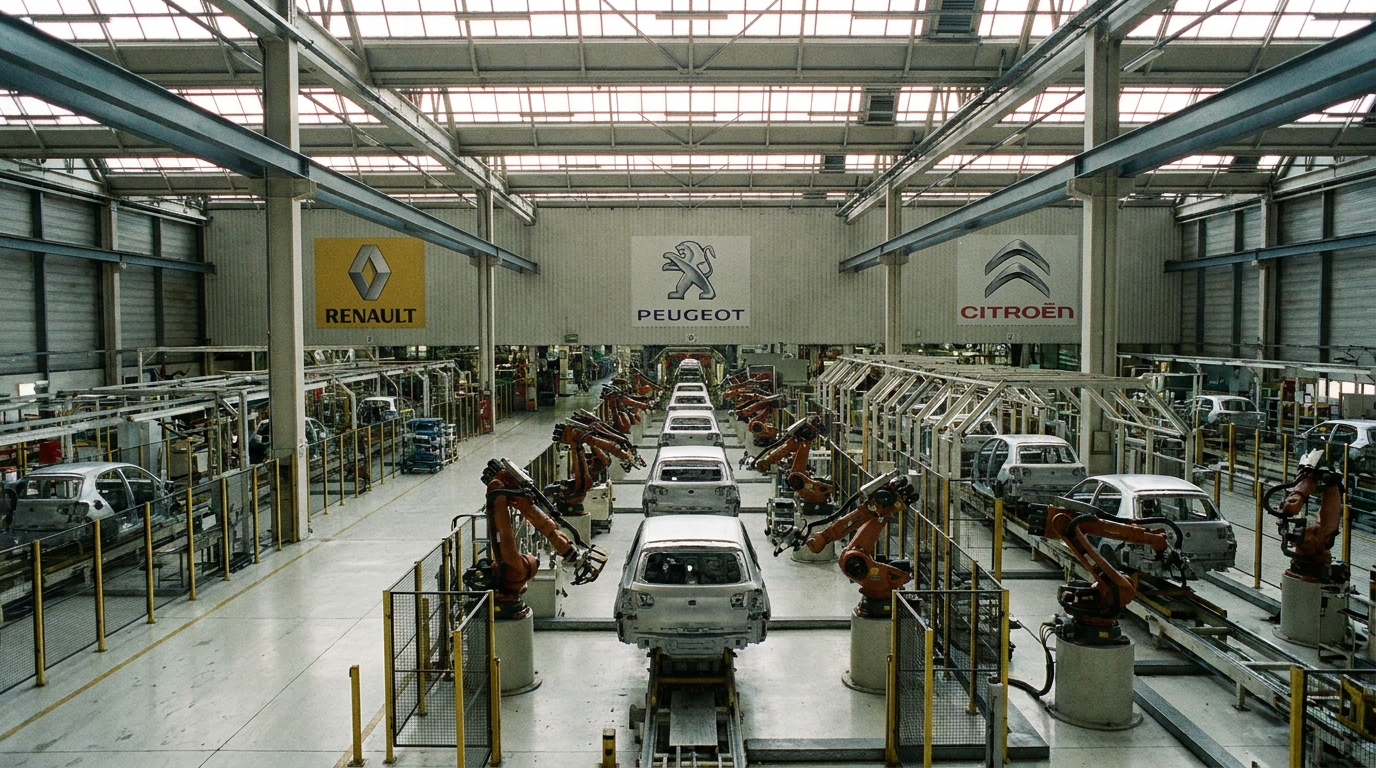
European automotive giant Stellantis announced in late September 2026 that it would temporarily halt production lines at four plants in France. The factories in Sochaux, Rennes, Mulhouse, and Poissy are expected to be idle for up to 15 working days in October 2026. As a direct result of this decision, more than 8000 employees will be placed on compulsory furlough. Partial unemploymentFor the European transport and logistics sector and the extensive network of automotive component suppliers, this is a wake-up call that requires immediate business risk assessment.
Two causes, one effect: what's behind Stellantis' decision?
An official statement from Stellantis management indicates supply problems with batteries for long-range electric vehicles. The strategic supplier of these components, the company ACC (Automotive Cells Company), a joint venture of Stellantis, TotalEnergies, and Mercedes-Benz, among others, is unable to meet the level of deliveries required by the company's production plans. This is a serious shortcoming, as high-capacity batteries are currently the heart of every modern electric vehicle and cannot be easily replaced by an alternative supplier in a short time.
However, behind the official narrative about battery problems there is a second, financially much more telling reason: deliberate reduction of inventory levels to protect cash flowStellantis is struggling to sell finished vehicles in the European market, which has been showing signs of saturation and declining demand for several quarters now—particularly in the electric vehicle segment. Every unsold car sitting on the factory yard represents tied-up working capital, generating storage, financing, and depreciation costs. Amid growing pressure on financial results and market uncertainty, the decision to deliberately slow production—even at the cost of downtime and demurrage payments—is becoming rational from the management's perspective. However, for outside observers, it clearly signals deeper structural problems.
Factories that have stopped: the geography of the problem
The choice of locations affected by the shutdowns is not accidental. All four plants are key hubs in the Stellantis Group's European automotive production:
- Sochaux — one of the oldest and largest automotive plants in France, historically associated with the Peugeot brand. It employs thousands of direct workers and an extensive network of local subcontractors.
- Rennes — a plant producing Citroën and DS vehicles, an important hub for the logistics of finished vehicles in western France.
- Mulhouse — a factory located in Alsace, close to the border with Germany and Switzerland, serving both the domestic and export markets.
- Poissy — a plant in the Paris region that produces Opel and Citroën models. Its shutdown has particular symbolic significance due to its proximity to the group's decision-making headquarters.
In total, this represents more than 8000 employees directly affected by the shutdown – not including the thousands of additional people employed by local subcontractors and service companies involved in the daily operations of these factories.
The domino effect in the supply chain – who will feel it first?
From a B2B market and credit risk assessment perspective, a production halt by a large OEM (Original Equipment Manufacturer) triggers a cascade of consequences across the entire value chain. The mechanism is well known to risk management experts, but its scale is exceptionally large this time.
TSL sector - sudden loss of volumes
The transport and logistics companies serving these four factories usually work on the basis of the model just-in-time — delivering components precisely when they're needed on the production line. A production halt means the immediate cancellation or suspension of regular transport orders. For carriers and logistics operators working on permanent contracts with Stellantis factories, the situation is critical: fleets are idling, drivers are waiting, and revenues are evaporating.
Worse still, such contracts are typically well-paid and form the financial foundation of many regional TSL companies. Their sudden loss—even for 15 days—can undermine the liquidity of companies that haven't built sufficient reserves or that finance their operations through factoring receivables from these contracts. Companies leasing vehicles for specific contracts may now be faced with leases they can't service due to a lack of revenue.
Tier 1, Tier 2 and Tier 3 suppliers – risk of payment bottlenecks
The domino effect is hitting the extensive network of automotive component suppliers just as hard. The pattern is as follows:
- Tier 1 Suppliers Manufacturers of braking systems, seats, and on-board electronics, for example, receive a notice to suspend the receipt of components. Their own production lines must slow down or come to a complete halt.
- Tier 2 Suppliers (e.g. producers of plastics, metal components, electrical cables) lose orders from Tier 1 - often without any formal notice, because contractual mechanisms in the automotive sector rarely protect smaller companies against sudden changes in volumes.
- Tier 3 Suppliers (raw materials, chemical semi-finished products, steel) feel the effects at the end, but their situation is sometimes the most difficult - they operate on very low margins and do not have a financial buffer for a longer period without revenues.
At each of these levels there is a risk of payment backlogsSmaller subcontractors who have issued invoices for previously delivered goods and are awaiting payment may encounter delays—especially if their contractors prioritize their own cash flow over timely settlements. In extreme cases, this could lead to restructuring or even bankruptcy proceedings among smaller entities in the chain.
The Big Picture: The Energy Transition Crisis in the European Automotive Industry
Stellantis's situation is not unique; rather, it's a symptom of the deep structural crisis the entire European automotive industry finds itself in. Carmakers across the Old Continent find themselves in a bind: on the one hand, obligated to make costly investments in electromobility by EU regulations, and on the other, confronted with weakening consumer demand for expensive electric vehicles.
European consumers, tired of inflation and rising living costs, are reluctant to buy an expensive electric car these days—even with subsidies and tax breaks at their disposal. Meanwhile, Chinese manufacturers, primarily BYD, SAIC, Geely, and others, are entering the European market with significantly cheaper EVs, possessing complete control over the supply chains of battery raw materials—from lithium and cobalt to finished cells. This is an advantage that the European industry cannot overcome in the short term.
The public mood in France—clearly visible in the reactions to media reports about Stellantis's downtime—is extremely pessimistic. There are voices about the country's ongoing deindustrialization, the loss of hundreds of thousands of jobs over the next decade, and the failure of industrial policy. Irony directed at Stellantis and former CEO Carlos Tavares (who left after the group's poor results) is mixed with real fear for the future of automotive sector workers and their families.
ACC – The Supplier That Failed. What Do We Know?
Automotive Cells Company is a European project to build independence in battery cell production—a gigafactory intended to free European manufacturers from dependence on Asian supplies. Unfortunately, the project is facing significant setbacks: delays in starting production lines, technological issues, and financial challenges. For Stellantis, this means that the strategic partner on which part of its electric vehicle production plan relied is not delivering components on schedule.
From a supply chain risk management perspective, this is a classic example of over-concentration—when a key component comes from a single, difficult-to-replace supplier, any disruption on that supplier's side is directly transmitted to the end manufacturer. Diversifying the battery supplier base, which industry analysts have been advocating for years, is proving extremely difficult to implement in practice due to technological and capital barriers.
Business risk perspective for the European market
For European companies in the transportation, logistics, finance, and manufacturing sectors, Stellantis's situation should be viewed as a wake-up call to urgently analyze their exposure to risks related to the automotive market. Below are the key areas requiring immediate assessment:
1. Verification of contractors in the automotive industry
Companies with customers in the supply chain of Stellantis or other large OEMs should immediately assess the financial health of these partners. It's especially important to verify their ability to meet their obligations on time in the event of a sudden drop in revenue. It's worth utilizing credit monitoring tools and risk reports available on platforms like EURODEBT.eu.
2. Review of contracts and securities
Transport and logistics companies that have regular transport contracts with automotive factories should carefully review their contracts for clauses regarding sudden suspension or reduction of orders. Lack of appropriate contractual safeguards (e.g., clauses take-or-pay) may mean that you cannot claim compensation for lost income.
3. Trade receivables insurance
The trade credit insurance market is already seeing increased interest in policies that protect against the risk of insolvency for automotive contractors. Companies that have not yet used such products should consider implementing them—especially if their exposure to the automotive sector exceeds 20-30% of total receivables.
4. Diversification of income sources
Companies heavily dependent on serving a single sector—in this case, automotive—should actively seek opportunities to diversify their order portfolios. Even a partial shift of transport volumes towards other industries (e.g., e-commerce, pharmaceuticals, construction) can provide a significant safety buffer in the event of further production downtime.
5. Real-time situation monitoring
The situation in the automotive sector is changing rapidly. It's worth monitoring reports on the financial results of major OEMs, changes in component orders, and production decisions, using professional sources of industry information. Early detection of warning signs can give a company time to take preventative measures.
What's next for Stellantis? Prospects for the coming months
Officially, Stellantis announces that the downtime is temporary and that production will resume within a few days. However, market analysts are cautiously optimistic. The group's structural problems—weak sales, excess inventory, difficulties with the supply of key components, and pressure from Chinese competitors—will not disappear after a month. There is a real risk that similar decisions to suspend production will recur in subsequent quarters, affecting additional factories in France, Italy, and other European countries where Stellantis operates.
The group's new CEO faces a formidable challenge: restructuring a costly and extensive portfolio of brands (Peugeot, Citroën, Opel, Fiat, Alfa Romeo, Jeep, and others) while simultaneously investing in EV technologies and competing with Asian rivals in the global market. This is a task that will take years, not quarters.
Summary: Time for a Risk Audit in Automotive
Stellantis's decision to suspend production at four French plants and furlough over 8000 employees is more than a temporary operational issue. It's a clear signal of deeper turbulence in the European automotive industry—an industry that has been one of the engines of economic growth on the Old Continent for decades and the foundation for thousands of transportation, logistics, and manufacturing companies across Europe.
For risk managers and business owners in the TSL sector, the key message is as follows: exposure to customers from the automotive industry should be treated with particular caution todayThe risk of payment backlogs, sudden losses in transport volumes, and liquidity problems among smaller subcontractors is real and growing. Verifying contractors, reviewing contractual security, and actively managing the receivables portfolio are steps worth taking now—before industry problems reach the company's wallet in the form of unpaid invoices.
EURODEBT.eu will continuously monitor the financial situation of entities associated with the Stellantis supply chain and the European automotive market. We encourage you to use the verification tools available on the platform to protect your business from the risk of unreliable or compromised contractors.




