

Rhine rail route to be closed in 2026: European logistics face five-month stress test
From July 10 to December 12, 2026, the right-bank railway line along the Rhine will be completely closed due to a comprehensive infrastructure upgrade by Deutsche Bahn. The more than five-month disruption to a key segment of the Genoa–Rotterdam corridor will threaten the operational continuity of hundreds of European logistics companies, disrupt supply chains in the chemical, automotive and plastics industries, and the financial impact will be felt particularly by small and medium-sized enterprises in the transport, shipping and logistics sector. Risk managers should take preparatory measures as early as possible.
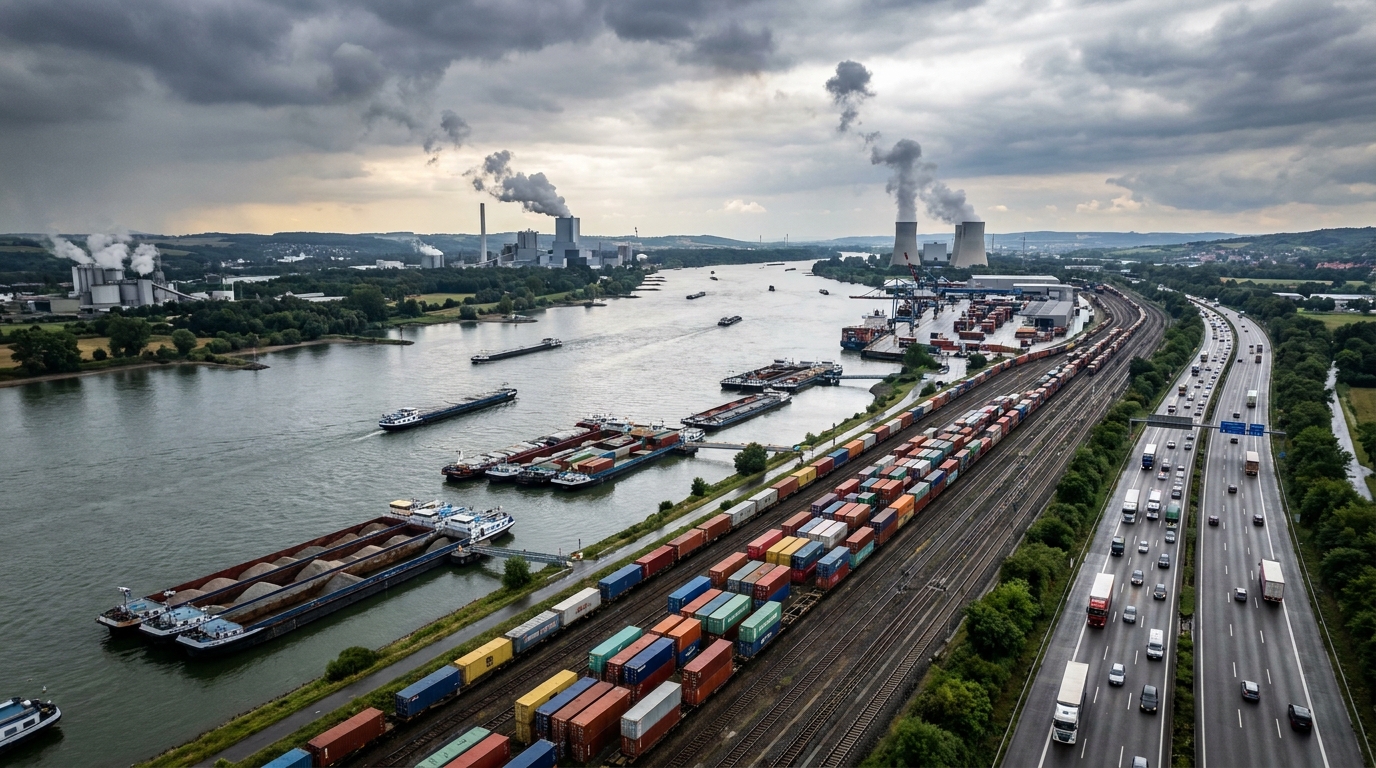
From July 10 to December 12, 2026, one of the key rail freight corridors in Europe – the right-bank railway route along the Rhine, called Rheinschiene – will be completely closed to traffic. Deutsche Bahn's decision to carry out a thorough modernisation of the infrastructure (German: General renovation) on this section means a disruption of over five months in the operation of a key segment of the Genoa-Rotterdam corridor. The European logistics industry is facing an unprecedented operational and financial challenge, and the effects of the closure will be felt not only by the TSL sector but also by the entire industrial ecosystem of the continent.
Rheinschiene – more than just a local railway line
To fully understand the scale of the problem, it's important to appreciate the strategic importance of the section being closed. The railway line along the right bank of the Rhine isn't just a regional passenger connection; it forms the backbone of one of the world's busiest freight corridors. Genoa–Rotterdam Corridor connects the Mediterranean port basins (primarily the Italian port of Genoa) with the largest logistics hubs of Northern Europe, including the port of Rotterdam – the largest port on the continent.
Dozens of freight trains travel this route daily, carrying chemical raw materials, plastics, automotive components, consumer goods, and intermodal goods from around the world. One need only look at the Port of Rotterdam's transshipment volumes—over 470 million tons of cargo annually—to understand just how crucial this artery is to the European economy. The complete suspension of rail traffic on this section for over five months isn't a disruption—it's a structural shock to the North-South supply chains.
Operational maze: detours, congestion, delays
From a transport operations management perspective, the closure of the Rheinschiene railway requires immediate route reorganization by carriers and freight forwarders. The problem is that alternative rail connections in this region of Europe are already operating at their capacity limits. Diverting additional freight trains to the left bank of the Rhine or alternative Central European corridors will immediately have a knock-on effect in the form of delays, schedule conflicts, and limited traction availability.
An additional factor complicating the situation in rail transport is heterogeneity of technical systems in Europe. International movementrodorequires rolling stock compatible with different electrical power supply standards (15 kV AC in Germany, 25 kV AC in France, 3 kV DC in Italy) and different rail traffic control systems. Each detour through a different rail network means additional time for locomotive changes, customs clearance, or technical documentation, drastically extending the overall transit time.
The consequence of the longer journey times is reduced rolling stock turnover. Wagons and locomotives that previously operated one trip per week between Genoa and Rotterdam will take up to twice as long to cover the same distance under detour conditions. In practice, this means that significantly fewer trips can be made with the same fleet of rolling stock. the effective capacity of the railway market is shrinking, even though the physical number of vehicles remains unchanged.
Alternatives with limitations: a barge and a truck are not enough
Industry experts indicate that the logistics sector will attempt to cushion the effects of the route closure through two main alternatives: inland navigation on the Rhine and road transport. However, both modes of transport can only offer partial support, and these are burdened with serious structural constraints.
Inland navigation: dependence on water levels
The Rhine has served as Western Europe's main transportation artery for centuries, with river barges carrying hundreds of millions of tons of goods annually between Switzerland and the North Sea. However, inland navigation has one critical weakness: dependence on water levelThe Rheinschiene closure falls during the summer months – July, August, and September – which have increasingly brought extreme droughts to Central Europe in recent years.
In the summer of 2022, low water levels on the Rhine caused major disruptions to inland navigation, with barges having to reduce their cargo capacity to a fraction of their normal capacity and some sailings being suspended. If the summer of 2026 brings similar hydrological conditions, inland navigation will not only fail to alleviate congestion following the rail closure, but will itself become another source of disruption.
Road transport: chronic driver shortage
Road transport is theoretically the most flexible alternative – trucks can navigate the road network, avoiding bottlenecks. However, the European road freight transport industry is struggling with chronic shortage of professional driversIndustry estimates indicate a shortage of several hundred thousand drivers across Europe, and the problem is worsening as the working population ages.
Even if driver availability were not an issue, a massive shift of freight from rail to road would immediately result in increased traffic congestion, particularly on the key A3, A5, and A61 motorways in Germany and on the Alpine transit corridors. This, in turn, would translate into higher fuel costs, longer journey times, and higher freight rates for road transport.
Financial implications for the TSL sector
From the point of view of financial risk analysis – an area that constitutes the core of EURODEBT.eu’s activities – the closure of Rheinschiene generates multi-level threats to the operational liquidity of European transport and logistics companies.
A sharp increase in operating costs
Every detour means higher costs. In rail transport, this means higher infrastructure access fees on alternative routes, higher labor costs for drivers and shunting personnel, additional costs for changing traction at technical system boundaries, and higher fuel consumption (in the case of diesel traction on non-electrified sections). The number of cargo damages resulting from additional rolling stock manipulation will also increase, leading to higher compensation payments and more expensive insurance policies.
Contractual penalties and customer disputes
Transport and logistics contracts contain clauses regarding timely deliveries. Delays due to the closure of railway infrastructure are not automatically considered force majeure – this depends on the specific contractual provisions. Many logistics companies may find themselves in a difficult situation when they must prove that they exercised due diligence in organizing transport despite infrastructure limitations known in advance. Contract disputes over contractual penalties for late deliveries could significantly burden the industry in 2026.
Payment backlogs and threats to solvency
The Rheinschiene are particularly vulnerable to the effects of the closure. small and medium-sized enterprises in the TSL sectorThese companies have limited financial buffers and less negotiating power with large customers. A five-month period of increased operating costs, combined with potential payment holdbacks from customers awaiting cargo delivery, could dramatically strain their liquidity.
Market practice is ruthless: customers often withhold payment of invoices until the goods are actually received. If delivery is delayed – for reasons beyond the forwarder's control – the forwarder must still finance current operating costs from its own funds or a working capital loan. With rising interest rates, the cost of such financing is significant. EURODEBT.eu analysts predict that payment delay rates in the TSL sector will deteriorate significantly in the second half of 2026, which will increase credit risk throughout the supply chain.
The broader context: fluctuations in freight rates on the seas
The closure of Rheinschiene is not happening in a vacuum. European logistics are simultaneously grappling with high variability of sea freight rates, which has persisted since the COVID-19 pandemic and has been amplified by disruptions in the Red Sea (restrictions on transit through the Suez Canal) and geopolitical tensions affecting global supply chains.
The combination of unpredictable ocean freight costs and serious disruptions on the land part of the Genoa-Rotterdam corridor creates an extremely unfavorable situation.rodooperational challenge for European freight forwarders. Companies that have previously compensated for low margins in one leg of the transport chain with higher margins in another may suddenly discover that both legs of their supply chain are generating increased costs simultaneously.
Industries particularly vulnerable
The closure of the Rheinschiene will not affect all sectors equally. Based on an analysis of the cargo flow structure along the Genoa-Rotterdam corridor, it is possible to identify sectors particularly vulnerable to disruption:
- Chemical and petrochemical industry: Transporting chemicals requires specialized rolling stock (tank trucks, tank wagons), which is more difficult to redirect to road routes. Delays in the delivery of chemical raw materials can halt production at entire plants.
- Plastics processing: Plastic granulates and semi-finished products are transported in large volumes between ports and production facilities inland. Supply disruptions will disrupt production schedules in this highly integrated industry.
- Automotive: Automakers and component suppliers operate in a just-in-time system, where a delay in the delivery of even a single component can bring the entire assembly line to a halt. Plants located in southern Germany, Austria, and the Czech Republic are particularly vulnerable.
- Retail and e-commerce: Delays in consumer goods deliveries will translate into empty shelves and unfulfilled online orders during the peak fall/winter season, which coincides with the final months of the route closure.
- Mineral and construction raw materials: Bulk bulk goods such as aggregates, cement, and metal ores are primarily transported by rail due to cost constraints. Transferring these volumes to road transport is economically inefficient or even impossible.
Macroeconomic side effects
Logistics disruptions always have an inflationary impact. Higher transportation costs are inevitably passed on to subsequent links in the value chain, until they end up in the prices paid by end consumers.rodoIn a country where European central banks have only just managed to control the wave of inflation after the pandemic, an additional cost impulse from logistics is highly undesirable.
It's also worth paying attention to asymmetric effect: Logistics cost increases are felt immediately, while normalization after maintenance work is completed takes much longer. The market does not automatically return to its pre-disruption state – it takes weeks or months for rail capacity to stabilize, production backlogs to be cleared, and freight rates to return to baseline levels.
Business Risk Perspective: What Should Companies Do Now?
For risk managers and business owners in the TSL and manufacturing sectors, there are several key actions that should be taken now – a few months before the planned closure of Rheinschiene:
- Overview of transport contracts: Clauses regarding on-time delivery, force majeure, and liability for delays should be carefully reviewed. Consider renegotiating or amending contracts based on the foreseeable disruption period (July–December 2026).
- Diversification of logistics providers: Companies that are overly dependent on a single rail operator on the Genoa-Rotterdam corridor should now establish relationships with alternative operators offering road, multimodal or other rail connections.
- Building buffer stocks: Particularly in just-in-time industries, it is worth considering temporarily increasing stocks of key raw materials and components before July 2026 to ensure production continuity during disruptions.
- Monitoring the credibility of logistics partners: Verifying the financial health of key logistics subcontractors is essential. Companies that already show signs of liquidity problems may not survive a five-month period of increased costs. EURODEBT.eu offers comprehensive verification reports that allow you to assess the risk of working with a specific entity in the TSL sector.
- Financial planning: Financial services should model scenarios assuming a 20–40% increase in logistics costs in the analyzed period and an extension of the cash conversion cycle resulting from delays in order fulfillment.
Summary: The logistics industry is entering a zone of turbulence
The closure of the Rheinschiene in the summer of 2026 is one of the largest planned infrastructure disruptions in European logistics in many years. A five-month disruption to the operation of a key segment of the Genoa-Rotterdam corridor, combined with structural constraints on alternative modes of transport, fluctuating sea freight and a chronic driver shortage, creates arodoan exceptionally difficult environment for European logistics companies.
Small and medium-sized companies in the TSL sector are most at risk, as they lack sufficient financial reserves to safely weather the months-long period of increased costs and payment bottlenecks. However, the effects of disruptions will also be felt by manufacturing industries and, ultimately, end consumers, who will pay higher prices for goods transported over longer routes.
For all participants in the European TSL market, the conclusion is clear: the time to prepare is nowCompanies that respond proactively—renegotiating contracts, diversifying supply chains, and verifying the financial health of their logistics partners—will emerge from this period stronger. Those that ignore the looming threat could find themselves in serious trouble as early as the third quarter of 2026.




