
EES paralyzes European ports: Interferry warns ahead of 2026 summer peak
The Interferry association warns that the EU Entry/Exit System (EES) is already causing serious congestion at European ferry ports. The first problems emerged during the long weekends in May — Stena Line and Brittany Ferries report system failures and delays lasting several hours. Without urgent corrective action, the peak of the 2026 summer season could paralyse Europe's key logistics hubs, generating enormous costs for carriers and supply chains.
Interferry, representing the global ferry industry, issued an urgent appeal to European Union institutions and member state governments on June 22, 2026. The organization demands an immediate, pragmatic approach to enforcing the EU Entry/Exit System (EES), warning that without urgent operational adjustments, European ports face a real threat of complete communication and logistical disruption in the summer of 2026.
What is EES and why is the ferry industry sounding the alarm?
The EU Entry/Exit System entered into full force on April 10, 2026. Its primary goal is to digitize and modernize border controls at the European Union's external borders—particularly for third-country nationals (TCNs), i.e., those outside the Schengen area. The new system involves the registration of biometric data, the automatic verification of travel documents, and the tracking of foreigners' duration of stay in the EU.
On paper, the reform sounds rational. In practice, however—especially inrodoferry ports—its implementation revealed serious systemic and organizational gaps. The problem is that when designing the EES, EU legislators took as their reference point the airport model, where passenger flow is relatively uniform and well-organized. Meanwhile, a ferry port presents a completely different operational reality.
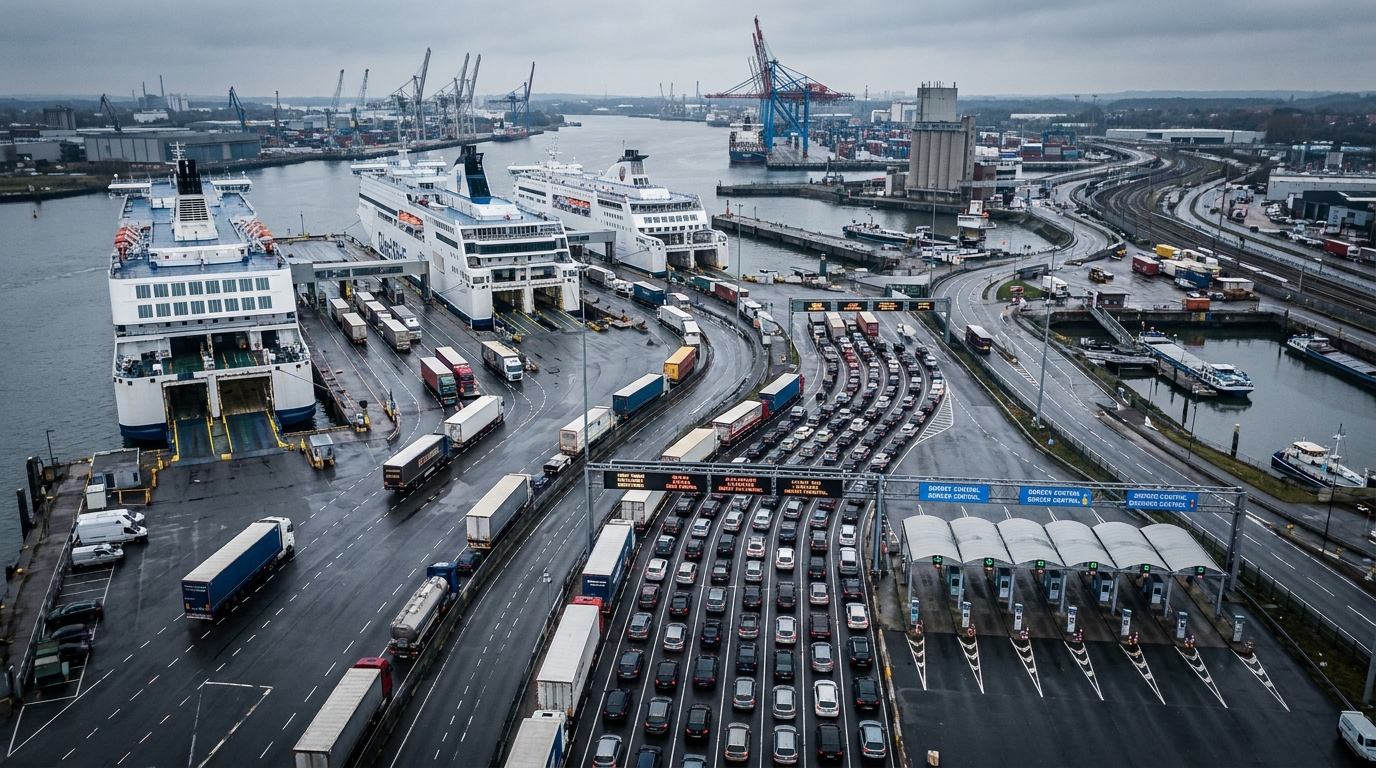
At the same time and through the same check-in gates, all flow simultaneously: foot passengers, families traveling in private cars, tour buses with dozens of tourists, and—most importantly from the perspective of the European economy—tractor-trailers transporting goods in the Ro-Ro (roll-on/roll-off) system. Applying a uniform biometric procedure designed to handle a uniform passenger flow to this complex, multi-channel traffic pattern proves exceptionally problematic in practice.
May weekends as a harbinger of disaster: first hard data
The May long weekend of 2026 became the first serious test of the new system—and the results were unequivocal. European ports reported massive congestion, and ferry operators began officially reporting specific infrastructure and organizational failures.
Stena Line, one of the largest ferry operators in Europe, operating, among others, on the strategic route through the Dutch port of Hook of Holland, reported unacceptable delays in disembarkation and embarkation procedures. The company also reported mass confusion among passengers who cannot distinguish between the EES system and the ETIAS (European Travel Information and Authorisation System)—two separate control mechanisms operating in parallel. What is particularly disturbing is that the flagship mobile application "Travel to Europe", which was supposed to be the digital pillar of the new check-in system and make it easier for travelers to register themselves, remains practically unavailable in most European countries.
Brittany Ferries, which handles connections through French ports, reported complete non-functionality of mobile tablets intended for motor vehicle drivers at check-in desks. French border authorities were effectively forced to collect biometric data only from pedestrian passengers—truck and car drivers remained outside the full procedure. Furthermore, the need to manually create profiles for foreigners who had not previously registered in the system drastically increased border crossing times at each desk.
Johan Roos warns: this is just a prelude to summer chaos
Johan Roos, Interferry's Director of Regulatory Affairs, leaves no doubt about the gravity of the situation. In the organization's official statement, he stated bluntly that the May disruptions were merely a prelude to much more serious problems that will fully materialize as the peak summer season approaches.
The logic is simple: during the long May weekends, ports handled a fraction of typical holiday traffic. In July and August, millions of travelers will flow through European ferry terminals—families with children, tourists from third countries, organized groups—and, at the same time, an uninterrupted flow of freight transport that cannot and should not stop for vacations. The overlap of these two streams, given the current state of digital infrastructure, threatens a scenario where check-in queues will be measured not in minutes but in hours.
Risk to supply chains and logistics operators
For risk managers and owners of transport and logistics companies operating in Europe, this situation has concrete, measurable financial and operational implications. Truck downtime in port queues generates a cascade of negative consequences:
- Increase in operating costs — Every hour a tractor-trailer is idled is a cost to the carrier. With long-hour port blockages, bills skyrocket, directly impacting operating margins.
- Violations of drivers' working time regulations — a driver stuck in a queue at the border exhausts his or her daily or weekly working time limit, which may prevent the driver from reaching his or her destination on time and expose the carrier to sanctions from the control authorities.
- Risk of losing credibility on time — for companies building their market position based on the reliability of deliveries, systematic delays resulting from border problems translate directly into the credibility assessment by customers and trading partners.
- Contractual penalties for delays — particularly acute in the case of deliveries of time-sensitive goods: fresh and frozen food, pharmaceutical products, components for production lines operating in a just-in-time system.
- Supply chain disruptions — The disruption at key port hubs (Hook van Holland, Calais, Harwich, Dover) has a knock-on effect on the entire European logistics network. Delayed cargo at one point delays transshipment, storage, and distribution across the continent.
It's worth emphasizing that Ro-Ro ferry ports play an absolutely crucial role in European trade. Hundreds of trucks pass through the Hook of Holland alone daily, transporting goods between the UK, the Netherlands, and the rest of the continent. Disrupting this hub isn't just a local operator's problem—it directly impacts the economic interests of entire industries.
What exactly does Interferry propose?
The organization doesn't stop at alarmist messages—it also presents specific demands. Interferry calls for action on two levels:
National Level - Flexibility within existing regulations
The EES legal framework includes provisions allowing Member States to implement flexible enforcement mechanisms in situations of high traffic density or system failures. Interferry urges national governments—especially France, the Netherlands, and other countries with large ferry ports—to actively utilize these possibilities. In practice, this means allowing simplified check-in procedures during peak hours, prioritizing freight traffic, and flexibly managing passenger flows.
EU level - possible suspension of strict biometric requirements
In the event that Member States are unable to ensure a functioning system infrastructure before the peak summer season, Interferry is calling on the EU institutions to consider temporarily suspending the most stringent biometric check-in requirements. This suspension would remain in effect until technology, port logistics, and—equally importantly—traveller awareness reach a level that allows for the system to function smoothly.
The organization also points to the urgent need for a mass information campaign aimed at third-country nationals planning to travel to Europe. Passengers' lack of familiarity with applicable procedures is one of the main factors contributing to longer check-in times—and a problem that can be solved relatively cheaply and quickly, unlike costly and time-consuming IT infrastructure repairs.
Business risk perspective for companies in the TSL industry
The situation surrounding EES implementation is a classic example of regulatory risk materializing operationally. This has led to specific management recommendations for transport and logistics companies operating on routes involving European ferry ports.
First and foremost, it's worth reviewing customer contracts for force majeure clauses and provisions covering delays resulting from border controls—and ensuring they cover regulatory scenarios, not just random events. Companies whose supply chains rely on regular ferry crossings should consider activating contingency plans that include alternative land or rail routes, which may prove more predictable in the event of escalating port problems.
Communication with drivers and dispatchers is also crucial: it's worth providing them with up-to-date information on clearance status at individual ports, and when planning sailing schedules for the 2026 summer season, it's important to factor in a time buffer significantly exceeding current norms. Monitoring communications from ferry operators (Stena Line, Brittany Ferries, DFDS, and others) becomes part of routine risk management, rather than a one-off crisis response.
At a strategic level, it's worth monitoring the EU institutions' response to Interferra's appeals. Any suspension or relaxation of EES requirements for maritime traffic will have a direct impact on logistics planning in the second half of 2026. The EURODESK.eu platform will provide ongoing information on any regulatory changes in this area.
Summary
The implementation of the EU Entry/Exit System at European ferry ports is proceeding in a manner that should raise serious concerns for all participants in the supply chain. Initial system tests during the May long weekend revealed deep-seated technical and organizational problems—the unavailability of key applications, faulty mobile equipment, a lack of traveler preparation, and drastically extended check-in times. With the 2026 summer peak approaching, when millions of tourists and thousands of trucks will pass through European ports, the risk of systemic paralysis is real and serious.
Interferry's message is clear: without a flexible, pragmatic approach to enforcing EES regulations and urgently repairing its digital infrastructure, Europe will face a logistical crisis this summer, the costs of which will be borne by carriers, their customers, and ultimately, consumers across the continent. The time for action is now—not after queues in Hook of Holland and Calais have disrupted European trade for weeks.