

Mandatory Smart Tachograph V2 software update – what are the risks for carriers for non-compliance?
The European Commission has officially confirmed the requirement to update the software of second-generation smart tachographs – this applies to VDO DTCO 4.1 and Stoneridge SE5000-8.1 devices used by transport operators across the EU. The update must be carried out during the next periodic inspection or when the device is first installed in a new vehicle. Failure to comply with this requirement exposes transport companies to severe financial penalties, vehicle immobilisation, and in extreme cases – loss of their transport licence and a risk to their financial liquidity.
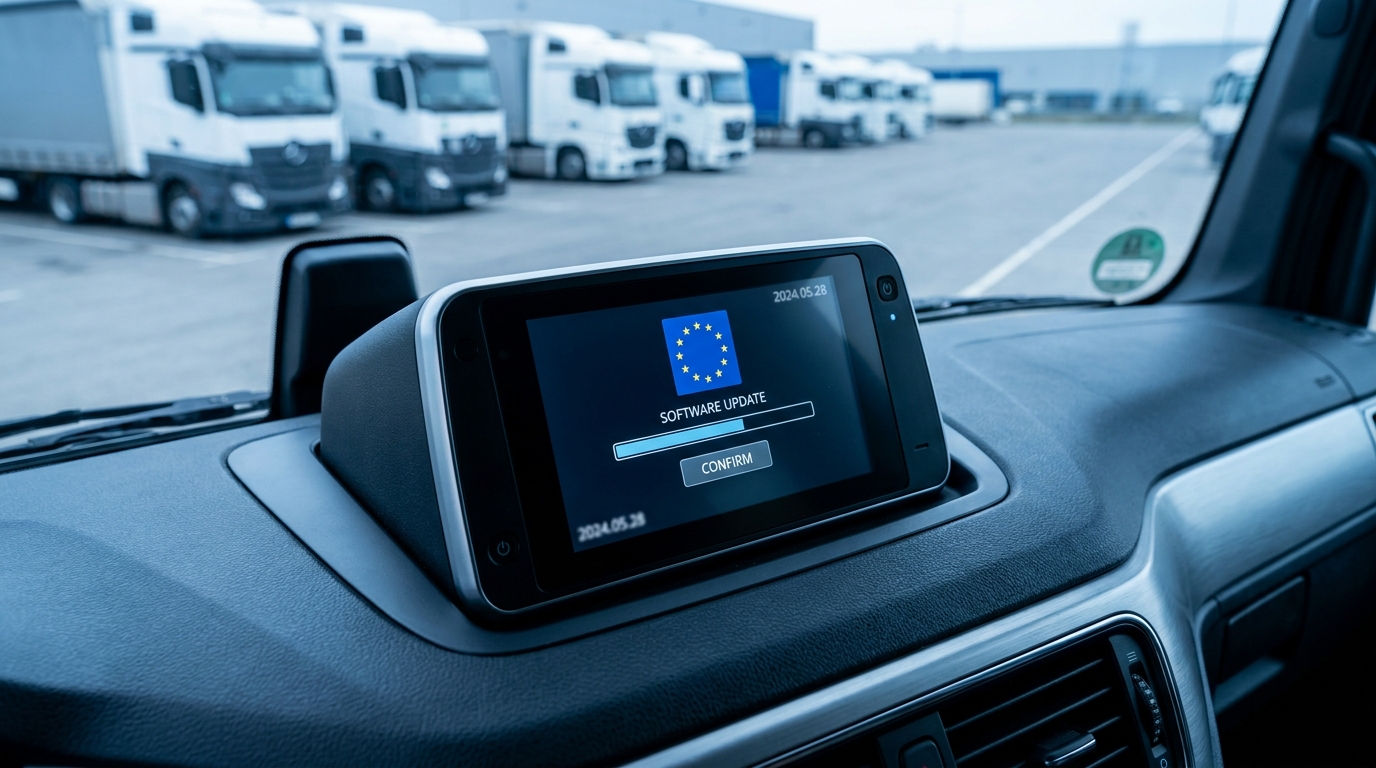
The European Commission, acting through its Joint Research Centre (JRC), has issued a binding declaration requiring all European road hauliers to update the software in their second-generation smart tachographs. This requirement primarily applies to the two most widely used recording equipment models on the market – Continental's VDO DTCO 4.1 and Stoneridge's SE5000-8.1. The deadline for this requirement is linked to the schedule of mandatory periodic tachograph inspections or the initial installation of the device in a new vehicle. While at first glance this requirement may seem like a mere technical formality, its legal, operational, and financial implications for the transport, forwarding, and logistics industry are significant and require immediate action from fleet managers.
Smart tachograph V2 – the foundation of the Mobility Package
To understand the importance of this requirement, it's worth recalling the regulatory context in which second-generation smart tachographs operate. They are a key element of the Mobility Package—a comprehensive EU set of regulations aimed at fundamentally reforming the road transport sector in Europe. The package's main goals include improving working conditions for professional drivers, increasing transparency in the recording of driving time, breaks, and rest periods, and eliminating unfair market practices known as social dumping.
V2 smart tachographs stand out from previous generations with several advanced technological features. Primarily, they are equipped with satellite signal reception modules (GNSS), including signals from the European Galileo navigation system, enabling automatic and precise recording of border crossings. This is particularly important in the context of enforcing cabotage regulations and posted drivers. Furthermore, these devices support DSRC (Dedicated Short-Range Communication) technology, allowing enforcement authorities to remotely and wirelessly read tachograph data directly from a passing vehicle—without having to stop it.
The implementation of V2 tachographs was gradual, primarily affecting newly registered vehicles. Today, these devices are already widely used in European transport fleets, and their proper functioning is the basis for the legality of transport operations within the European Union.
What is a mandatory update and what does it involve?
The European Commission's decision to introduce a mandatory software update is not an impulsive action – it results from a systematic process of verification and improvement of security systems, which the JRC conducts in close cooperation with manufacturers of certified recording devices.
The system patch being implemented addresses several key technical goals:
- Elimination of identified security gaps – Any software, regardless of its level of sophistication, may contain vulnerabilities discovered only after its implementation. The update closes known vulnerabilities that could potentially be used to manipulate data recorded by the tachograph.
- Improvement of satellite signal verification algorithms – The precision and reliability of border crossing detection is directly dependent on the quality of the software supporting the GNSS module. The new software version optimizes these processes, reducing the risk of incorrect registrations or gaps in records.
- Ensuring full compatibility with current driver cards and company cards – the tachograph card market is dynamic, and subsequent generations of cards may require updated drivers and communication protocols in the device itself.
- Adaptation to current EU certification requirements – a device with outdated software may no longer meet the formal approval criteria, which may result in serious legal consequences.
Who exactly is covered by this requirement? Every road haulier operating vehicles equipped with VDO DTCO 4.1 or Stoneridge SE5000-8.1 tachographs in their fleet is required to update their software to the latest version, approved by the European Commission. The update must be performed by an authorized workshop with the appropriate certification for tachograph servicing and calibration.
Schedule – when and how to do it?
The European Commission has decided on a solution to prevent hundreds of thousands of vehicles from simultaneously arriving at tachograph workshops across Europe. The software update requirement is linked to the schedule of existing, mandatory service procedures:
- At the next mandatory periodic inspection of the tachograph – These inspections are typically performed every two years. If your vehicle is close to its due date, a software update should be included in the scope of work performed during this inspection.
- When installing a tachograph for the first time in a newly registered vehicle – Any new device installed in a vehicle must have the latest software version. Truck dealers and assembly shops should ensure that delivered devices meet this requirement.
This solution is beneficial from a logistical perspective, but it should not be interpreted as permission to postpone the matter. Fleet managers should review the inspection dates for all vehicles equipped with the above-mentioned tachograph models now and ensure that authorized workshops in their region are prepared to perform the update. In some European countries, the number of workshops with the appropriate certifications is limited, which can lead to problems with availability of appointments.
Operational and legal risks – what are the consequences of not updating?
This aspect of the topic is particularly important for EURODEBT.eu, as it directly impacts the assessment of the operational and financial stability of transport companies. The consequences of non-compliance with the tachograph software update requirement are multifaceted and can have far-reaching consequences.
Financial penalties imposed by inspection services
European authorities responsible for road transport enforcement – the Polish Road Transport Inspectorate (ITD), the German Federal Office for Logistics and Mobility (BALM), the French DREAL, and the Irish RSA – consider tachographs with outdated, non-compliant software to be defective devices. This violation is categorized similarly to operating a faulty tachograph or manipulating recording data. Depending on the national regulations of individual member states, financial penalties can range from several thousand to even several dozen thousand euros per vehicle. For a fleet of several dozen or several hundred vehicles, the cumulative liabilities resulting from administrative penalties can pose a serious threat to a company's financial liquidity.
Vehicle immobilization
Road transport inspectors in many EU countries have the authority to immobilize a vehicle if they detect serious tachograph malfunctions. A vehicle with outdated software may be impounded until the fault is repaired, generating direct operational losses: towing costs, vehicle storage fees, contractual penalties for missed delivery dates, and driver accommodation costs.
Invalidity of working time records
A tachograph's non-compliance with applicable technical regulations may result in enforcement authorities deeming the data recorded by the device regarding driver driving and rest times unreliable or invalid. This means that the transport company is unable to prove proper compliance with driver working time regulations, which in turn opens the door to further sanctions – this time for violations of driving time standards.
Threat to transport license and good reputation
The most serious, though not always immediate, consequence is the risk of losing a transport license. Licensing authorities in individual Member States maintain a register of infringements attributed to a specific carrier. Accumulating infringements – especially in the category concerning recording equipment – may lead to the initiation of proceedings regarding compliance with the requirement of good repute by road transport operators. Loss of good repute is equivalent to the withdrawal of the license and, de facto, exclusion of the operator from the market.
Financial perspective – impact on liquidity and creditworthiness
From a business risk assessment perspective, negligence in tachograph compliance can quickly escalate into financial problems. Transport companies typically operate on relatively low margins, and unexpected administrative penalties, combined with downtime costs and potential contractual penalties, can shake the balance sheet of even a well-managed enterprise.
It's worth noting that the costs of software updates and mandatory calibration at an authorized service center, while an additional budgetary burden—particularly noticeable in large fleets—are incomparably lower than the potential penalties. Investing in timely updates is therefore not only a legal obligation but, above all, a rational economic decision.
Entities financing the operations of transport companies – banks, leasing companies, factoring companies, and debt collection agencies – should consider the fleet's tachograph compliance status as one element of their risk assessment of their TSL client portfolio. Companies that fail to demonstrate a proactive approach to meeting regulatory requirements in an area as fundamental as tachographs may signal a broader problem with their compliance management culture, which is a significant indicator of credit and debt collection risk.
Cybersecurity as an additional dimension of updating
It's worth emphasizing another, often underestimated, aspect of this requirement. Second-generation tachographs are advanced digital devices that process sensitive data and communicate with external systems via wireless technology. With the growing number of cyberattacks targeting transport infrastructure, regular software updates are becoming a key element of digital security.
Outdated tachograph software may contain vulnerabilities that, in theory, could be exploited to unauthorizedly access the data recorded by the device. Manipulating tachograph data is a serious crime, but the mere risk of such manipulation resulting from neglected updates may be considered by enforcement authorities as a lack of due diligence on the carrier's part. Therefore, having a certified, up-to-date software version is not only a formal requirement but also a tangible safeguard for the integrity of the company's data.
Practical steps for fleet managers
Taking the above into account, we recommend the following actions:
- Instant fleet audit – Identify all vehicles equipped with VDO DTCO 4.1 and Stoneridge SE5000-8.1 tachographs and check the currently installed software version in each of these devices.
- Verification of inspection schedules – compile a list of the upcoming mandatory periodic inspection dates for all vehicles subject to the update requirement. It is during these inspections that the update should be performed.
- Prior contact with authorized service centers – Don't wait until the last minute. Contact certified tachograph workshops now to book suitable dates. For large fleets, it may be necessary to spread the service across several locations and over several weeks.
- Documentation – Ensure that each update is properly documented. Calibration and update reports provide proof of compliance in the event of a roadside inspection or administrative proceeding.
- Driver and dispatcher training – Inform your drivers about what a tachograph software update is and why it's mandatory. An informed driver is the first line of defense against problems during a roadside inspection.
- Monitoring regulations – Designate a person within your company responsible for monitoring current regulatory requirements for tachographs. Regulations in this area are evolving, and further updates may be required in the future.
Summary – Risk Assessment from the EURODEBT.eu Perspective
The mandatory software update for Smart Tachograph V2 smart tachographs is further evidence of the European Commission's consistent and uncompromising enforcement of technological standards in road transport. This decision is consistent with the long-term strategy of digitizing and tightening the driver working time monitoring system, constituting an integral element of achieving the goals of the Mobility Package.
For transport companies across Europe – and especially Polish carriers, which constitute one of the largest segments of the EU road transport market – this requirement means acting now. A reactive approach, which involves waiting for a roadside inspection and only then considering an update, is an extremely risky and costly strategy.
From the perspective of business partners in the TSL industry, the technical compliance status of a fleet—including tachograph software up-to-dateness—is becoming an increasingly important indicator of the quality of company management. Companies that prioritize regulatory compliance demonstrate a higher level of operational maturity and represent a more secure trading partner and client to financial institutions. Those that neglect their obligations in this area generate unpredictable financial risks—both for themselves and their contractors.
We recommend that risk managers and credit analysts monitoring client portfolios in the TSL sector consider tachograph compliance as one of the due diligence criteria when assessing the operational condition and credibility of transport companies.rodoIn the face of increasing regulatory requirements, the ability to manage technical compliance is becoming a sustainable competitive advantage – and a key determinant of the long-term financial stability of transport companies.