

More than 800 transport companies disappeared from the Polish market in Q1 2026 – a silent crisis that does not show up in the records
In the first quarter of 2026, more than 800 transport companies holding a Community licence left the Polish market on a net basis — the rate of closures is four times higher than in previous years. The phenomenon of “quietly exiting the market” means that traditional debtor registers and National Court Register (KRS) databases do not reflect the true scale of the crisis. For risk managers, monitoring transport licence activity, rather than just the formal status of the business, is becoming crucial. Without systemic regulatory changes — excise duty refunds, shorter payment terms and VAT reform — the trend may continue in subsequent quarters.
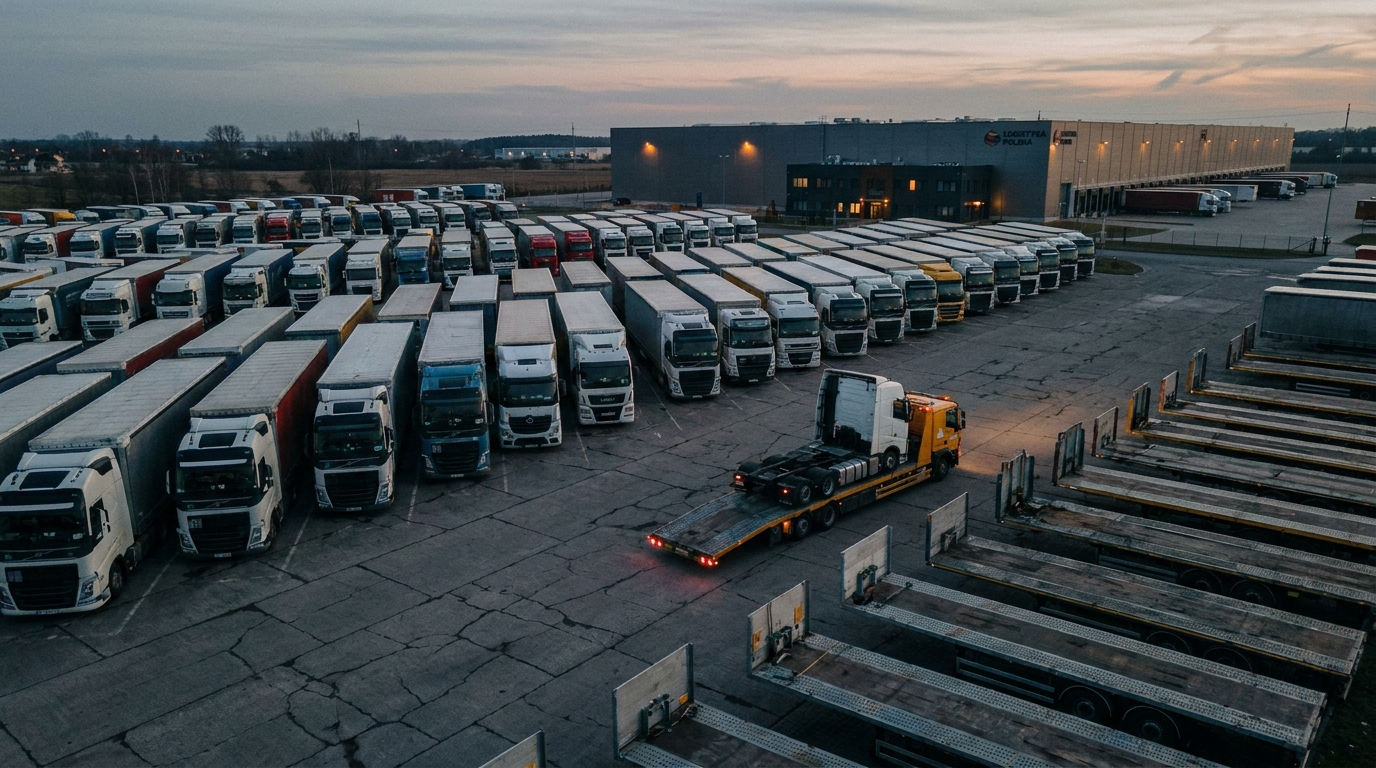
In just three months – from January to March 2026 – the Polish road transport sector has lost a net number of over 800 companies with a Community license. This is not an ordinary market correction. Data collected by TruckFocus.pl analysts and the International Association ofrodoRoad Carriers (ZMPD) indicate a structural breakdown, the scale of which is comparable to the effects of multi-year crises. Moreover, traditional tools for verifying contractors — KRS registers, debtor databases, bankruptcy reports — largely contribute to this breakdown. they do not registerFor risk managers and logistics company owners, this means one thing: existing due diligence procedures require urgent updating.
Numbers that speak for themselves
In the first quarter of 2026, a total of over 1700 Community licences authorising the performance of internationalrodoroad transport. During the same period, approximately 900 new entities entered the market. The net balance was the loss of over 800 companies—and that was in just one quarter.
Even more alarming is the rate of complete business closures. A total of 1234 transport companies ceased operations during the period under review. For comparison, a figure close to this figure has been recorded for the entire year so far. This means that the pace of company closures has accelerated four times faster than historical norms.
Polish road transport has been building a leading position in Europe for decades. Polish companies serve approximately one quarter of all cabotage and cross-border road transport in the EUThis potential is being systematically dismantled today—not by a single sudden catastrophe, but by the accumulation of several crisis-inducing factors simultaneously.
“Quiet Exit” – A Phenomenon That Confuses Risk Analysts
A key observation from the latest data is the changing model by which Polish transport companies are going out of business. Classic bankruptcy—with a court filing, an entry in the Central Economic Information Center (COIG), and a visible record in the registers—is becoming rare. Instead, a phenomenon known as "quiet exit from the market".
The mechanism is as follows: a carrier losing financial liquidity doesn't wait for a formal bankruptcy declaration. Instead, it takes a series of preemptive measures: it returns vehicles (tractors, semi-trailers) to the lessor, terminates existing transport licenses, settles—or not—current liabilities, and closes the company in a simplified manner. The entire process occurs outside the radar of traditional debtor registers.
The practical consequences for business partners are serious:
- The company can be active in the National Court Register, and at the same time its Community licence may already be expired or suspended - which means the effective cessation of operational activities.
- No entry in the register of debtors is not synonymous with solvency - the entrepreneur could simply have given up the business before he had time to accumulate formal liabilities.
- Verification in BIK, KRD or ERIF may not reveal any irregularities for an entity that de facto no longer functions as an active carrier.
The conclusion is clear: monitoring the status of the transport license becomes a more important indicator of the company's health than its status in the register of entrepreneursFor entities commissioning transport, financing fleets, or providing trade credit in this industry, the lack of an active license should be a top priority alarm.
Why do small transport companies fail faster than large ones?
The current crisis is disproportionately impacting micro and small transport enterprises—companies with one, two, or at most several vehicle combinations. These constitute the backbone of the Polish TSL industry, but are also most vulnerable to any economic turbulence.
The difference between a small and a large carrier is primarily economies of scale and negotiating powerLarge fleet companies can count on:
- Preferential rates on fleet cards when purchasing fuel,
- Wholesale prices for tires and spare parts,
- Dedicated, negotiated insurance tariffs (OC, OCP, AC),
- Access to long-term contracts with guaranteed freight rates,
- Ability to absorb temporary losses thanks to a diversified client portfolio.
Small businesses don't have any of these advantages. Their cost structure, however, is almost identical to that of the giants— permanent financial burdens are largely independent of the economic situationVehicle leasing payments, carrier liability insurance premiums, driver salaries with a full social package, licensing fees and professional competence certificates – all these costs are constantly being incurred, regardless of whether the tractor is parked or traveling loaded across Europe.
In this context, the March fuel shock proved particularly devastating. The blockade of the Strait of Hormuz in March 2026 triggered a massive increase in crude oil prices and rapidly impacted diesel prices at European gas stations. At its peak, the increase in fuel costs compared to the same period of the previous year exceeded 40 percentFor a small carrier, fuel typically accounts for 30 to 40 percent of total operating costs. A 40 percent jump in this figure meant that the operating margin—typically measured in Poland in the 2-5 percent range—almost completely evaporated or became negative.
Liquidity Cannibalization: How Freight Exchanges Are Destroying Carriers
The cost crisis would be easier to weather were it not for the accompanying revenue dysfunction. The freight rate-setting mechanism in Poland—dominated by freight exchanges and freight forwarding intermediaries—currently works to the detriment of small carriers in a systematic manner.
The logic is perverse: the deeper the crisis and the more companies are on the verge of bankruptcy, the stronger the pressure to lower rates. A carrier knowing they have to pay a leasing installment in a week is willing to accept a job below their cost—just to generate some revenue. In industry jargon, this phenomenon is called "liquidity cannibalization"Companies are literally devouring their own financial resources, operating at a loss just to postpone the inevitable liquidation.
In addition, there's the issue of payment deadlines, which has been the Achilles' heel of Polish transport for years. According to data presented by ZMPD, carriers on the domestic market and in settlements with domestic forwarders are waiting for payment for services provided. up to 120 daysFour months from service completion to funds being deposited into the account is a timeframe that no company with limited working capital can sustain.
A separate issue is the conflict between these deadlines and tax obligations. Polish VAT regulations require the invoice issuer to pay the tax due by the date of issuance of the document—not the date of actual payment. This means that the carrier must finance VAT out of your own pocket long before they receive payment for the service. With margins of several percent and hundreds of thousands of zlotys in monthly turnover, this is a mechanism with real, destructive power.
What is the industry calling for and what changes could reverse the trend?
ŚrodoThe industry is not remaining passive. ZMPD, the Transport and Logistics Employers' Association of Poland (TLP), and other carrier organizations have prepared specific packages of demands that, if implemented, could stop the avalanche of liquidations.
The most important proposals include:
- Partial refund of excise duty on diesel fuel for road carriers - a mechanism functioning successfully in Germany, France and Belgium, not present in the Polish tax system so far.
- Statutory limitation of payment deadlines in transport up to a maximum of 30 days - a solution that would require an amendment to the Act on payment terms in commercial transactions, taking into account the specificity of the TSL sector.
- Modification of VAT regulations towards making the tax liability dependent on the date of actual payment, rather than the date of invoice issuance - analogous to the so-called cash method.
- Joint and several liability of forwarders for unpaid debts to subcontractors-carriers, which would force intermediaries to more carefully verify their own contractors.
- Temporary reduction of social security contributions for drivers performing international transportrodowe, which would reduce one of the largest components of fixed costs for small businesses.
However, the effectiveness of these demands depends on the pace of legislative processes – and these rarely keep pace with the dynamics of market crises.
Macroeconomic dimension of the crisis: who will fill the gap left by Polish carriers?
The scale of the problem goes far beyond the balance sheets of individual companies. Road transport in Poland generates an estimated 6–7 percent of gross domestic product and is the direct employer of several hundred thousand professional drivers. Its destabilization has multiplier effects on the entire economy—from industry to retail.
From the perspective of the European transport market, the situation has another dimension. The gap left by disappearing Polish companies will not remain empty—it will be immediately filled by carriers from countries with more favorable regulatory conditions and a lower cost base. Companies that are at the forefront here are Lithuanian, Romanian and Spanish, which have been successfully competing with Polish transport in Western European markets for years. The crisis in the Polish TSL sector may therefore, paradoxically, accelerate the erosion of the dominant position of Polish carriers in Europe—a position built over three decades.
For large Polish logistics operators, the liquidation of small entities brings short-term benefits: less competition means greater negotiating power and potentially higher rates. However, in the long term, the loss of thousands of specialized micro-carriers means less flexibility for the entire system and higher operational risks for supply chains based on subcontracting.
Business Risk Perspective: What Should Every Risk Manager Do Today?
For entities operating in the TSL industry—transport clients, fleet leasing companies, insurers, banks, and fuel suppliers—the situation described requires a specific and urgent procedural response. Existing contractor verification standards are facing a crisis of "quiet market exit." structurally insufficient.
Practical recommendations for risk and compliance departments include:
- Verification of the activity of the community license as a mandatory element of every onboarding process for a contractor from the TSL industry - above the National Court Registers and debtor databases.
- Regular monitoring of license status already established business partners – no less than once a quarter, in the current market environment even monthly.
- Implementation of early warning indicators based on the timely settlement of current commercial liabilities - delays in invoice payments by 15-30 days should automatically trigger a verification procedure.
- Analysis of cost structure and fuel exposure when assessing the creditworthiness of transport companies – especially in the context of oil price volatility on global markets.
- Vehicle portfolio verification in the context of leasing agreements - handing over vehicles to the lessor is one of the first signals of the approaching closure of the business.
Traditional bankruptcy indicators – the number of restructuring proceedings, entries to the COIG, court judgments – are in the current situation of Polish transport significantly less reliable than ever beforeThe actual loss of active market players is many times greater than official bankruptcy statistics would suggest. Risk managers who rely solely on these sources make decisions based on data that does not reflect reality.
Summary
The first quarter of 2026 has set a new, alarming benchmark for the Polish transportation market. Over 800 companies have disappeared from the market at an unprecedented rate, and the mechanism by which they disappear—silent, imperceptible to records, and ahead of formal bankruptcy procedures—means the scale of the problem is actually greater than any official statistics indicate.
The industry faces a dramatic combination of unfavorable factors: structural imbalances in freight rates, abnormal payment deadlines, tax burdens that are inappropriate for the sector's business model, and external cost shocks, such as the March spike in fuel prices. Without systemic interventions—excise tax refunds, shortened payment deadlines, and reform of VAT settlement rules—the pace of liquidation may continue or even accelerate in the coming quarters.
For the entire business ecosystem collaborating with the TSL industry, this is a signal for a fundamental review of risk verification and monitoring procedures.rodoa place where a company can cease to exist operationally long before any trace appears in public records, prevention and continuous monitoring replace reactive verification as a basic instrument for counterparty risk management.




