
PLN 1.32 billion in debts of Polish carriers: an alarm for European logistics in 2026
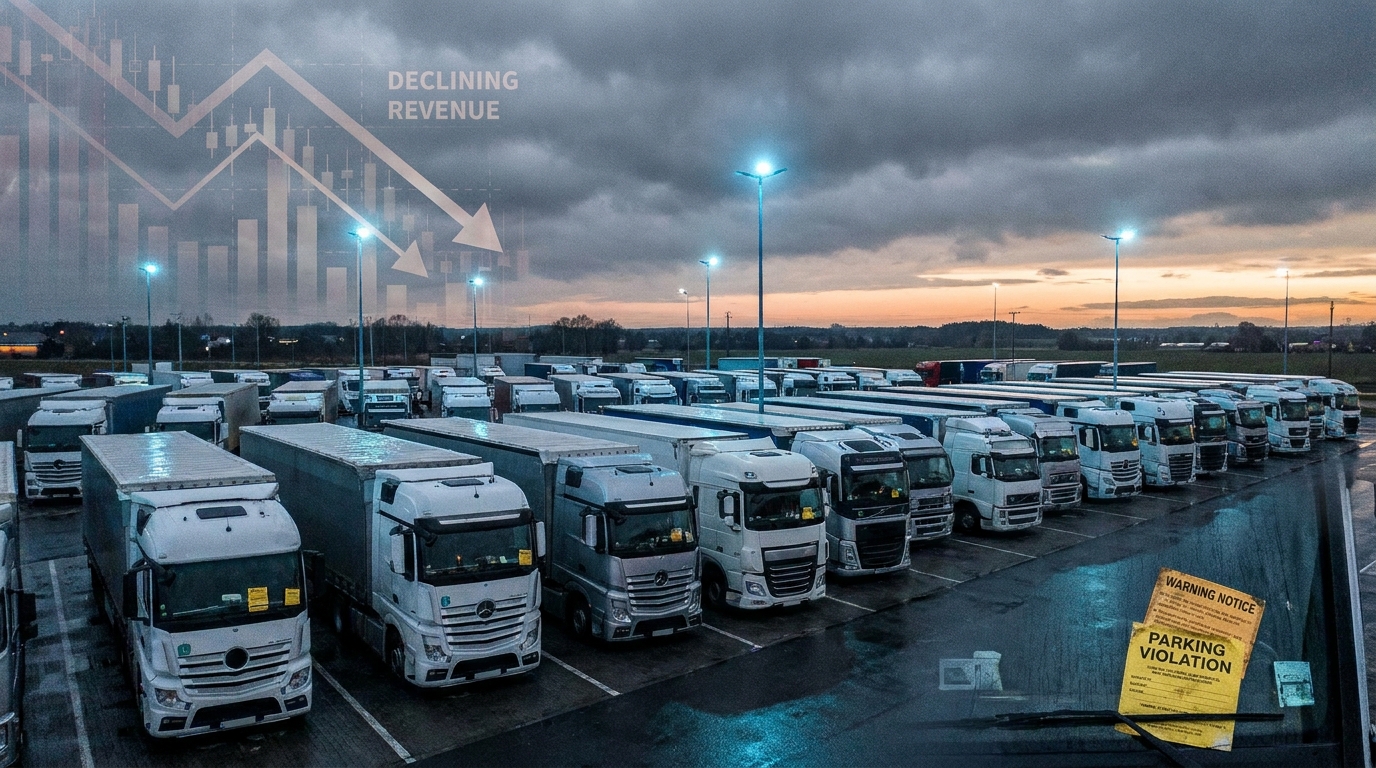
Poland's transport, freight forwarding and logistics (TSL) industry is facing a serious financial crisis. Data published in November 2026 by Krajowy Rejestr Długów (KRD) reveal that the total debt of the entire TSL sector has exceeded 1.66 billion zlotys, of which as much as 1.32 billion zlotys is owed by road freight companies. The number of entities listed in the register with overdue liabilities has approached 24,000. These figures should immediately alert every risk manager working with Polish carriers — both at home and abroad.
Record debt: figures that speak for themselves
The scale of the problem leaves no room for doubt. Of the nearly 24,000 indebted companies across the TSL sector, more than 23,000 are road carriers alone — the foundation of Polish and European land logistics. The 1.32 billion zlotys owed by this group alone is an alarming record and means that the liquidity crisis is no longer a marginal phenomenon. This is a systemic problem affecting large numbers of companies of various sizes, although — importantly — it is very clearly concentrated among the smallest market participants.
It is worth noting that KRD data record only liabilities that are overdue and have been reported to the register. The actual scale of financial difficulties in the sector may be much greater — some debts remain undisclosed, and many companies are stuck in a grey area of indebtedness, juggling successive invoices without formally entering a debt collection spiral.
Who has suffered most? A profile of the indebted carrier
The data clearly show that the burden of the crisis falls disproportionately on sole proprietors and microenterprises with fleets of one to a few vehicles. These businesses are the most financially vulnerable: they lack the reserves needed to withstand payment delays, have limited access to bank credit and often rely on one or a few key contracts — the loss or disruption of which means immediate difficulties meeting their obligations.
Paradoxically, this market segment is also a key operational component for large logistics operators and integrators, which readily subcontract transport and thereby avoid their own fleet and employment costs. Subcontractors' financial difficulties pose a direct operational risk to their clients — a risk that European logistics companies have underestimated for too long.
Why did the crisis occur? An analysis of the causes
Payment bottlenecks — a ticking time bomb in every contract
One of the main causes of mounting debt is a problem that has plagued the TSL industry for years: extended payment terms. In Polish transport, invoices with 60-day and often 90-day payment terms have become standard. Under normal market conditions this can be tolerated — provided the deadlines are met. In reality, however, the situation is quite different.
Many clients — especially large shippers and logistics operators — treat small carriers as a free source of working capital, delaying payments without consequences. A carrier that has completed a service often waits three, four or even five months for payment. In the meantime, it must pay for fuel, insurance, lease instalments and the driver's wages. The result? Loss of liquidity, recourse to expensive short-term loans or failure to pay its own obligations — directly resulting in entries in KRD.
Operating costs out of control
Alongside payment bottlenecks, Polish carriers face persistent cost pressures. Fuel prices and fleet maintenance costs remain at historically high levels, while freight margins — particularly in standard road transport — are extremely thin. In this situation, even small fluctuations in diesel prices or road tolls can push the profitability of an individual trip below zero.
The absence of appropriate fuel and energy clauses in contracts is particularly damaging. When signing a contract at a fixed freight rate, carriers often assume the entire risk of fluctuations in energy commodity prices — without any mechanism for automatically adjusting their remuneration. When prices rise, they lose money on every kilometre, with neither legal nor negotiating tools to secure swift compensation.
Leasing as a silent cash drain
The third major factor is lease obligations. A substantial share of Poland's road fleet is financed through this instrument. In prosperous times, leasing was a sensible solution, enabling rapid growth without committing companies' own capital. But amid slowing demand for transport services and shrinking margins, fixed lease instalments become an insurmountable burden for many companies. Selling vehicles to escape these obligations means an immediate reduction in operational capacity and loss of contracts — a vicious circle from which many companies cannot escape.
Poland as a pillar of European transport — systemic risk
To properly assess the severity of the crisis, it is necessary to recall the role Polish carriers play in the European market. For many years, Poland has been the undisputed leader in road freight transport in the European Union, handling the largest volume of cabotage and international transport of all member states. Polish trucks dominate routes to Germany, France, the Benelux countries, Scandinavia and Southern Europe.
This means that the financial problems of Polish transport companies are not merely a domestic issue. They are disruptions with a potentially Europe-wide reach. When a significant proportion of carriers lose liquidity and leave the market, European supply chains feel the impact very quickly — through higher freight rates, longer order fulfilment times and capacity shortages in key logistics corridors.
Capacity scenario: what happens if 24,000 companies disappear?
Although the simultaneous mass bankruptcy of all indebted entities is an extreme scenario, even the departure of several thousand microcarriers from the market in a relatively short period would create a significant shortage of transport capacity (a capacity crunch). The effects would be felt directly:
- Higher freight rates — reduced transport supply amid sustained demand inevitably drives up prices, affecting the profitability of shippers and manufacturers.
- Disruptions to component supplies — the automotive, electronics and food industries, which rely on the just-in-time model, are particularly vulnerable to transport delays.
- Pressure on retail — delays in consumer goods deliveries may lead to local shortages across store networks, particularly in the fresh produce segment.
- Market consolidation favouring large players — the crisis eliminates small players, leaving room for large operators that can dictate pricing terms.
Business risk perspective: what does this mean for your company?
For risk managers and owners of logistics companies across Europe, the KRD data from November 2026 should be a signal to immediately review their portfolio of subcontractors and logistics partners. Below we identify the key risk areas requiring urgent analysis:
Counterparty risk and due diligence
Logistics companies that subcontract transport to Polish carriers should immediately verify their financial condition — checking entries in KRD, BIG InfoMonitor and equivalent registers in other countries. A company's presence in a debt register does not necessarily mean imminent bankruptcy, but it is a clear warning sign requiring further analysis. The EURODEBT.eu platform provides tools for quickly verifying Polish and European transport companies specifically in this regard.
Operational continuity risk
Every company that relies on a handful or a dozen or so regular transport subcontractors for its supply chain should diversify its carrier base and — more importantly — have active contingency plans in case a key partner suddenly becomes unavailable. It is also worth considering framework agreements with several carriers with different profiles rather than relying exclusively on one provider.
Reviewing payment policy
For shippers and large logistics operators from Western Europe, it is high time to rethink their payment policies towards subcontractors. Shortening payment terms and eliminating delays is not just a gesture of goodwill — it is an investment in the stability of their own supply chain. Companies that continue to use 90-day payment terms and tolerate missed deadlines will face higher operating costs in the future in the form of sudden rate increases or interruptions to order fulfilment.
What should transport companies themselves do?
Although the perspective of shippers and operators is crucial for EURODEBT.eu readers, it is also worth considering the situation of carriers themselves, who are looking for ways out of the financial crisis:
- Receivables factoring — selling invoices to factoring companies can immediately improve liquidity, eliminating the effects of long payment terms. The cost of factoring, although real, is often lower than the cost of losing operational capacity or having to take out expensive working capital loans.
- Renegotiating contracts with indexation clauses — every new contract should contain mechanisms for automatically adjusting freight rates in the event of significant changes in fuel or energy prices. This is not an excessive demand — it is a standard that protects both parties.
- Fleet consolidation and cost restructuring — companies with excessive lease obligations should consider voluntarily reducing their fleets to the number of vehicles that actually generate enough revenue to cover fixed costs.
- Using mediation and restructuring — Polish law offers restructuring tools that allow debt to be managed in an orderly manner without declaring bankruptcy. Using these tools early is a much better option than waiting for a bailiff's notice.
Systemic risk assessment: very high
The EURODEBT.eu editorial team assesses the current level of systemic risk in Poland's TSL industry as very high. The sector's total debt exceeding 1.66 billion zlotys — alongside the rise in the number of indebted entities to nearly 24,000 — indicates that the crisis is structural rather than cyclical. In other words: a temporary improvement in market conditions will not be enough to restore normality. Deeper changes are needed in business models, contract structures and payment policies throughout the supply chain.
European trade and logistics partners should treat these figures as a serious warning — and act proactively, not reactively. Verifying counterparties, diversifying the carrier base and reviewing commercial terms are measures that, taken today, can protect against costly surprises tomorrow.
EURODEBT.eu will continue to monitor the situation in the Polish and European TSL sector, providing readers with up-to-date data and risk analyses needed to make informed business decisions.