

France excludes road hauliers from fuel subsidies - industry warns of risk of bankruptcies
The French government excluded the road freight transport sector (TRM) from the fourth wave of fuel subsidies, granting support exclusively to farmers, fishers and the construction industry. At the same time, tens of millions of euros owed to carriers from earlier rounds of assistance have not been paid out — in May, not a single company received a penny. Industry organizations such as OTRE, FNTR and Union TLF warn: without urgent government intervention or a meaningful reform of the indexation mechanism, many French SME carriers are on the brink of bankruptcy, threatening the stability of the supply chain across Europe.
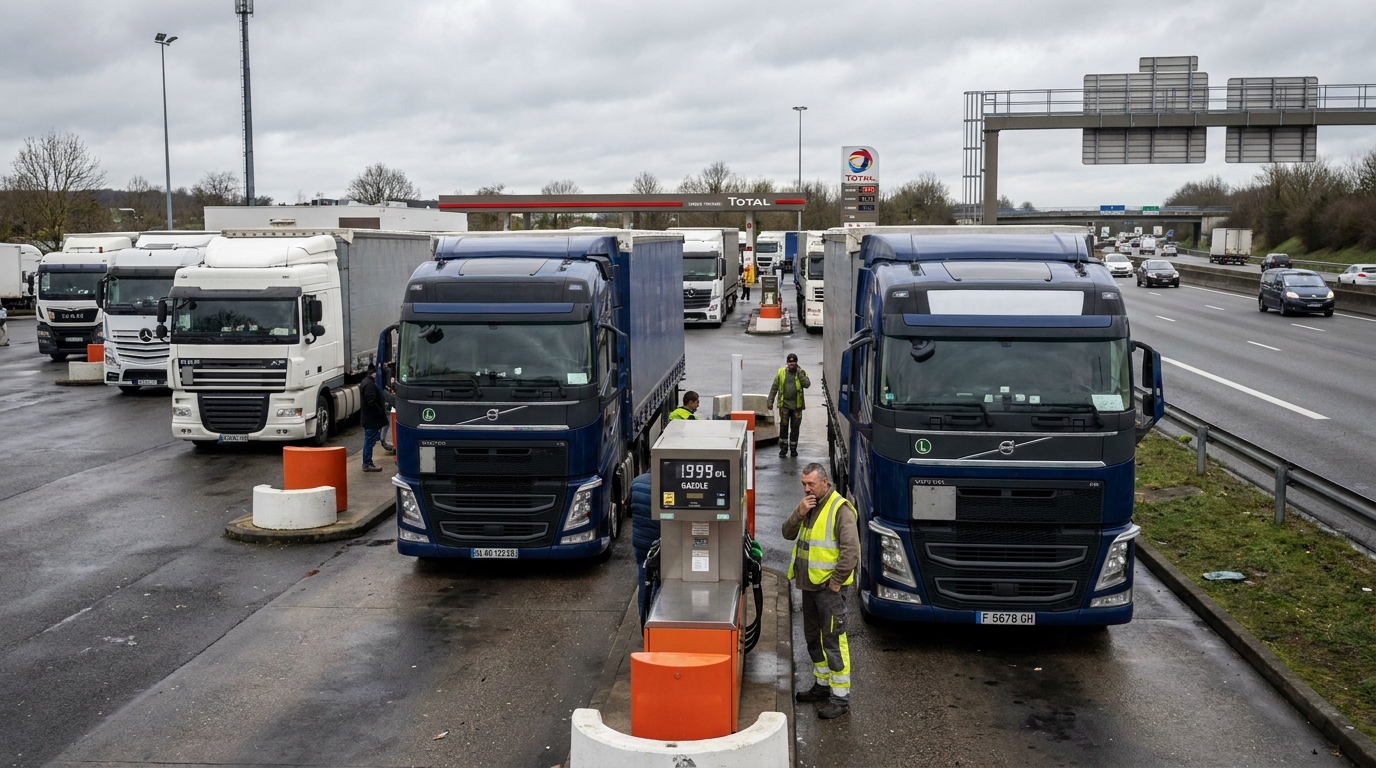
The French government has made a surprising and controversial decision to exclude the road freight transport sector (TRM) from the fourth round of state diesel subsidies. The support, scheduled for September and October, will go exclusively to farmers, fishermen, and construction companies (BTP), leaving thousands of carriers without systemic support at one of the most difficult times for the industry.rodoThe situation in the transport sector is clear: sharp criticism aimed at the government, growing problems with financial liquidity and real fears of a wave of bankruptcies among small and medium-sized logistics enterprises.
A promise that wasn't kept
Just a few weeks ago, government spokeswoman and Energy Minister Maud Bregeon publicly assured that the fourth wave of fuel subsidies would cover all sectors most affected by the ongoing energy crisis—including road transport. However, in a surprise announcement, the government backtracked on these declarations, limiting the group of beneficiaries to three selected industries.
This decision surprised representatives of the transport sector, who were not even informed of the planned change of position before its official announcement. Jean-Marc Rivera, general delegate of OTRE (Organisation des transporteurs routiers européens), openly pointed to the complete lack of social dialogue and consultation with therodocarriers. Two other key industry organizations reacted similarly—FNTR (Fédération nationale des Transports Routiers) and Union TLF—whose representatives did not hide their disappointment and outrage at the way the authorities are conducting fuel policy.
For risk managers and owners of logistics companies operating in France or maintaining business relationships there, the signal is clear: energy policy in this country has become an unpredictable risk factor, and government declarations cannot be the basis for financial planning.
The Government's Argument: Indexation Mechanism - Theory vs. Reality
The official justification for excluding the TRM sector from fuel aid is the existence of a legal mechanism for indexing diesel fuel costs. Under current regulations, road hauliers have the ability to automatically pass on rising fuel costs to their clients and customers. This mechanism was intended to protect transport companies' margins from fluctuating oil prices.
In practice, however, the situation is radically different. Industry experts and organizations representing carriers agree on several key barriers that prevent the effective use of indexation:
- Strong bargaining position for customers — the vast majority of entities on the TRM market are small and medium-sized enterprises that have no real negotiating power in the face of large shippers and distribution networks.
- Threat of losing the contract — in a highly competitive worldrodoIn this area, carriers often prefer to absorb rising costs themselves rather than risk the termination of the contract by a customer who can find a cheaper alternative on the market - especially a foreign one.
- The Complexity of Contract Renegotiation — Enforcing full indexation in existing contracts requires time, legal resources and determination that smaller companies often simply do not have.
- Suboptimal functioning of the mechanism — the very fact that the Ministry of Transport has recently initiated work on simplifying and strengthening the regulations on indexation is a telling signal: the government indirectly admits that the current regulations do not work satisfactorily.
Florence Berthelot of FNTR emphasized that the government's decision is not only overdue but also disconnected from market realities. Companies need immediate and predictable financial stability, not abstract legal mechanisms whose practical effectiveness leaves much to be desired.
Voices from the industry: frustration, appeals and warnings
ReactionrodoThe transport sector's reaction to the government's decision took the form of a coordinated protest by the main industry organizations. Jean-Thomas Schmitt, chairman of the Union TLF, described the treatment of freight transport as the only sector completely deprived of support as absolutely unacceptable. In his statement, he included specific demands addressed to the authorities:
- an immediate moratorium on any new tax and levy increases for the transport sector until the presidential election;
- maintaining the preferential tax regime for B100 fuel, used by some carriers as an alternative to standard diesel fuel;
- suspending plans to introduce regional eco-taxes, which the industry believes constitute an additional, unbearable burden on already tight company budgets.
ŚrodoThe transport sector is making it clear that patience is running thin. Months of struggling to pay previously promised compensation, coupled with the now-announced refusal to pay another round of support, have brought confidence in government declarations to a historic low.
Administrative chaos: earlier waves of aid still not reaching businesses
The problem isn't limited to exclusion from the fourth wave of subsidies. Equally, if not more, serious is the dramatic administrative inefficiency in implementing previously announced support programs. Data collected by industry organizations and specialist portals, including analyses by TRM24, reveal the scale of the problem:
- First wave (April): Of the over 11,000 applications submitted for subsidy, fewer than 7,000 have been processed. This means that almost 40% of eligible carriers have not yet received the promised funds for this period.
- Second wave (May): The situation is even more alarming. Despite nearly 10,000 complete applications submitted, literally not a single euro has been deposited into companies' accounts. The funds for May remain unpaid in their entirety.
- Third wave (June, July, August): The program does not even have a formal legal basis - there are no implementing regulations and relevant decrees, which completely blocks the possibility of submitting applications and paying out funds.
This picture of administrative dysfunction is shocking given the current financial needs of carriers. Transport companies cannot afford to defer fuel payments—tanks must be filled daily and bills paid promptly, no matter how slowly the bureaucracy works. As a result, many companies are effectively financing their operations from their own reserves or loans, waiting for money that is formally owed to them but is practically unavailable.
The European Context: Unfair Competition and Threatened Liquidity
The situation of French carriers is particularly acute in the context of the European transport market, which has for years been characterized by strong competitive pressure from companies from countries with lower labor costs and more favorable tax systems. Polish, Romanian, and Bulgarian transport companies have been successfully competing with Western carriers for years thanks to their lower operating costs.
For logistics companies from Central and Eastern Europe, which regularly compete with French entities for loading contracts, the current situation could present a window of opportunity. The weakened financial position of French transport SMEs could lead to:
- reductions in freight rates by companies struggling to survive (which may be beneficial for shippers in the short term, but destabilizes the market in the long term);
- takeover of market shares by foreign carriers operating on the basis of cabotage and other forms of cross-border activities;
- disruptions to the supply chain in France in the event of bankruptcy of key local operators.
From the perspective of logistics companies with business partners, subcontractors or contractors in France – especially in the SME segment – the current situation should be treated as a warning signal requiring a review of the risk portfolio.
Risk assessment for business partners operating in France
For risk managers and owners of logistics companies in Poland and other Central European countries cooperating with French carriers or having exposure to the local market, the current situation raises a number of practical questions and implications.
What should you pay special attention to?
- Financial liquidity of partners in France — Transport companies awaiting outstanding government compensation payments while simultaneously incurring high fuel costs are particularly vulnerable to problems settling their own liabilities. It's worth verifying the financial standing of key subcontractors and partners.
- Risk of supply disruptions — a possible wave of bankruptcies among French transport SMEs may lead to problems with the execution of orders and contracts, especially in the local and regional distribution segment.
- Pressure on freight rates — companies struggling to survive may offer unrealistically low rates, which on the one hand is attractive in the short term, but on the other carries the risk of a sudden termination of cooperation or failure to meet contractual obligations.
- Unpredictability of the regulatory environment — The government’s abrupt change of stance on fuel subsidies, coupled with the chaos in the payment of earlier compensation, indicates an unstable regulatory environment that complicates long-term financial and contractual planning.
Recommended actions
- Review receivables and liabilities owed to French transport partners for the risk of delays or insolvency.
- Update contract clauses on force majeure and extraordinary events to include supply chain disruption scenarios resulting from subcontractor financial problems.
- Monitor industry announcements from France – particularly from OTRE, FNTR and Union TLF – as early indicators of crisis escalation or easing.
- Consider diversifying your subcontractor portfolio for companies that are heavily dependent on one or more French logistics operators.
A systemic perspective: what does this crisis say about the state of European logistics?
The French case is not an isolated incident—it is a litmus test for the entire transport and logistics industry in Western Europe. Rising fuel costs, wage pressure, and tightening environmental standardsrodoand political instability create a worldrodoa environment in which even well-managed SMEs can quickly find themselves in financial difficulties.
A key lesson from the current situation in France is that government promises to support the transport industry—regardless of the country—should not be taken for granted when planning finances. Support mechanisms, even if formally in place, may not be available in practice due to bureaucratic delays or sudden shifts in political priorities.
Industry organisations are right to point out that the lack of adequate support or effective mechanisms to protect margins could lead to dramatic consequences for the entire supply chain – not only in France, but indirectly in all countries whose economies are commercially linked to it.
Summary: Time to review the risk
The French government's decision to exclude the road freight transport sector from the fourth wave of diesel subsidies is an event that reaches far beyond the borders of a single country. It sends a clear warning signal to the European logistics industry: even in countries with developed institutional infrastructure, the transport sector may be left without systemic protection at a time when it needs it most.
The combination of record fuel prices, blocked funds from previous aid waves, an ineffective indexation mechanism, and now the refusal to grant further support creates a mix that could prove fatal for many small and medium-sized logistics companies in France. Industry organizations agree: without rapid intervention—whether in the form of direct subsidies or a genuine reform of indexation—a wave of bankruptcies is a real scenario that will impact the functioning of supply chains across Europe.
For all entities with business exposure to the French market – whether as partners, creditors or competitors of local carriers – this is the moment when it is worth reaching for tools to verify the financial condition of contractors and update their own operational risk management plans.




