

Galeria na brzęd for the fourth time: Beetz co-owner accuses management of mistakes that will affect hundreds of logistics companies
Galeria, the German department store chain, has filed for insolvency for the fourth time in six years — this time amid an open conflict between co-owner Bernd Beetz and the management team led by Tilo Hellenbock. Another insolvency proceeding directly threatens hundreds of suppliers and logistics companies, including Polish carriers serving German retailers. EURODEBT.eu analysts assess the payment risk of doing business with Galeria as very high, with a real threat of a domino effect throughout the supply chain.
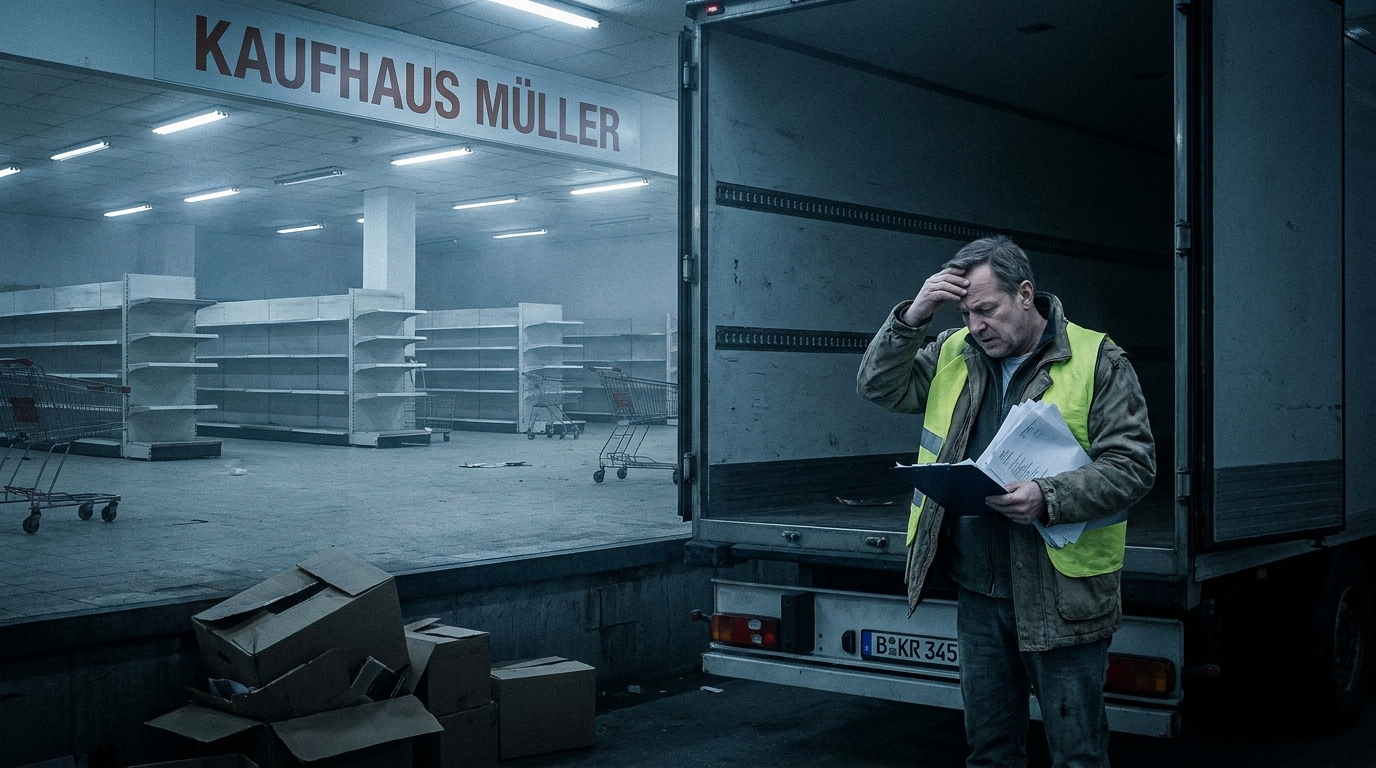
For the fourth time in six years, Germany is witnessing the collapse of one of Europe's most recognizable retail chains. Galeria, the successor to the legendary Kaufhof and Karstadt brands, has filed another insolvency petition with the district court in Düsseldorf. This time, however, public attention is focused not only on the fate of employees and the 83 operating department stores, but above all on the unprecedented, public conflict within the company. Co-owner Bernd Beetz openly and bluntly attacked the current management, claiming that another bankruptcy was unnecessary. For the hundreds of transport, logistics, and delivery companies serving the chain—including many Polish companies—this news represents a real, immediate financial threat.
Fourth bankruptcy in six years - a shameful record on the European market
The history of Galeria Galeria is a chronicle of successive crises. The first application for creditor protection was filed in 2020, at the beginning of the COVID-19 pandemic, when lockdowns virtually shut down brick-and-mortar retail. The second followed in 2022, when inflation, rising energy costs, and changing consumer shopping habits effectively clipped the wings of traditional department stores. The third installment of the crisis occurred in 2024, when Signa Holding—the chain's then-owner—collapsed, forcing a search for new investors. The fourth application, filed in 2025, closed a symbolic circle.
For market observers, this fact isn't just a statistic. It signals a structural crisis in a business model that—despite several opportunities for profound transformation—has failed to effectively rebuild itself. Each subsequent bankruptcy procedure generates systemic costs: for creditors, employees, contractors, and financial institutions. In the case of Galeria Galeria, these costs are cumulative, creating a spiral of market distrust.
Beetz vs. Hellenbock: A Public Battle for Accountability
What distinguishes this crisis from previous ones is the unprecedented nature of the internal conflict within the company itself. Bernd Beetz—a businessman and investor associated with the investment company that, together with the American fund NRDC, acquired Galeria in the summer of 2024—publicly questioned the competence and decisions of the board led by Tilo Hellenbock.
In a statement to industry media, Beetz didn't mince his words. He emphasized that the new owners entered the company under extremely difficult circumstances, committing significant equity capital and dozens of man-hours to rebuilding the company after Sign's collapse. Their efforts included, among other things, a radical overhaul of the brand identity—removing the historical Kaufhof and Karstadt brands from the name—and moving the headquarters from Essen to Düsseldorf. All in an effort to break away from a burdened past and begin a truly new chapter.
According to Beetz, however, the operational management team has failed to keep pace with these ambitions. The co-owner points to three fundamental areas of neglect:
- Assortment management — lack of a clear, coherent and bold product policy that would clearly distinguish the Gallery from the competition in both stationary and e-commerce;
- Customer orientation — insufficient adaptation of the offer and shopping experience to the expectations of the modern, increasingly demanding and mobile consumer;
- The pace of transformation — too slow and insufficiently rigorous implementation of necessary operational changes, despite clear market signals indicating the urgency of action.
Beetz doesn't question the very concept of traditional department stores. On the contrary, his thesis is essentially optimistic: he argues that this format still has a justification for its existence, as long as it is run with absolute operational excellence and a clear market identity. The problem is that Galeria hasn't achieved this excellence under its current management.
Logistics and transport on fire – who will pay for management’s mistakes?
For EURODEBT.eu readers, however, the key issue isn't the personal nature of the conflict within the management board, but rather the specific, measurable consequences of another bankruptcy for companies serving the Galeria's supply chain. And these consequences are serious and immediate.
As an operator of 83 department stores across Germany, Galeria generates significant demand for logistics services. This includes road transport, warehousing, last-mile logistics, returns management, cross-docking, and many other specialized services. This network collaborates with hundreds of entities—from large logistics operators and specialized warehousing companies to smaller regional carriers.
Filing an insolvency application automatically triggers a number of legal mechanisms that directly affect the position of contractors:
- Payment suspension — the court administrator takes control of the company’s cash flow and may suspend the payment of receivables to service providers;
- Disputing previous payments — bankruptcy law allows for the challenge of transactions made within a certain period before the declaration of bankruptcy, which theoretically means that even money already received can be demanded back;
- Uncertainty about the continuation of contracts — the administrator has the right to unilaterally terminate or renegotiate contracts, which puts existing partners in an extremely difficult negotiating position;
- Payment bottlenecks throughout the entire chain — companies that do not receive payments from Galeria may have difficulties settling their own liabilities to subcontractors, drivers or fleet lessors.
Smaller businesses—SMEs—are particularly at risk, as they may have a high concentration of revenues in a single client. If a shopping mall accounts for 20, 30, or more percent of such a company's turnover, a payment default could quickly threaten its existence.
Polish transport companies at the heart of the European crisis
It's worth emphasizing a dimension that's particularly important for Polish entrepreneurs. Polish transport and logistics companies play a fundamental role in serving the German retail market. The Polish transport industry is one of the largest and strongest in Europe—Polish trucks and lorries dominate European roads, and many of them regularly deliver to retail chains in Germany.
In Galeria's case, Polish carriers could be involved both directly—as network partners—and indirectly, as subcontractors of large European logistics operators contracted with Galeria. In both cases, the risk is real. Polish transport companies must immediately verify:
- the amount of current, unpaid receivables from the Gallery or its associated companies;
- the terms and conditions of trade receivables insurance and the current credit limits permitted by the insurer;
- contractual provisions regarding securing receivables and the possibility of suspending services;
- the legal status of any guarantees or pledges established to secure the contract.
In the event of bankruptcy of a foreign contractor, quick legal action is also crucial - filing a claim in bankruptcy proceedings within the statutory deadline is a necessary condition for participating in the division of the bankruptcy estate.
The credit insurance market and trade credit - a wake-up call
The fourth bankruptcy in six years has another, often overlooked, but extremely significant market effect: a dramatic and probably irreversible decline in the confidence of trade receivables insurers in Galeria as a contractor.
Credit insurers—such as Euler Hermes (Allianz Trade), Coface, and Atradius—continuously monitor the financial situation of thousands of companies and adjust the credit limits offered to their clients. Upon filing for bankruptcy or even at the first sign of financial difficulties, insurers typically immediately reduce or completely withdraw the limits granted.
For Galeria's suppliers and logistics partners, this represents a concrete reality: trading with a company in bankruptcy proceedings takes place with virtually no safety net. Trade credit—the ability to deliver goods or services with deferred payment—becomes uninsurable. In practice, the only acceptable form of settlement becomes prepayment or cash on delivery.
For the logistics industry, where margins are typically tight and cash flow is crucial, this settlement model is deeply problematic. Transport companies must first cover fuel, labor, insurance, and fleet depreciation costs before even issuing an invoice. The requirement for prepayment from the debtor, when that same party is in bankruptcy proceedings, is practically impossible to meet.
The domino effect – a real threat to the entire value chain
Economists and risk analysts use the term "domino effect" to describe a situation where the bankruptcy of one large entity triggers a cascade of problems for its counterparties. In the case of Galeria Galeria, this threat is very real.
The pattern is always similar: a large retailer defaults on payments to a logistics operator. The logistics operator, with receivables frozen in bankruptcy proceedings, encounters liquidity problems. Consequently, it settles its obligations to transport subcontractors late or incompletely. These subcontractors, in turn, struggle to pay vehicle leases, insurance, or driver salaries on time. The chain of difficulties spreads like a wave—from the core (Galeria) to an increasingly broader circle of entities, which may have little contact with the original problem.
The scale of this phenomenon in the case of Galeria Galeria could be significant. The chain of 83 department stores, employing several thousand people, generates turnover and goods flows that engage dozens, if not hundreds, of transport and logistics companies of varying sizes and business profiles.
The prospect of receivership – what next?
After filing for bankruptcy, the District Court in Düsseldorf will appoint a receiver to secure the company's assets and conduct the proceedings. In the first phase—the so-called interim proceedings—the priority is to maintain operational continuity, meaning maintaining the department stores' operations and preserving jobs.
For logistics partners, the administrator's decisions regarding contract continuation will be crucial. The administrator has the authority to selectively maintain or terminate contracts, based on profitability for the bankruptcy estate. Logistics companies deemed essential to the continued operation of the network can count on continued cooperation, albeit under modified financial terms.
In this context, it is crucial for transport and logistics companies to actively manage their position in this process – to submit receivables on time, maintain contact with the administrator and monitor all information from the proceedings on an ongoing basis.
The Wider Context – The Crisis in European Brick-and-Mortar Retail
The Galeria's story is not an isolated anomaly. It is part of a broader, structural trend of transformation in the European retail market. The expansion of e-commerce, changes in consumer behavior following the pandemic, inflation in operating costs and commercial real estate—all these factors combine to create an extremely challenging environment.rodoa vista for traditional department stores.
Examples from other European markets are equally telling: the British chain Debenhams, Italy's La Rinascente, and Belgium's ING brick-and-mortar formats—all are struggling, or have struggled, with similar challenges. Germany, with its strong consumer culture and dense brick-and-mortar retail network, was able to resist this wave for a long time. However, the successive bankruptcies of Galeria shopping malls demonstrate that this stronghold, too, has begun to crack.
Beetz is right to argue that the department store model is not doomed—but only if the offerings and shopping experience are radically redefined. Examples like El Corte Inglés in Spain and Selfridges in the UK demonstrate that large-scale retail can be profitable when it prioritizes uniqueness, quality, and experience over mass-market and price. The mall has so far failed to successfully navigate this path.
Risk Assessment for Logistics Partners - EURODEBT.eu Recommendations
In light of the above analyses, transport and logistics companies cooperating with Galeria or considering such cooperation should take into account the following risk factors:
- Payment risk - VERY HIGH. The fourth bankruptcy procedure in six years is a stark wake-up call. A lack of historical payment reliability, revoked insurance limits, and lack of access to trade credit make Galeria a high-risk contractor.
- Contract continuation risk - HIGH. The receiver may terminate or renegotiate existing contracts at any time. Logistics companies should be prepared for sudden changes in terms or termination of cooperation.
- Risk of domino effect - MODERATE TO HIGH, depending on the concentration of revenue from the shopping mall contract in the company's total turnover. The higher the shopping mall's share of revenue, the higher the systemic risk for the entire enterprise.
- Legal risk – MODERATE. The possibility for the administrator to challenge payments made before the declaration of bankruptcy requires consultation with a lawyer specializing in bankruptcy law – especially in the context of German law.
Summary - Lesson for the Market
The Galeria case is another painful reminder that even seemingly stable, large, and recognizable brands can pose a significant financial risk to their business partners. The internal conflict between the co-owner and the management further complicates forecasting and reduces the chances of a quick and efficient recovery from the crisis.
For the transport and logistics industry—both in Germany and Poland—the most important lesson learned is the need for constant, active monitoring of the financial condition of key contractors. Tools such as business intelligence, solvency reports, credit limits, and credit insurance are not luxuries—they are a necessity in the world.rodowhere one large unreliable debtor can threaten the existence of the entire company.
The mall can survive. A new administrator, a new operational strategy, and perhaps a new industry investor could give the chain another chance. However, for suppliers and logistics partners, now faced with frozen receivables, philosophical considerations about the future of department stores are of secondary importance. Their pressing concern is the here and now: collecting owed money and protecting their own financial liquidity.




