

Record PLN 47 billion in arrears for Polish companies: transport at the forefront of risk, SMEs pay the highest price
The overdue debt of Polish businesses has reached a record level of nearly 47 billion zlotys, and the transport, shipping and logistics sector has the highest proportion of unreliable payers in the entire national economy — 8.6 percent of companies have overdue liabilities. An informal payment hierarchy favors large corporations at the expense of SMEs, creating a domino effect in supply chains. European partners and financial institutions working with the Polish transport sector should urgently review their counterparty risk management procedures.
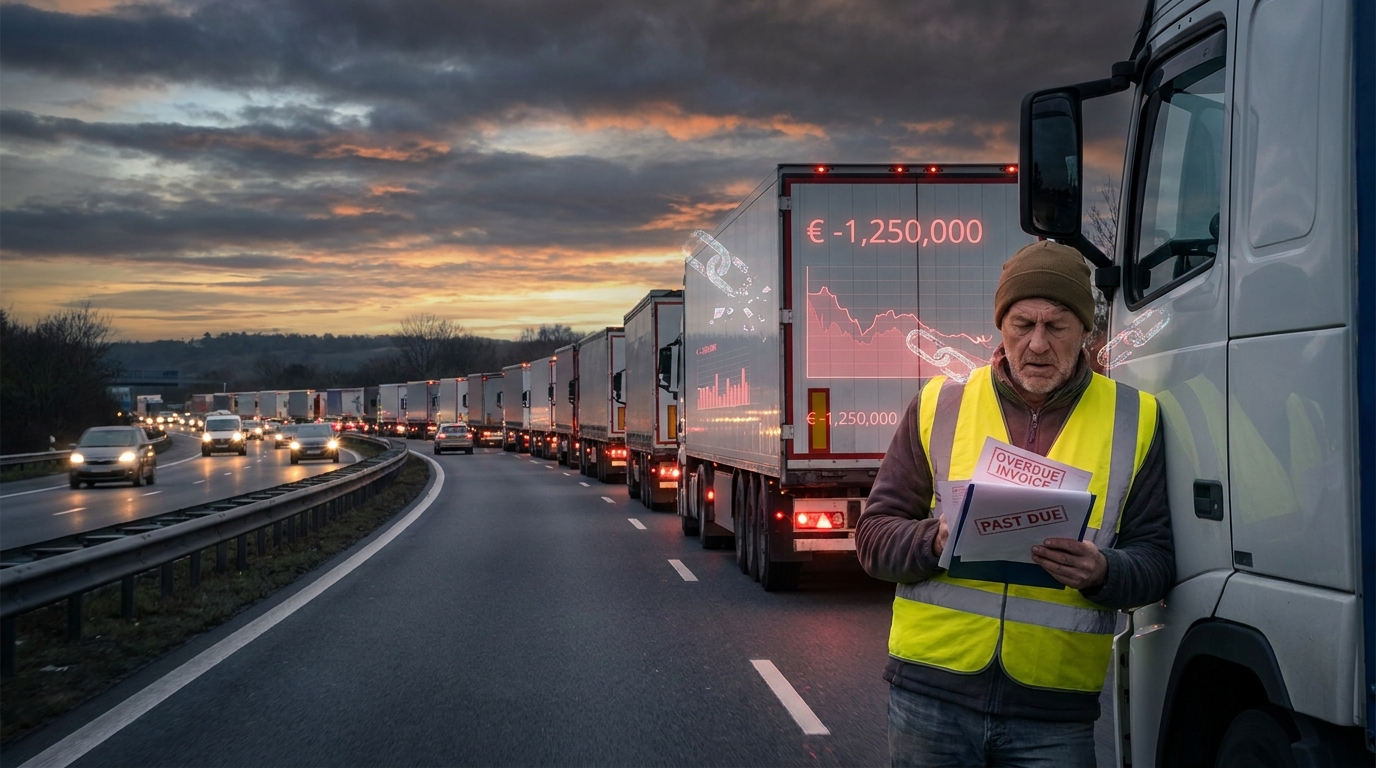
By the end of the first half of 2026, the outstanding debt of Polish companies had exceeded nearly PLN 47 billion—a historic high that should raise red flags for any risk manager working with Polish partners. A report published on September 18, 2026, by BIG InfoMonitor, prepared in collaboration with the Credit Information Bureau and Keralla Research, leaves no doubt: the problem of payment backlogs is no longer just a matter of bilateral relations—it has become a systemic threat to entire supply chains in Central Europe.
Debt spiral: fewer debtors, but everyone is deeper in debt
The first, seemingly reassuring piece of news from the report is the decline in the number of companies in arrears. Compared to the same period last year, the number of debtors decreased by nearly 4,400 entities, now standing at over 313,500. However, if we stopped at this information, the picture would be grossly incomplete.
In parallel with the decline in the number of debtors, the value of their liabilities is rising—and rapidly. Total arrears increased by over PLN 1,7 billion, or nearly 4 percent, over the year. In practice, this means that debts are not spilling over to new companies, but are becoming increasingly concentrated within a relatively stable group of entities that have already had trouble paying their debts. The average value of overdue liabilities per debtor has increased to approximately PLN 150—up from PLN 142 a year earlier and PLN 137 two years ago. The trend is clear and alarming.
Dr. Waldemar Rogowski, Chief Analyst at BIG InfoMonitor, puts it bluntly: companies with financial problems are sinking deeper into a debt spiral, from which it becomes increasingly difficult to escape on their own with each passing quarter. This is a classic liquidity trap mechanism—the more a company owes, the higher the interest and contractual penalties, and the less chance there is of rebuilding its payment capacity without external intervention.
Informal payment hierarchy: who gets paid first?
One of the report's most significant—and most dangerous—conclusions concerns the so-called informal payment hierarchy. Although this phenomenon has been known for years, this is the first time it has been documented in such a precise manner.
Only one in five Polish companies (21,4 percent, to be precise) declares that they treat all their creditors equally and pay invoices in the order in which they are due. Three-quarters of entrepreneurs—75,2 percent—openly admit that the order of payment is determined by two factors: the market position of the contractor and the length of the relationship.
In practice, this means a hierarchy that looks like this:
- Large corporations and strategic suppliers — receive payment first, regardless of the invoice due date
- Long-term business partners — they benefit from a "loyalty bonus" and can count on timely or almost timely settlement
- New partners and companies from the SME sector — they end up at the end of the queue; their invoices are waiting to be processed until the developer's liquidity situation allows them to be paid
For the transportation and logistics industry, where carriers, freight forwarders, and warehouse operators often function as supply chain links serving both large clients and smaller subcontractors, this hierarchy has devastating consequences. A carrier waiting for payment from a large client simultaneously becomes indebted to gas stations, service centers, and tractor leasing companies. The domino effect spreads rapidly throughout the entire supply chain.
The TSL sector: nominally fourth, but the worst in terms of indicators
Raw figures for specific industries confirm that the transport, forwarding, and logistics sector is facing an exceptionally difficult situation. In terms of nominal arrears, transport ranks fourth among all sectors of the Polish economy, with debt reaching PLN 3,3 billion. It is followed by trade (PLN 8,9 billion), industry (PLN 8,7 billion), and construction (PLN 6,2 billion). Together, these four sectors account for over 57 percent of all overdue business debt in Poland.
However, when we look at the risk indicator—the percentage of companies in a given industry with overdue liabilities—the picture becomes even more alarming for the transport and warehousing sector. In transport and warehousing, a staggering 8,6 percent of entities are in arrears. This is almost double the average for the entire Polish economy, which is 4,4 percent.
For comparison, other higher-risk sectors are as follows:
- Water supply and waste management — 7,2 percent of companies with arrears
- Mining — 6,8 percent
- HoReCa industry (accommodation and catering) — 5,7 percent
Transport takes the inglorious top spot on this list. Moreover, it's an industry where liquidity problems are cascading—a single unreliable payer can snarl dozens of smaller carriers and subcontractors operating on commission. Given European supply chains, this means foreign contractors are very exposed to the risk of insolvency by their Polish partners.
Macroeconomic Context: Why Now?
The record level of arrears did not occur in a vacuum. The report points to three overlapping factors that have created an exceptionally unfavorable environment in 2025 and 2026.rodoa spur for the financial liquidity of enterprises.
First, rising operating costs — Inflation in labor, fuel, and energy costs has outpaced revenue growth for many quarters, especially in the transportation sector, where margins are already among the lowest in the entire industry. Secondly, slowdown in consumption — Reduced internal and external demand resulted in lower order volumes, with unchanged fixed fleet and infrastructure costs. Thirdly, geopolitical uncertainty — disruptions in global and European supply chains have forced the need to maintain higher cash buffers or take out more expensive working capital loans.
Combined with the informal payment hierarchy described earlier, the effect is toxic: companies save their own liquidity by delaying payments to weaker partners, who in turn do the same to even weaker ones, and the entire working capital link in the supply chain is gradually depleted.
The End of Patience: Creditors React Faster and Tougher
The change noted in the BIG InfoMonitor report on the creditor side is just as significant as the debt data. Polish entrepreneurs have clearly moved away from the "wait and see" model in favor of tough, immediate debt collection. As BIG InfoMonitor CEO Paweł Szarkowski points out, the era of passively waiting for transfers is definitely coming to an end.
The statistics on late payment response times speak for themselves:
- 15,5 percent of creditors reacts immediately - on the first day after the payment deadline, reminder procedures are initiated
- 27 percent takes action after a week
- 22 percent responds after two weeks at the latest
- Only a marginal percentage of companies wait longer than a month
The professionalization of the tools used is also increasing. Already, 40 percent of companies support telephone reminders (used by 48 percent of creditors) and text messages (44 percent) with formal payment demands—an increase of 7 percentage points year-on-year. More and more entities are using external credit bureaus and credit reference agencies to verify the payment credibility of new clients in advance.
From a risk management perspective, this is a positive change—but it also has a dark side. Faster debt collection by stronger creditors can further accelerate the domino effect: a company that defaults on payments simultaneously begins to face more intense debt collection efforts from its creditors, exacerbating its liquidity problems and increasing the risk of bankruptcy.
Risk perspective for foreign contractors and financial institutions
The data described in the BIG InfoMonitor report have a direct impact on the business decisions of companies operating in the European transport and logistics market – both those cooperating with Polish carriers and forwarders, as well as financial institutions financing this sector.
The concentration of high debt amounts in the TSL sector, combined with the highest percentage of companies with arrears in the entire economy (8,6 percent), has several specific implications:
- Higher counterparty risk — when establishing new business relations with a Polish transport partner, it is necessary to thoroughly verify its liquidity situation, payment history and structure of liabilities before issuing a trade credit or concluding a long-term contract
- Tightening the criteria for credit insurance — Companies offering trade credit insurance for transactions with Polish TSL entities must take into account a significantly higher risk factor for unreliable payers; higher premiums or a narrower scope of cover should be expected in this segment
- Cascading Risk in the Supply Chain — selective payment of invoices by large entities creates hidden risks for entire networks of suppliers and subcontractors; a problem in one link can quickly paralyze several others
- The need for continuous monitoring — one-time verification of the contractor before concluding the contract is not enough; the report indicates that the financial situation of companies is deteriorating gradually and disproportionately, which requires constant monitoring of payment indicators in real time
What does this mean for the TSL industry in Poland and Europe?
Polish transport and logistics companies have long been key players in the European road transport market. Poland is the largest provider of road transport services in the European Union—Polish carriers handle almost one in three truckloads transported within the EU. Liquidity problems in this sector therefore have not only a national but also a European dimension.
The phenomenon of informal payment hierarchies particularly affects small and medium-sized carriers—companies with fleets of several to a dozen vehicles that lack the negotiating power of large logistics groups or access to cheap bank financing. For such entities, a delay in one or two large invoices can mean a lack of funds to pay leases, fuel, or salaries. This leads to the need to take out expensive factoring loans—or, in the worst-case scenario, to declare bankruptcy.
The growing professionalization of debt collection by creditors, while understandable and justified, may paradoxically accelerate a market purge in the TSL sector. Companies that have been teetering on the brink of liquidity for years will increasingly lose access to trade credit and may not survive subsequent quarters in such a challenging environment.
Recommendations for business partners and financial institutions
In view of the described situation, EURODEBT.eu recommends the following actions for companies cooperating with the Polish TSL sector:
- Verify before signing the contract — check reports in economic information databases (BIG, BIK, KRD) and industry intelligence agencies before each new business relationship
- Monitor continuously, not just once — implementing a system of automatic alerts about changes in the contractor's payment status is now a standard in professional risk management
- Use shorter payment terms or advance payments — in the case of new or unverified partners in the TSL sector, consider shortening payment terms or requesting an advance payment before the order is processed
- Diversify your supplier base — dependence on one or several Polish transport subcontractors creates a concentration of risk; it is worth having alternative options ready to launch
- Include cascading risk in your supply chain assessment — check not only the direct partner, but also their key suppliers and subcontractors; the domino effect can surprise even proven companies
Summary: Time for proactive risk management
The record level of arrears of Polish enterprises, reaching almost PLN 47 billion, combined with the highest percentage of unreliable payers in the TSL sector in the entire national economy, creates arodoThis represents a high-risk environment for all participants in European supply chains. Informal payment hierarchies discriminate against smaller partners and subcontractors, and the knock-on effect can affect even those contractors who rigorously adhere to payment deadlines.
A key lesson for European risk managers is that traditional, one-off credit checks before entering into cooperation are far from sufficient. Debt dynamics—growing amounts concentrated in an increasingly narrow group of entities—require the implementation of continuous monitoring, not annual audits. Companies that understand this and adapt their procedures accordingly will reduce their exposure to bad debt risk. Those that fail to do so may experience firsthand the domino effect in the supply chain.




