

Revision of the Eurovignette Directive 2026: new road tolls for trucks and the growing risk of insolvency in transport
On 2 September 2026, the European Parliament's Transport Committee approved a revision of the Eurovignette Directive, introducing a new road charging system directly linked to CO2 emissions from heavy goods vehicles. These changes create enormous cost pressure on carriers with conventional diesel fleets, which is particularly severe for small and medium-sized companies from Central and Eastern Europe. According to ICCT analyses, the difference in total cost of ownership between an electric truck and a combustion-engine vehicle could reach 25% by 2030, fundamentally changing the financial position of the sector.
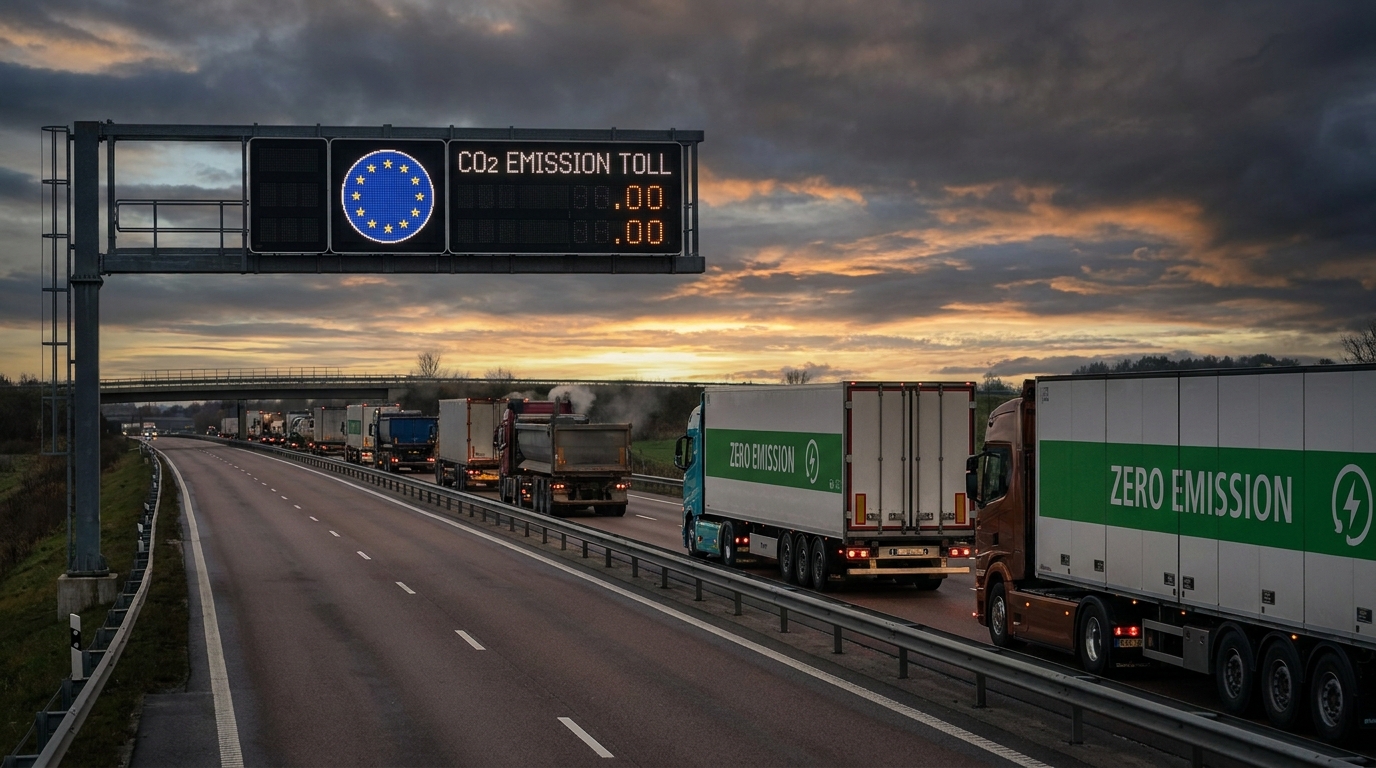
On September 2, 2026, the European Parliament's Transport Committee approved a provisional agreement on the revision of the Eurovignette Directive, which regulates road tolls for heavy goods vehicles. The vote—30 in favor, 5 against, and 4 abstentions—confirmed the political compromise reached between the EU Council and the European Parliament back in June 2026. The new regulations, directly linked to CO2 emission standards effective from July 1, 2026, will change the financial foundations of European road transport. For risk managers and logistics company owners, this means one thing: it's time for a fundamental review of the financial stability of business partners in the TFL sector.
Where did this revision come from and what is driving it?
The Eurovignette Directive, in its original form, was one of the cornerstones of the EU's road infrastructure charging system for heavy goods vehicles. However, it was criticized for years for its inconsistency with the European Union's climate ambitions, as the fees charged to hauliers did not adequately reflect the actual carbon footprint of individual vehicles.
The revision, finalized to coincide with the entry into force of new CO2 emission standards for heavy-duty vehicles in July 2026, aims to change this. EU lawmakers decided to directly link the road toll system to a vehicle's emission class, thus creating a powerful economic incentive to accelerate the decarbonization of transport fleets. In practice, this means that diesel trucks will become increasingly expensive to operate—not only due to rising fuel prices but also to progressively higher road toll rates.
The political compromise that preceded the vote in September 2026 was the result of months of negotiations. Its conclusion just before the new CO2 emission standards came into force was no coincidence—the goal was to ensure that road pricing regulations were ready just as the automotive and transportation industries were entering a new regulatory era.
What exactly does the directive change? Key provisions
Discounts for low- and zero-emission vehicles
The most important tool in the revised directive is a system of preferential road toll rates for low-emission vehicles. European Union member states will have the option—but not the obligation—to provide significant discounts for such vehicles:
- Until June 30, 2031: EU countries will be able to reduce the standard toll rate by up to 75 % for low-emission trucks.
- After July 1, 2031: the maximum discount level will be reduced to 50 % standard rate.
- Key condition: Preferential rates for low-emission vehicles can only be granted if the country in question has even more favorable conditions – or a complete exemption from fees – for completely zero-emission vehicles, i.e., in particular, fully electric trucks.
This last condition is particularly important from the perspective of the entire system's architecture. European legislators ensured that the hierarchy of preferences was clear and irreversible: the highest financial benefits should go to those operators who have made the most radical technological leap—that is, eliminated emissions altogether, not merely reduced them.
Legal certainty and unified definitions
The revision also clarifies the definitions of key terms that have previously generated interpretational discrepancies between individual member states. The amendment clarifies:
- Vehicle Definitions zero-emission and low-emission in the context of road tolls.
- Criteria for classifying vehicles into individual categories CO2 emission classes.
- Status specialized vehicles — such as garbage trucks or heavy construction equipment — which have so far been in a regulatory grey zone.
For companies like Axxès—a toll collection system operator operating in the French and European markets—unifying definitions means more efficient tariff management and avoiding costly interpretation disputes with national administrations. For carriers, it eliminates uncertainty about the toll rate they will pay for a given vehicle on a given route.
What was missing - trailer aerodynamics postponed
It is worth noting that European legislators have decided toresign One of the mechanisms initially considered was modulating road tolls based on the aerodynamics of the trailer being towed. The idea was to reward carriers who used trailers with better aerodynamic parameters, which translates into lower fuel consumption and emissions.
Ultimately, it was determined that implementing such a system would be too complex operationally—especially for roadside inspections, where rapid and unambiguous vehicle category identification is crucial. However, the European Commission announced that the topic may be revisited in future legislative work. For carriers and trailer manufacturers, this signals that investments in aerodynamics can still yield regulatory benefits—though somewhat later than originally planned.
The Cost Accounting Revolution: What Does the Data Say?
Changing road pricing rules is just one of many forces shaping the economics of European road transport today. However, when combined with other cost trends, its impact could prove transformative.
Research conducted by ICCT (International Council on Clean Transportation) puts hard numbers on the table. Analysts from this organization have calculated that exemption from road tolls for electric vehicles would mean that the total cost of ownership (TCO) of an electric tractor unit for long-distance transport would be lower by 2026 4,9% lower than the cost of a comparable diesel vehicle.
The picture changes drastically when we add maximum CO2 emissions fees imposed on internal combustion vehicles into the equation. In this scenario:
- In 2026, an electric tractor unit will be cheaper to operate by 15,8 % compared to Diesel.
- By 2030, this advantage could increase to almost 25 %.
These are not marginal differences. With industry operating margins often not exceeding a few percent, a 15-25% difference in TCO can be the difference between a given transportation company and its future. Credit analysts and risk managers should consider these figures as a benchmark when assessing a carrier's financial health.
Who is most at risk? Risk map for the TFL sector
The new regulations do not affect all transport market participants equally. Geographic and structural analysis allows us to identify groups of entities particularly susceptible to a deterioration in their financial situation due to the Eurovieniata revision.
Small and medium-sized transport companies - at the center of risk
The European road transport market is highly fragmented. Thousands of small and medium-sized companies—operating a few or a dozen vehicles, often financed through leasing—form its backbone. These entities are most vulnerable to the effects of the Eurovieniata revision for several reasons:
- Legacy fleet: Transport SMEs are less likely than large corporations to regularly replace their fleet. Their trucks are often several or more years old, often failing to meet even Euro VI standards—let alone low-emission classes.
- Limited access to financing: Purchasing an electric truck costs €300-500 or more. For a small carrier with a tight balance sheet and a history of difficult access to credit, such an investment is simply out of reach without external assistance.
- Low operating margins: In conditions of intense price competition, which we observe especially in the groupage and FTL cargo segments, each additional operating cost directly reduces the already very thin margin.
- Limited negotiating power: Large logistics companies may attempt to pass on rising costs to their clients. Small subcontractors, dependent on one or a few large contractors, have significantly less room to renegotiate rates.
Carriers from Central and Eastern Europe under pressure
Transport companies from Poland, the Baltic States, the Czech Republic, Slovakia, Romania, and Bulgaria deserve special attention. These countries currently provide the largest share of transport services in the European market—and it is precisely there that the concentration of small companies with legacy fleets is highest.
Polish carriers, which are leading players in European cabotage and international transportrodoThey operate primarily with diesel fleets. Electromobility in heavy road transport is still in its infancy in this part of Europe—charging infrastructure is rudimentary, and the availability of financing for fleet transformation is significantly lower than in Western Europe. Rising road tolls for diesel vehicles will therefore hit these carriers harder and faster than many expect.
Market consolidation – an inevitable consequence
The economic logic of the new regulations leads to one almost inevitable conclusion: the transport market in Europe is waiting accelerated consolidationLarge logistics groups with the capital to transform their fleets, access to green financing, and negotiating power with clients will gain a structural competitive advantage. Smaller entities that fail to transform—or fail to obtain sufficient financial support—will face a real risk of losing liquidity and solvency.
For the industry as a whole, this means fewer, but stronger, players. For logistics service providers and their customers, this means potentially higher freight prices in the next few years, as the supply of transportation services is limited by the exodus of weaker players from the market.
Risk Assessment Perspective: What Should Risk Analysts and Managers Monitor?
The revision of the Eurovignette Directive introduces a crucial new dimension in assessing the credit and business risks of companies in the transport sector. For risk managers, financial analysts, and owners of companies contracting transport services, here are the most important warning indicators to consider in due diligence processes and ongoing partner monitoring:
- Age and emission structure of the fleet: A carrier with a fleet of Euro V or older vehicles, without a fleet replacement plan, is a high-risk entity over the next 2-4 years. The key question is: how quickly will their operating costs increase due to the new fees?
- Presence or absence of transformation strategy: A company that doesn't have a plan to decarbonize its fleet—even in its infancy—sends a troubling signal. In an industry where regulatory pressures on electrification are imminent, a lack of strategy translates into a lack of adaptability.
- Liquidity and debt ratios: Rising operating costs coupled with low margins quickly erode financial liquidity. Companies with high debt-to-EBITDA ratios and low interest coverage should be considered candidates for debt service failure.
- Access to financing and banking relationships: A carrier with active credit lines and a documented history of cooperation with financial institutions has a better chance of surviving the transition period. The absence of such relationships or a history of credit problems are alarming signals.
- Geographic and customer diversification: Companies heavily dependent on a single market or client are more susceptible to shocks. Revenue concentration combined with rising costs is a toxic combination.
- Structure of customer contracts: Does the carrier have the ability to pass on cost increases to its clients? Long-term contracts with fixed rates concluded before 2026 could prove to be a trap for companies unable to renegotiate them.
Regulatory Context – The Directive as Part of a Wider Puzzle
The Eurovieniata revision doesn't exist in a vacuum. It's part of a much broader regulatory package that the European transport sector will have to absorb in the coming years. CO2 emission standards for heavy-duty vehicles, the Alternative Fuels Infrastructure Directive (AFID), ESG reporting requirements, and cabotage regulations all create complex and mounting regulatory pressure.
In this context, the Eurovignette is unique in that its impact is immediate and directly measurable in cost calculations. While ESG requirements can be temporarily ignored by smaller companies (at least until they become a condition for accessing contracts or financing), higher road tolls must be paid now, for every kilometer driven.
It's also worth noting that the directive gives member states some discretion in applying discounts—but doesn't mandate it. This means that the specific fee rates will vary between countries, making it difficult for cross-border carriers to precisely plan their costs. For companies operating in multiple markets simultaneously, tracking current rates in each country will become a crucial element of operational management.
Opportunities overshadowed by threats – who will benefit from the new regulations?
Although the dominant tone in the discussion about the Eurovision Song Contest revision is anxiety – especially in therodoin the case of small and medium-sized carriers - it is also worth noting the positive aspects of the new regulations for those who are ready or able to prepare for them.
Companies that invest early in electrifying or hydrogenating their fleets will gain a measurable cost advantage as early as 2026. As time passes and taxes on combustion vehicles increase, this advantage will grow—potentially reaching a 25% difference in TCO by 2030. This could be a decisive factor when winning contracts with large clients, who are increasingly considering the carbon footprint of logistics providers in their purchasing decisions.
Manufacturers of electric trucks and charging infrastructure have also recognized the opportunity—demand for their products and services will grow as economic pressure for transformation intensifies. Leasing and finance companies offering green financing for transportation will similarly benefit—with the right product portfolio, they can become key partners in the fleet transformation process.
Summary: New era, new risks, new assessment standards
The approval of the Eurovignette Directive revision by the European Parliament's Transport Committee marks a turning point for the European road transport sector. The new regulations, closely linked to CO2 emission standards effective from July 2026, create a powerful economic engine to accelerate the decarbonization of truck fleets—but at the same time, they impose a growing financial burden on those carriers unable or unwilling to make the transition.
From a business and credit risk assessment perspective, the conclusions are clear: the lack of a fleet transformation plan or the inability to implement it is currently one of the most serious indicators of an increased risk of insolvency in the transportation sector. Risk managers, credit analysts, and owners of companies contracting transportation services should include a transformation readiness assessment as a regular part of the business partner vetting process.
The transportation market is facing inevitable consolidation. The companies that will survive and strengthen their position are those that are thinking strategically about their fleet structure, access to financing, and the ability to adapt to new regulatory realities. All others face the question not of whether they will encounter problems—but when.




