

Germany, the epicenter of bankruptcy in Europe: every third major bankruptcy in the region comes from beyond the Oder River
The Allianz Trade report for the first half of 2026 raises the alarm: the number of major insolvencies in Germany increased by 10%, and one in three major bankruptcies in Western Europe comes from that country. The automotive sector leads the insolvency statistics, creating a serious risk of a domino effect for transport and logistics companies linked to German supply chains. Experts are calling for an immediate tightening of credit policy and wider use of instruments to secure receivables.
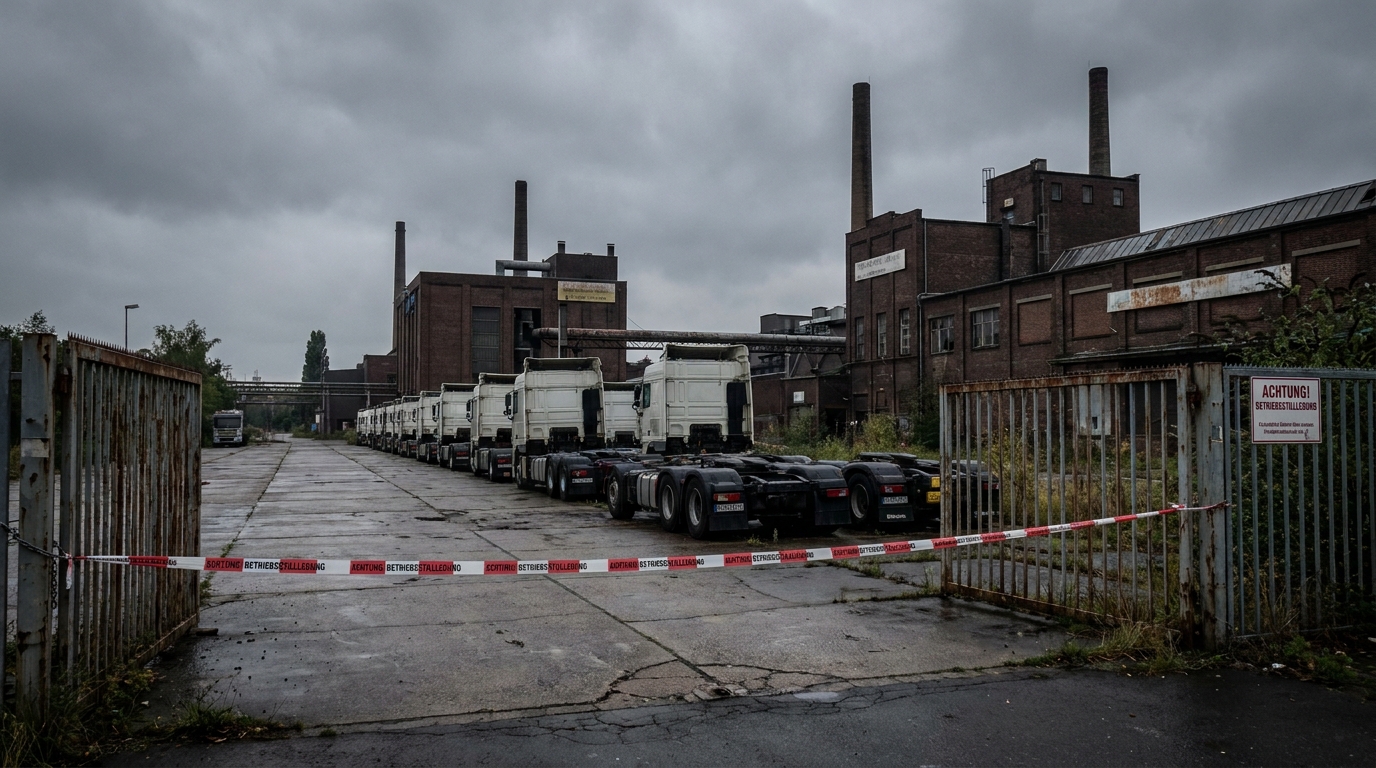
The latest report published by Allianz Trade—one of the leading global trade credit insurers—paints an alarming picture of the condition of the largest companies in Germany and throughout Western Europe. Data for the first half of 2026 leaves no doubt: the wave of major bankruptcies has not only not slowed down, but is accelerating, reaching record levels in recorded history. For the transportation and logistics industry, which is deeply intertwined with the health of the manufacturing industry, these results represent a wake-up call.
Record levels of bankruptcies in Germany - the hard numbers
In the first six months of 2026, Germany registered 33 so-called Großinsolvenzen, i.e. the bankruptcy of large entities with annual revenues exceeding EUR 50 million. 10% more than in the same period of the previous year - and this against the background of the already exceptionally difficult 2025, which ended with a total number 94 such cases (8% increase compared to 2024).
The cumulative value of turnover of companies that declared insolvency in the half-year under analysis amounted to approximately 4,5 billion euros — 3% more than a year earlier. Importantly, the average turnover per bankrupt company fell by nearly 7%, to €137 million. This is a subtle but significant change: problems are increasingly affecting not only the absolute giants, but also companies in the middle tier of the largest players—entities that often play key roles in supply chains, and whose collapse can trigger an avalanche of further bankruptcies among collaborators.
Looking at the longer time horizon – the last four quarters – Germany has seen 97 major bankruptcies, which places it firmly in first place in Western Europe. For comparison: France recorded 69 cases, Italy 62, and the United Kingdom 45. In total, 325 such events occurred in Western Europe out of 504 recorded globally, which means that the old continent has more than 60% of all global cases bankruptcy of large enterprises.
The most vulnerable industries: automotive in the lead
Sector analysis provides further disturbing conclusions. In the first half of 2026, the undisputed leader in terms of the number of spectacular bankruptcies was automotive sector — with seven major bankruptcies. Automotive, an industry that for decades has been a showcase and a pillar of Germany's export power, is currently grappling with an exceptionally difficult set of circumstances: the electromobility transformation, pressure from Asian manufacturers, a collapse in demand in some key markets, and rising operating costs.
The next positions were occupied by:
- Retail — 5 major bankruptcies,
- Machine construction — 4 cases,
- Services — 4 cases.
This comparison reveals a painful paradox: these are the industries that for decades defined Germany's economic strength and determined its international competitiveness.rodoare currently the epicenter of the crisis. The machinery and automotive industries are creating supply chain structures of enormous complexity, engaging hundreds, and often thousands, of partners from across Europe—including numerous transport and logistics companies that support their daily operations.
The domino effect – the biggest threat to the transport industry
Milo Bogaerts, CEO of Allianz Trade for the DACH region (Germany, Austria, Switzerland), leaves no doubt about the scale of the threat to companies associated with bankrupt entities. "Large industrial and automotive companies serve as centers of gravity for extensive networks of partners. When one such player goes out of business, the pressure is immediately felt by dozens, even hundreds, of related entities." — warns the expert.
For transport and logistics companies, the risk of a domino effect is particularly acute for several key reasons:
- Low operating margins — The TSL industry operates with margins much lower than many other sectors, which means that even a single non-payment of several invoices can seriously undermine the liquidity of a transport company.
- Concentration of clients — Many carriers and freight forwarders operate on a model in which a few key accounts account for the vast majority of revenue. The failure of one of them could spell financial disaster.
- Extended payment terms — In relationships with large industrial entities, deadlines of 60, 90, or even 120 days are standard. In the event of bankruptcy of the client, receivables for months of deliveries may prove uncollectible.
- Lease and loan obligations — Transport companies are burdened with fixed fleet financing costs that don't disappear with the loss of a customer. A lack of revenue combined with fixed costs quickly leads to a loss of liquidity.
A payment gridlock caused by the bankruptcy of a single large automotive manufacturer could, within a few weeks, lead to financial difficulties for dozens of transport companies that serviced its logistics chain – from the transport of components to factories, through the distribution of finished vehicles, to the operation of spare parts warehouses.
Structural causes of the German bankruptcy crisis
Germany's dominance in European bankruptcy statistics is not accidental – it results from a combination of deep structural problems that have been building up over several years, and which the pandemic, the energy crisis and geopolitical turbulence have only accelerated and highlighted.
High energy costs
Germany is among the countries with the highest industrial electricity prices in Europe. For energy-intensive companies—component manufacturers, metallurgical plants, and chemical producers—this means a dramatic decline in competitiveness vis-à-vis rivals from Asia or even other European countries. Costs that cannot be fully passed on to end users eat into margins and, consequently, their working capital and ability to service liabilities.
Automotive transformation
The automotive sector is undergoing the greatest technological revolution since the invention of the internal combustion engine. The transition to electromobility requires enormous investment, simultaneously disrupting the existing business models of thousands of companies producing components for combustion engines, gearboxes, and exhaust systems. Companies that for decades specialized in precision components for classic engines are facing the need for extensive restructuring or liquidation.
Regulatory and bureaucratic burdens
Growing regulatory complexity—both at the national and EU levels—is generating real costs for companies, especially those with more traditional business models. ESG reporting requirements, changes to environmental protection regulationsrodos or complicated administrative procedures absorb time and resources that could be directed towards innovation and market adaptation.
Competitive pressure from emerging markets
Chinese automotive and electronics companies are aggressively conquering the European market, offering products at prices that European companies cannot compete with given their current cost structures. This phenomenon is particularly painful for Germany, a country whose exports have for years been fueled by the very industries where Asian dominance is now most felt.
The Global Picture: Western Europe as the World's Insolvency Center
Maxime Lemerle, Chief Insolvency Analyst at Allianz Trade, highlights the global context of the observed trends. In the first half of 2026, 247 major bankruptcies — 13% more than a year earlier. Globally, the problems are most acutely affecting:
- Retail — 59 cases,
- Service sector — 38 cases,
- architecture — 33 cases.
Western Europe accounts for over 60% of all global bankruptcies of large companies. This is unprecedented and alarming data, as it means that the risk of contagion to contractors through a contagion effect is structurally higher in European value chains than anywhere else in the world. For transport companies operating in the European area—both domestic and cross-border operators—this signals an urgent need to review their counterparty risk management policies.
Practical conclusions for the transport and logistics industry
The data presented by Allianz Trade should prompt owners and managers of transportation companies to take specific adaptive measures. Here are key recommendations from a business risk management perspective:
1. Constant monitoring of the financial condition of key clients
Regularly checking the creditworthiness of business partners—especially those in the automotive, machinery, and trade sectors—should become part of standard operating procedures, rather than a reactive measure taken only when problems arise. Verification platforms such as EURODEBT.eu enable ongoing monitoring of warning signs: payment delays, changes in ownership structure, or information about restructuring proceedings.
2. Diversification of customer portfolio
Dependence on one or a few large clients in high-risk sectors is a recipe for disaster in an environment of increasing bankruptcies. A diversification strategy—both sectoral and geographic—reduces concentration risk and ensures stable cash flow even in the event of the loss of a single partner.
3. Implementation or extension of receivables insurance
Trade credit insurance products offered by players such as Allianz Trade, Euler Hermes, and Atradius are an effective instrument for protecting receivables against the consequences of a customer's bankruptcy. Given the growing wave of bankruptcies, the cost of such a policy may be many times lower than the potential loss on unsecured receivables.
4. Tightening credit policy towards new contractors
Before establishing a new business relationship or significantly increasing engagement with an existing client—especially in the automotive or machinery industries—it's worth conducting an in-depth analysis of their financial situation. Shortening standard payment terms, requiring advance payments, or requiring bank guarantees as security may seem burdensome for the business relationship, but in the long run, they protect the financial liquidity of the transport company.
5. Closely monitor warning signs in the supply chain
Bankruptcies are rarely sudden—they are usually preceded by a number of early warning signs. These include: extended invoice payment deadlines, requests for payment deferrals, management turnover, restructuring announcements, and press reports about a given entity's difficulties. Systematic monitoring of these indicators offers the opportunity to limit exposure before risk materializes.
Outlook: Will the trend reverse?
Analyst forecasts for the second half of 2026 are not optimistic. The structural problems of the German economy—the energy and automotive transformation, competitive pressures, and high operating costs—will not disappear within a few quarters. At the same time, global geopolitical tensions and trade uncertainty related to new tariff barriers may further weaken export-oriented industries.
Moreover, the statistics don't fully account for delayed effects—companies currently struggling financially but not yet declaring bankruptcy may be draining their partners' resources for months before finally ending up in insolvency. In this context, the actual scale of the transport industry's exposure to the risk of a domino effect may be much greater than the bankruptcy numbers alone suggest.
For European transport and logistics companies, the coming months will be a test of their risk management maturity. Those that take the signals from the Allianz Trade report as an impetus to strengthen verification procedures and secure receivables will be much better prepared for potential turbulence. A passive approach, however, and relying on existing trust relationships without ongoing verification of partners' standing, could prove to be a costly mistake—literally.
Summary - Risk Assessment from a EURODEBT.eu Perspective
The Allianz Trade report for the first half of 2026 confirms that the European market is entering a phase of heightened systemic risk. Germany—the eurozone's largest economy and a key driver of demand for transportation services in the region—is at the epicenter. Every third major bankruptcy in Western Europe today comes from Germany, and the automotive sector leads the way in this dramatic statistic.
For risk managers and transport company owners, this means one thing: the time for passive trend-following is over. Active verification of contractors, diversification of order portfolios, receivables insurance, and constant monitoring of warning signals are not options, but necessities—in a world whererodowhere the domino effect can strike with surprising speed and force, eliminating from the market even those transport companies that have previously enjoyed a stable position.




