
Spain introduces mandatory digital DeCA: what European carriers need to know before October 2026
Spain is the first EU country to introduce the mandatory digital DeCA document for all road transport operations, eliminating paper consignment notes from roadside checks from 5 October 2026. Failure to provide the required electronic documentation may result not only in fines of up to 18,000 euros, but above all in the immobilisation of the vehicle and a cascading deterioration in the carrier's liquidity. European logistics operators must immediately begin adapting their IT systems to avoid operational paralysis in one of the continent's largest transport markets.
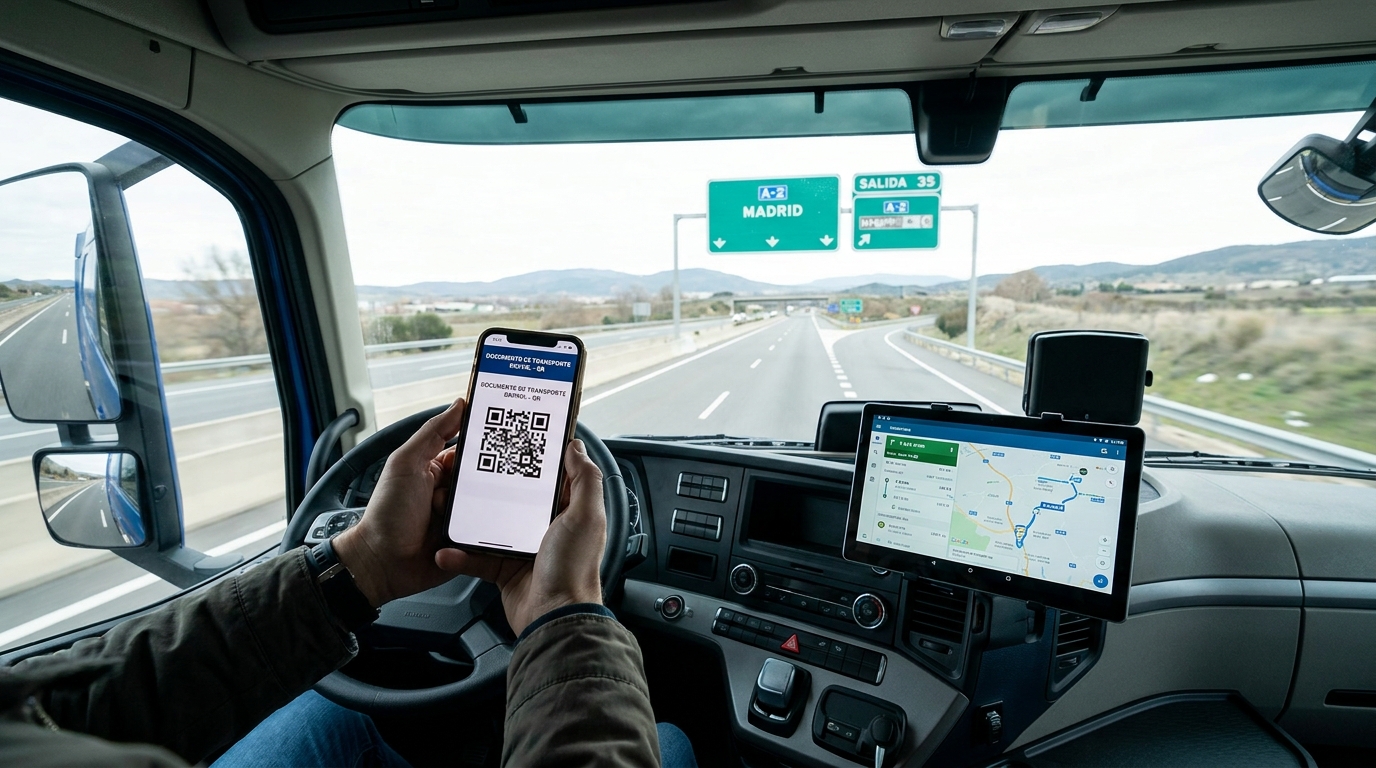
Spain has just set new standards for the entire European transport and logistics industry. It became the first European Union member state to completely eliminate paper transport documentation from roadside inspections—and not in the distant future, but with a specific, definitive deadline: 5 October 2026 yearFrom now on, the absence of a digital Administrative Control Document (DeCA) on board a vehicle traveling on Spanish roads automatically exposes it to financial penalties and the immobilization of its fleet. For thousands of Polish, German, French, and other European carriers that regularly operate routes across the Iberian Peninsula, the clock is already ticking.
DeCA — what is it and where does it come from?
Full name of the document - Documento electrónico de Control Administrativo — clearly indicates its nature: it is an electronic tool for administrative supervision of road transport, not another version of the traditional waybill. The legal basis for this change is Sustainable Mobility Act (Ley 9/2025, de 3 de diciembre, de Movilidad Sostenible), passed by the Spanish Parliament on December 3, 2025 and in force from December 5, 2025. The regulations provide for a ten-month transition period, which ends on October 5, 2026.
It's worth noting that DeCA wasn't created in a vacuum. It's part of a broader, consistently implemented strategy by the Madrid government, aimed at the complete digitalization of the logistics sector and tightening supervision over the flow of goods within Spain. Since January 2026, the so-called carta de porte digital — digital waybill introduced by Royal Decree for domestic commercial contracts between B2B entities with a value exceeding €150. Although DeCA and carta de porte digital These are two separate legal instruments, but together they create a coherent, highly digitalized legal ecosystem regulating road transport in Spain. Companies operating in the Iberian market must understand both mechanisms simultaneously.
What exactly must DeCA contain and how must it be presented?
The DeCA document itself covers all the key elements of a transport service that regulatory authorities must be able to verify in real time. These include:
- Full details of the entity ordering the transport (sender or forwarder)
- Details of the actual carrier executing the order
- The exact place of loading and the final place of unloading of the goods
- Detailed specification of the transported cargo (type, weight, packaging)
- Complete vehicle identification data (registration number, trailer)
- Details of the driver carrying out the transport
The above information is nothing new—it has been appearing in classic waybills for decades. However, the real revolution is exclusively digital form of presentationDuring a roadside inspection, the driver must be able to present the DeCA document electronically—for example, via a dynamic QR code or a unique URL accessible on a mobile device. And here's an aspect that surprises many carriers: a printout of a DeCA document - even if it contains all the correct data - will be treated by the inspector as if the document was missingThe physical paper copy has no legal value in an audit after October 5, 2026.
This requirement poses specific infrastructure challenges for transport companies. Drivers must have a functional device with internet access or an offline app that will keep their document up-to-date even in areas with poor network coverage. Rural areas of Castile, Extremadura, and Andalusia are not among the best places for network coverage—and it is precisely there that roadside inspections of trucks bound for major logistics hubs are most frequently conducted.
Sanctions system: not just a fine, but the risk of operational paralysis
Financial risk analysts should pay particular attention to the fact that the threat posed by the DeCA regulations is two-dimensional. The first, more obvious layer is financial sanctionsAdministrative penalties for lack of proper digital documentation or significant formal errors in its content start at around 400 € for a single violation. This sounds relatively bearable—until we consider the scale and escalation mechanism.
In case of repeated violations recorded by the control authorities within a 12-month time window, the amount of the sanction may increase up to 18 000 euroAssuming a vehicle makes a dozen or so trips across Spain each month, each resulting in a fine, the total financial burden over the course of a year could push a smaller carrier to the brink of insolvency.
The second—and potentially much more dangerous—layer of risk is the inspector's authority to immediately immobilize the vehicle at the inspection site. Stopping a truck in the field means a cascade of negative business consequences that cannot be overestimated:
- Breaking delivery deadlines (SLA) — delays in delivery result in automatic activation of contractual penalty clauses on the part of the recipient of the goods
- Suspending payments for issued invoices — contractors often make the execution of a transfer dependent on the timely completion of the service
- Downtime costs — driver's remuneration for waiting time, parking fees, possible costs of storing cargo requiring controlled temperature
- Loss of reputation — repeated problems with timeliness result in the loss of contracts, especially in industries with stringent supply chain requirements (automotive, FMCG, pharmaceuticals)
- Deterioration of financial liquidity — the accumulation of the above factors may trigger a spiral of payment backlogs
From the perspective of assessing the creditworthiness and financial credibility of transport companies, this mechanism—not the amount of the administrative penalty itself—poses the greatest threat to the stability of companies unprepared for DeCA implementation. A payment backlog caused by a series of fleet immobilizations could develop faster than the company can take corrective action.
The European Context: DeCA as a Harbinger of a Wider Revolution
Spain's decision is not detached from pan-European trends – on the contrary, it is almost a year ahead of the EU schedule. From July 9, 2027 the regulation of the European Parliament and of the Council will come into force eFTI (Electronic Freight Transport Information, Regulation 2020/1056), which will oblige the authorities of all 27 Member States to accept electronic transport documents. This is a fundamental change in the regulatory approach: today, most EU countries use electronic transport documents allows as an alternative to paper ones - after 2027 they will have to be accept as standard.
However, the difference between the EU and Spanish approaches is fundamental and deserves to be highlighted. The eFTI Regulation requires Member States to accept electronic documents, but does not prohibit paper documents. Spain has gone a few steps further— completely eliminating paper waybills from the control circuit on its territory and anticipating the eFTI regulation by nine months. This is a pioneering piece of legislation on a continental scale and will certainly be observed by legislators in other countries as a potential model to follow.
What does this mean practically for transport companies? Prevoznik, which invests in an IT system supporting DeCA requirements in Spain today, should ensure that its chosen technology provider already addresses the upcoming eFTI requirements in its solution. This will avoid double implementation costs and the need to migrate systems again in 2027.
The technology market is reacting: what solutions are available?
The logistics software industry has already responded to market demand. SaaS platforms dedicated to the TSL sector, such as the tool digiCMR Ybil platforms and integrated telematics systems offered by providers such as Mapon, among others, enable the generation of electronic waybills compliant with applicable standards in minutes, not hours. A key functionality that carriers should pay particular attention to when choosing a supplier is offline mode.
As mentioned, some routes across Spain pass through areas with limited mobile network coverage. A technology solution that doesn't work without a constant internet connection becomes a serious weakness in the compliance process. A good system must ensure that drivers have access to the current DeCA document regardless of the quality of the network in a given location—for example, by storing an encrypted copy of the document locally on a mobile device.
Implementing the system, however, is only part of the challenge. Equally important is training of drivers and dispatchers in handling the new documentation flow. In companies with extensive fleets and staff turnover—typical of large Polish carriers operating in Western markets—the training process should be planned at least several months in advance.
Who is most at risk? Risk profile by carrier type
Not all transport market participants face the same risks associated with DeCA implementation. Based on the analysis of cross-border traffic structure, several groups of entities can be identified as particularly vulnerable:
- Small and medium-sized transport companies from Central and Eastern Europe — especially Polish, Czech, and Slovak airlines, which operate intensively on routes through France and the Pyrenees to Spain. Due to limited IT resources and often lower levels of internal digitalization, adapting to DeCA requirements can be both a technical and financial challenge.
- Subcontractors and asset-light companies — using external vehicles or carrying out orders as subcontractors for larger operators. The client's lack of direct control over the process of generating digital documentation can lead to a situation in which the driver—and formally the carrier—is responsible for the lack of DeCA.
- Carriers specializing in seasonal transport — e.g., agricultural and food products from Spain (fruit, vegetables, olive oil). Seasonal traffic peaks increase the statistical probability of roadside checks and increase the risk of sanctions for failure to prepare documentation.
- New entrants to the market — companies that are just starting to operate on Iberian routes may not be aware of the new legal requirements if they do not keep up to date with legislative changes in individual EU countries.
Receivables and counterparty risk perspective
For financial institutions, factoring companies, and companies monitoring counterparty risk in the transport, forwarding, and logistics industry, implementing DeCA opens a new dimension of risk analysis. Transport companies that lack operational readiness to meet digital documentation requirements in Spain may soon find themselves facing challenges with their receivables portfolios.
The mechanism is simple: inability to generate a DeCA document → vehicle detention by an inspector → delay or failure to complete delivery → activation of penal clauses in contracts with contractors → dispute over freight remuneration → suspension of invoice payment → deterioration of liquidity indicators → difficulties in settling own liabilities to lessors, subcontractors and fuel suppliers.
Monitoring firms and institutions managing trade risk should now—as part of their due diligence procedures—verify whether their TSL clients have implemented or are planning solutions compliant with DeCA requirements. Failure to do so could result in unexpected debt collection problems after October 2026.
Operational recommendations for transport and logistics companies
Taking into account the above conditions, TSL companies operating in the Iberian market should immediately take the following actions:
- Audit of the current state of documentation digitization — verification whether the TMS (Transport Management System) or ERP systems used already support the generation of electronic documents compliant with the requirements of Ley 9/2025 and eFTI standards
- Selection and implementation of the appropriate technological solution — with preference given to platforms that support both DeCA requirements and future eFTI 2027 standards, with an offline mode function for drivers
- Staff training — extending the training program not only to drivers, but also to dispatchers, forwarding specialists and persons responsible for issuing transport documentation
- Revision of contracts with subcontractors — verification whether the clauses regarding responsibility for transport documentation are up to date and precisely define who is responsible for generating and storing DeCA
- Implementation schedule with time buffer — System testing should begin no later than June 2026, leaving three months to fix issues before the mandatory entry into force of the regulations
- Monitoring the evolution of regulations — regularly monitoring the announcements of the Spanish Ministry of Transport and the European Commission guidelines on eFTI in order to keep the procedures up to date
Summary: DeCA as a turning point for European logistics
Spain's introduction of a mandatory DeCA document is much more than a local administrative change. It sends a signal to the entire European transport and logistics sector that the era of paper-based transport documentation is over—and that the pace of this change will be dictated not by conservative market participants, but by lawmakers who have lost patience with gradual evolution.
For risk managers and owners of transport companies, there is one key conclusion: Adapting to DeCA requirements is not a matter of convenience or an option to consider – it is a prerequisite for maintaining operational continuity in one of Europe's largest logistics marketsSpain handles a huge volume of European trade, while also serving as a gateway to African and Latin American markets. Excluding itself from this market due to deliberate problems with digital documentation would be a mistake whose consequences could prove irreversible for smaller entities.
October 2026 is closer than it seems. Companies that begin preparations today will have time for leisurely testing, training, and optimization. Companies that wait until summer 2026 will be racing against time under operational pressure. And companies that ignore the issue will find themselves on the other side of a stranded truck at a roundabout in Zaragoza, counting their losses.