

Crisis in Polish road transport: ZMPD calls for protective shield. Over a thousand companies will disappear from the market in 2026.
The Association of International Road Carriers in Poland (ZMPD) issued an urgent appeal to Prime Minister Donald Tusk in September 2026 to provide a protective package for the road transport industry. Data from the Chief Inspectorate of Road Transport confirm that more than a thousand transport companies disappeared from the market in 2026 alone. Fuel costs exceeding 30% of operating expenses and two-year waiting times for residence cards for drivers from outside the EU are pushing the SME sector to the brink of insolvency. For business partners, this is a clear signal that enhanced due diligence is necessary before entering into or continuing cooperation with Polish carriers.
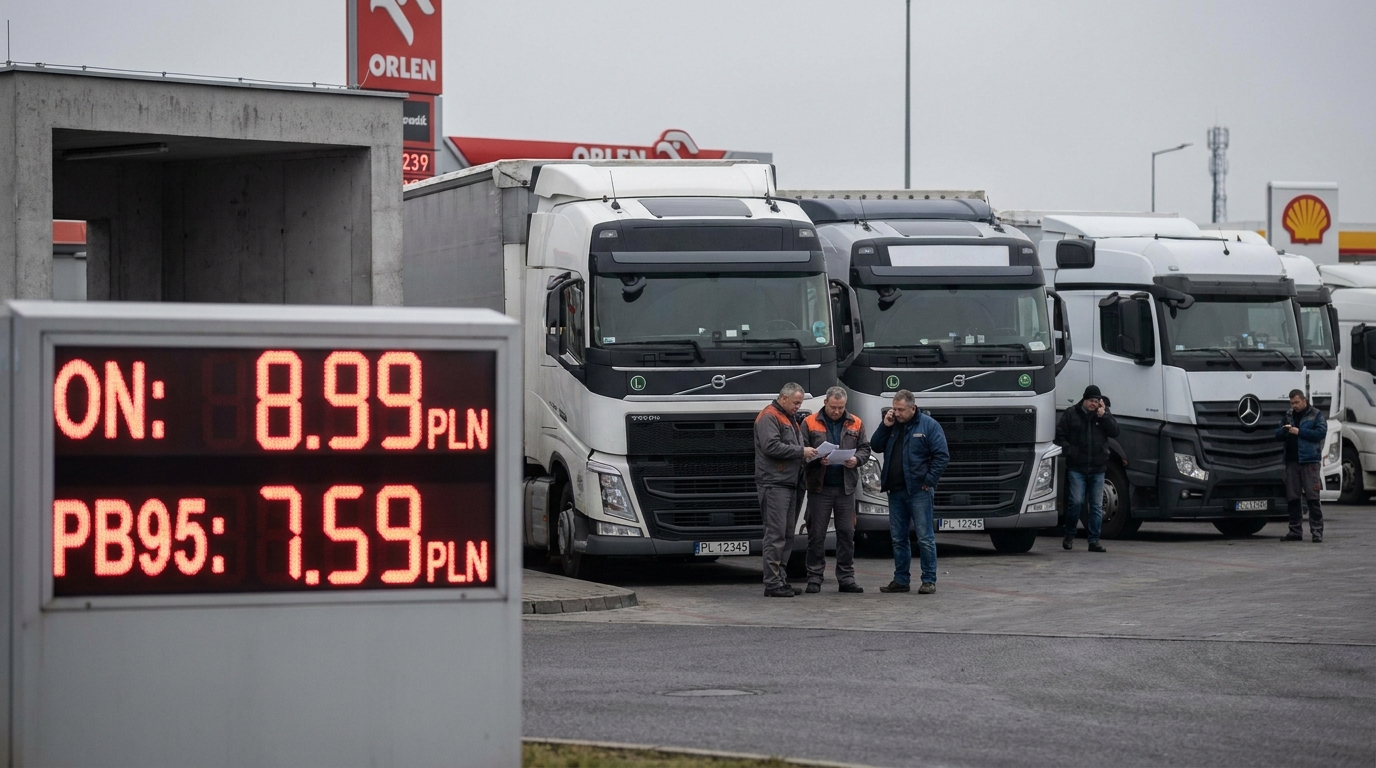
In September 2026, the International Association ofrodoThe Polish Road Carriers' Union (ZMPD) has sent an official appeal to Prime Minister Donald Tusk to immediately cover the road transport sector with a comprehensive protective program. The alarm signal that accelerated this decision is the hard data from the Chief Inspectorate of Road Transport: in just nine months of 2026, the Polish international transport marketrodoOver a thousand companies have disappeared. For risk managers and business partners cooperating with Polish carriers, this is a clear warning sign that should trigger enhanced due diligence procedures.
The scale of the crisis: a thousand companies less, forty thousand under pressure
A formal appeal on behalf of the ZMPD was signed by the organization's president, Jan Buczek. The letter, dated September 21, 2026, leaves no doubt about the scale of the problem. The Polish road transport industry, which still numbers over 40 active entities, is grappling with unprecedented cost pressures. The loss of over a thousand companies in less than a year means that companies are going out of business at a rate of more than three per day.
Of particular importance from a risk assessment perspective, this phenomenon primarily affects the small and medium-sized enterprise sector, which forms the backbone of the Polish transportation industry. It is precisely these SMEs—typically operating fleets of several to several dozen vehicles—that are least protected against sudden cost shocks and are most likely to lose financial liquidity under prolonged margin pressure.
It is worth emphasizing that despite the dramatic bankruptcy dynamics, Poland still remains the European leader in the area of internationalrodoMaintaining this position in the long term, however, becomes realistic only if the government takes decisive intervention measures – otherwise, subsequent waves of bankruptcies may permanently change the structure of this market to the detriment of Polish entities.
Fuel: The Cost That Kills Profitability
The main culprit behind the crisis is record-breaking fuel costs. According to data presented by the Polish Transport Authority (ZMPD), fuel expenses currently account for over 30 percent of the total operating costs of a typical Polish carrier. This level, coupled with pressure from clients to maintain low freight rates, makes running a profitable business nearly impossible for many companies.
The mechanism is simple and ruthless: a sharp increase in diesel prices immediately reduces operating margins, which in road transport are historically among the lowest of all industries. Companies that fail to negotiate fuel clauses in their contracts, or whose contracts are long-term and do not include cost indexation mechanisms, fall into a debt spiral. They rely on operational credit to their contractors, while they themselves are unable to timely settle their obligations to lessors, tire suppliers, or fuel distributors.
The situation is exacerbated by the fact that carriers from many other European Union countries—including France, Germany, and the Benelux countries—use systems that partially refund excise tax on fuel purchased for professional road transport. Poland has not yet implemented a similar mechanism, resulting in a real competitive asymmetry in the common European transport market. Polish carriers incur higher effective fuel costs than their Western European competitors, while simultaneously being required to offer comparable market rates.
What is the ZMPD demanding? The organization's specific demands
The ZMPD's appeal to Prime Minister Tusk contains a package of precisely formulated demands. The organization goes beyond general calls for help—it also identifies specific tools that, in its opinion, could stem the wave of bankruptcies and stabilize the sector.
- Fuel excise tax refund: A key demand is the introduction of a mechanism enabling carriers to recover a portion of excise tax on fuel purchased in Poland for professional purposes. The ZMPD (Polish Road Transport Association) demanded this solution in March 2026, but to no avail. The organization argues that identical instruments used in other EU countries constitute a form of illegal state aid that de facto discriminates against Polish entities.
- Agricultural model support program: ZMPD calls for the development of a support system for the transport industry, with a scale and structure similar to the assistance programs regularly provided to the agricultural sector. According to the organization, the government should treat road transport as a critical infrastructure element of the Polish economy, requiring similar institutional protection.
- Improving procedures for employing drivers from outside the EU: The third pillar of demands concerns the urgent reform of the system of legalization of work and residence of drivers from third countries - and in particular, a dramatic reduction of the waiting time for residence permits.
- Changes to the regulations regarding driver remuneration: The organization also points to the need to revise wage regulations in the industry, the current shape of which generates additional costs and hinders flexible human resources management.
Staffing crisis: two years for a residence card
In addition to the fuel problem, ZMPD points to another structural problem in the industry: a chronic and deepening shortage of qualified professional drivers. For years, the Polish transport industry has been supplementing this shortage with workers from countries outside the European Union—primarily Ukraine, Belarus, Georgia, and other Eastern European and Central Asian countries.
The problem, however, lies in the efficiency of the Polish public administration. According to information provided by the ZMPD, in some voivodeship offices the waiting time for issuing a temporary residence card for an employed employee is up to two years. This isn't an administrative problem—it's operational paralysis. A driver without a valid residence card cannot legally perform work in international transport.rodoThe company signs a contract, recruits an employee, covers the costs of his arrival and training, and then waits for months for the documents that will enable him to actually start working.
In practice, this means that transport companies face an insoluble dilemma: they cannot accept new orders without a sufficient number of drivers, and they cannot recruit drivers because the administration cannot keep up with processing requests. For entities dependent on seasonal contracts or those fulfilling orders requiring a rapid expansion of transport capacity, this procedural dysfunction is as destructive as rising fuel prices.
What the Central Statistical Office data says: transport under the highest financial pressure
The ZMPD appeal is not based solely on the organization's own estimates. The credibility of the diagnosis is confirmed by independent data from the Central Statistical Office. The latest economic situation survey conducted by the Central Statistical Office clearly indicates that of all the analyzed sectors of the Polish economy, transport and warehousing have the highest percentage of companies whose business decisions in the coming months will be determined primarily by the company's financial situation.
This figure is a staggering 65,6 percent, meaning that nearly two-thirds of transportation and logistics companies make investment, employment, and operational decisions not based on demand forecasts or strategic development plans, but rather on the current availability of financial resources. This is a classic symptom of a systemic liquidity crisis.
By comparison, in most other sectors, the rate of financial situation-driven decisions is significantly lower, allowing for more proactive, long-term management. Transport stands in contrast in this regard—a signal that business partners should treat as a serious risk factor.
Macroeconomic backdrop: rating downgrade and cost pressures
The difficulties facing the Polish transportation industry are part of a broader macroeconomic context that is not conducive to a rapid recovery. A key element of this picture is the recent decision by Moody's to downgrade Poland's credit rating from A2 to A3While the rating change itself is not a disaster for the Polish economy as a whole, it signals deteriorating assessments of growth prospects amid rising cost pressures.
For the transport sector, the rating downgrade has an indirect, yet real, impact: it could lead to higher borrowing costs for Polish companies, which, given the already strained balance sheets of many carriers, could pose an additional solvency risk factor. Companies that finance their fleets through leasing or loans are particularly sensitive to changes in financing terms.
The Ministry of State Assets is trying to reassure the market, assuring them that there is no threat of physical fuel shortages at stations. However, for carriers, this declaration has limited practical value—the problem isn't the availability of diesel, but its price. Even with full fuel availability, if its cost consumes a third of a company's revenue, the profitability of the business is at risk.
Business Risk Perspective: What B2B Partners Need to Know
For risk managers, purchasing departments and owners of companies commissioning transport services, the current situation in Polish road transport requires a specific response at the level of supply chain management procedures and strategies.
Verification of the carrier's financial condition
In the current environment, standard business partner verification procedures should be expanded to include a more in-depth analysis of financial liquidity indicators. It's worth checking:
- Does the carrier have current licensing documents and certificates of professional competence?
- What is his history of settling liabilities to contractors,
- Does the company use external fleet financing (leasing, credit) and under what conditions?
- What is the cost structure like and does the contract include mechanisms for indexing rates to fuel prices?
- What is the current employment status of drivers and is the company not at risk of staff shortages affecting the execution of orders?
Diversification of transport suppliers
In the wedrodoGiven the increased risk of bankruptcy among Polish SME carriers, relying solely on one or two transport service providers exposes the company to significant operational risk. A carrier's sudden cessation of operations—especially in the middle of a contract—can generate losses of thousands for the client. The supplier portfolio should include both domestic entities and foreign carriers operating on the same routes.
Contract clauses and financial security
All new or renewed contracts with Polish carriers should be supplemented with clauses protecting the client in the event of an unexpected termination of cooperation. Of particular importance are provisions regarding liability for cargo in transit, replacement procedures in the event of driver unavailability, and the terms of contract termination for reasons attributable to the carrier.
Monitoring the market situation
Monitoring industry news—including government decisions regarding a potential transportation shield—is now a necessary minimum element in supply chain risk management. If the government decides to introduce an excise tax refund mechanism or other forms of support, this could significantly improve the industry's condition within a few months. Failure to do so would mean a continuation of the current bankruptcy trend.
Will the government respond to the appeal? Scenarios for the industry
At this time, Prime Minister Tusk's government has not presented a formal response to the ZMPD's appeal. The industry is awaiting a signal that will determine whether Poland will opt for systemic intervention similar to that used in agriculture, or whether road transport will have to weather the cost crisis on its own.
The optimistic scenario assumes the rapid implementation of at least the excise tax refund mechanism—a solution that does not require lengthy legislative work and can be launched relatively quickly. Such a decision would reduce the effective cost of fuel for Polish carriers and at least partially eliminate the competitive disadvantage vis-à-vis companies from EU countries using similar mechanisms.
The pessimistic scenario—no government response or actions that are too small—means a continuation of the current trend. With over a thousand bankruptcies per year, the Polish transport industry could lose hundreds more entities by the end of 2026, which will inevitably impact the availability and pricing of transport services, and thus the costs of logistics for the entire Polish and European economies.
Summary: A warning sign for the entire market
The ZMPD's appeal to Prime Minister Tusk is not just a political gesture of industry lobbying. It's a document that briefly describes the state of one of the key sectors of the Polish economy—a sector responsible for the transport of the vast majority of cargo moving across Europe under the Polish flag.
There are four key conclusions to be drawn from this document for participants in the European transport and logistics market:
- The scale of bankruptcy is real and documented. GITD data confirms the loss of over a thousand companies in 2026 - these are not industry estimates, but hard numbers from the register of entrepreneurs.
- The problem is structural, not temporary. Fuel costs exceeding 30% of operating costs, a driver shortage and bureaucratic barriers are challenges that cannot be solved by one-off, ad hoc measures.
- SMEs are most at risk. Large transport groups have better access to financing, the ability to hedge fuel costs, and a stronger negotiating position with clients. Small and medium-sized carriers are most susceptible to these shocks.
- Due diligence is essential today. Cooperation with a Polish carrier from the SME sector without prior verification of its financial and operational condition constitutes a serious business risk in the current circumstances.
The EURODEBT.eu platform will continuously monitor the government's response to the ZMPD's demands and provide information on any further changes in the financial situation of Polish carriers. Should a protective shield or significant regulatory changes be announced, we will publish an immediate update of the sector's risk assessment.




