

Fuel crisis in European transport: IRU demands 30-day limit on payments from EU and billions in support for carriers
The International Road Transport Union (IRU) has issued an urgent appeal to the European Commission regarding the crisis caused by the sharp rise in fuel prices, which threatens the liquidity of thousands of small and medium-sized transport companies in Europe. The organisation is calling, among other things, for the introduction of an EU regulation limiting payment terms to 30 days. With margins of 1–3% and mounting payment backlogs, the transport, shipping and logistics sector is becoming a sector at increased risk of insolvency — which should prompt all business partners to step up monitoring of their counterparties.
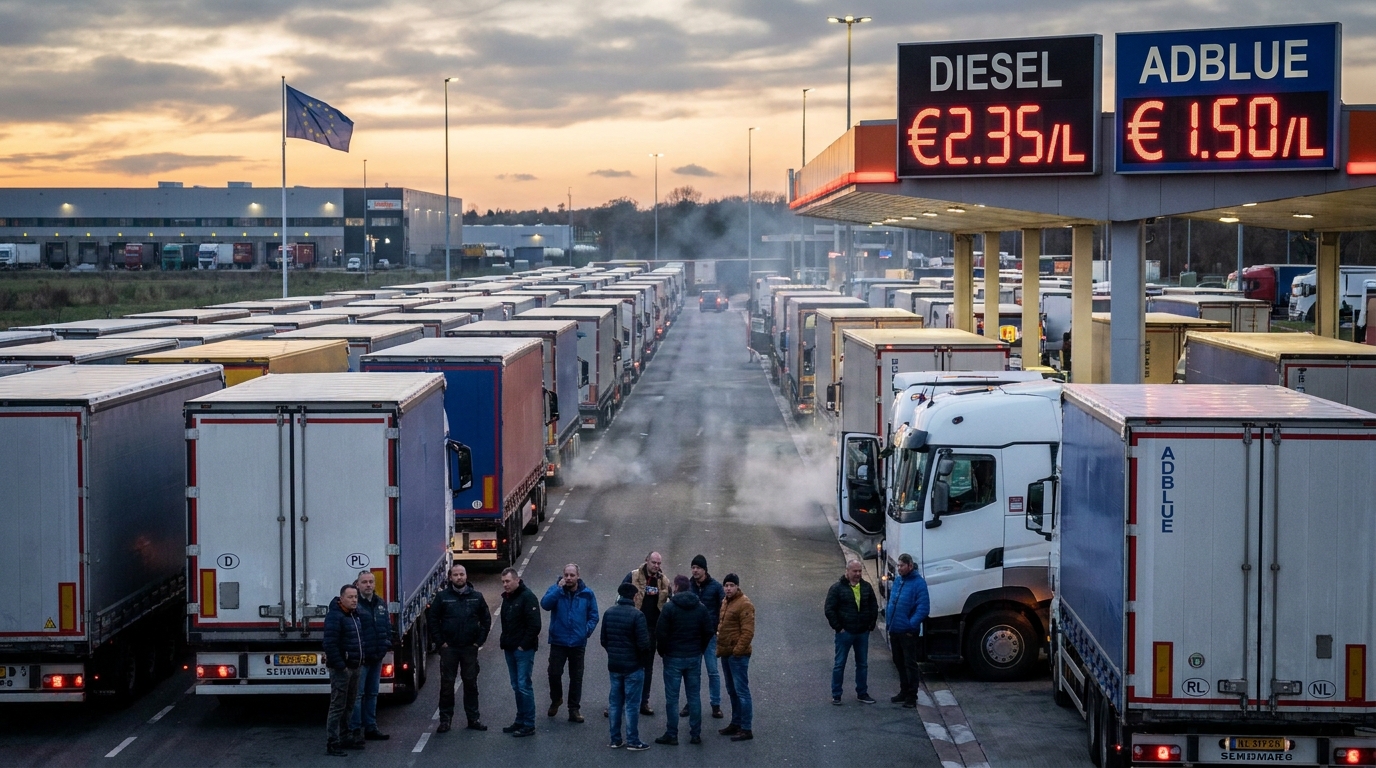
October 2026 will go down in history as one of the most challenging times of the last decade for the European transport and logistics industry. The sharp increase in diesel prices, a direct consequence of the escalating armed conflict in the Middle East, has led to a situation where thousands of small and medium-sized transport companies are teetering on the brink of insolvency. In response to the growing crisis, the InternationalrodoThe International Road Transport Union (IRU) has sent an urgent appeal to the President of the European Commission, Ursula von der Leyen, demanding immediate and precisely tailored legislative and financial intervention from the EU institutions.
The scale of the crisis: 6,8 billion liters per month in the heat of speculation
To properly assess the gravity of the situation, it is necessary to look at the hard figures describing the cost structure of European road transport. IRU Secretary General Habib Turki pointed out that fuel currently accounts for almost 30% of all operating costs a typical transport company. This is an impressive—and dangerous—proportion, especially considering the scale of consumption across the sector. Trucks, buses, and coaches operating on European Union roads consume a total of approximately 6,8 billion liters of diesel fuel each month.
When the price of this commodity soars and futures markets react to news from the Persian Gulf and the Red Sea, the effects are felt immediately – not by large corporations with extensive risk management and currency hedging departments, but by family businesses with several trucks from Poland, Romania, Bulgaria or Germany, which constitute the absolute foundation of European last-mile logistics.
Margins of 1-3%: where there is no safety cushion
The road transport industry has been operating under conditions of extreme price competition for years. The result is a structural erosion of profitability — the average operating margin in the sector ranges between 1% and 3%These are values that in many other industries would be considered a signal of immediate restructuring or market exit. In transportation, they are considered the norm.
The consequence of such thin margins is a complete lack of financial cushions. When the cost of the basic raw material—fuel—skyrockets, the company has nowhere to look for savings. It cannot easily renegotiate contracts with customers because price competition persists. Nor can it significantly burden customers with fuel supplements because market pressure is too intense. It is left with no choice but to dip into reserves—which are often simply nonexistent—or to take out short-term external financing.
The scissors effect: you pay for fuel upfront, but you wait months for the service
The situation is further exacerbated chronic payment delays, which have remained one of the darkest plagues of the TSL industry for years. The mechanism is both simple and deadly: the carrier must refuel the truck before setting off—a cash, immediate, and non-negotiable cost. Meanwhile, they receive payment for the service performed 60, 90, and often even 120 days after the invoice date.
Under normal market conditions, this time gap is painful but bearable. However, when fuel prices soar, each subsequent transaction generates not profit but, in effect, a loan to the client on terms no bank would accept. The combination of a 30% fuel cost, single-digit margins, and months of payment backlogs creates a mechanism that the IRU explicitly calls the "insolvency loop"—a destructive spiral leading directly to bankruptcy.
The IRU's two key demands for Brussels
In response to this crisis, the IRU has formulated two precise demands to the European Commission, which, in the organisation's opinion, can actually stop the wave of bankruptcies in the sector.
Proposal 1: Extension of the Temporary State Aid Framework until the end of 2027
The first request is for an extension for another year - until 31 December 2027 year — the Temporary State Aid Framework, introduced in response to the Middle East crisis, is in effect. This mechanism allows EU member states to provide financial support to companies affected by the armed conflict without having to go through the standard, months-long notification procedures for state aid.
The key element of this postulate is not so much the extension of the time frame, but maintaining in documents provisions dedicated directly to the road transport sectorThe IRU fears that during political negotiations, the specific needs of carriers will be blurred among the interests of other industries or simply ignored as too niche. Unfortunately, the history of EU crisis interventions provides precedents justifying these concerns.
Proposal 2: EU regulation on a maximum 30-day payment period
The second demand is structural in nature and—in the long term—potentially much more significant for the health of the industry. The IRU demands the adoption of a special EU regulation introducing a 30-day payment deadline in commercial road transport.
Importantly, the organization does not limit itself to calling for regulation. It clearly states that any regulation without an effective enforcement mechanism will be null and void from the moment it comes into force. The IRU therefore demands an effective control system and strict financial sanctions for entities violating statutory deadlines. Only a combination of a clear legal standard and a real penalty for violating it has a chance of changing the deeply rooted, pathological payment practices that have existed in the TSL industry for decades.
It's worth noting that similar regulations already exist in EU law—Directive 2011/7/EU on combating late payment in commercial transactions establishes a standard deadline of 60 days. The IRU therefore advocates tightening existing regulations and providing the transport sector with special protection, given its unique cost structure and role in the functioning of the overall economy.
Road protests - IRU chooses dialogue over blockades
The escalation of the fuel crisis has had an impact on the social climate in the industry. Several EU member states have already experienced spontaneous protests and road blockades organized by frustrated hauliers. Images of trucks blocking highways and border crossings are reminiscent of the dramatic agricultural protests of previous years, which paralyzed parts of European transport infrastructure.
The IRU authorities take a clear position on this issue: the organization distances itself from direct actions consisting of paralyzing road traffic. Habib Turki emphasized that an effective response to the crisis can only be a constructive institutional dialogue leading to specific legislative and financial solutions—not actions that disrupt supply chains and hit the very entrepreneurs they are supposed to serve.
This attitude is understandable from the perspective of an organization representing the entire sector. Roadblocks generate short-term media attention, but also generate losses for clients, consumers, and the industry itself. In the long term, they may also provide politicians with an argument against rapid aid measures—as the sector escalates tensions, its demands are easier to ignore.
Business Risk Perspective: The TSL Sector at High Risk
For risk managers, owners of logistics companies and entities financing transport activities, the above information should constitute a clear alarm signal requiring immediate revision of credit policy and monitoring of contractors.
For clients of transport services
Companies using third-party carriers should be aware that their logistics providers may find themselves in serious financial trouble in the coming months. The sudden bankruptcy of a multi-truck transport partner could mean not only the immediate need to seek alternative suppliers but also difficulties with the supply of raw materials or finished products, and in extreme cases, production bottlenecks.
- Verify the financial condition of your carriers — not only when establishing cooperation, but regularly, every quarter
- Monitor early warning signals: delays in order execution, sudden requirement of prepayments, problems with fleet maintenance
- Consider diversifying your carrier portfolio — dependence on one supplier of transport services in the current market situation is an unacceptable risk
- Analyze the possibility of early payments as a tool for retaining key logistics partners while negotiating more favorable pricing conditions
For factoring and leasing companies
Entities financing transport operations, both through receivables factoring and fleet financing, should urgently review their exposure to the TSL sector. The combination of record fuel costs, thin margins, and payment bottlenecks translates directly into carriers' deteriorating ability to service their financial obligations.
They require special attention small and medium-sized transport companies with a homogeneous fleet (only long-distance heavy vehicles) without diversified revenues, carriers with high levels of external financing purchased rolling stock and companies operating in markets with the highest pricing pressure (international transportrodoyou, spot).
For trade receivables insurers
Insurance companies offering trade receivables protection should consider tightening risk acceptance criteria for contractors in the TSL sector, or at least lowering credit limits and shortening the maximum terms of insured transactions. Experience from previous fuel crises (2008, 2022) indicates that a wave of transport bankruptcies usually occurs with a delay of several months following the price peak – which means the worst may still be ahead.
Macroeconomic Context: Why Things Could Be Worse This Time
European road transport has experienced numerous fuel crises. However, the current situation has several features that distinguish it from previous episodes and warrant increased concern.
First, operating cost inflation is multidimensionalFuel prices are rising, but so are insurance costs, driver wages (given the chronic shortage of personnel), and the cost of spare parts and service. The industry is therefore grappling with simultaneous cost increases on multiple fronts, not just a single, isolated price shock.
Secondly, implementation of new regulationsrodowiskowy (Euro 7, increasing decarbonisation requirements, CO2 emission fees in the ETS system) imposes additional investment burdens on the sector precisely at a time when profitability is at its lowest in years.
Thirdly, geopolitical context of the crisis suggests that fuel price increases may be permanent, not temporary. The escalation in the Middle East shows no signs of ending soon, meaning energy markets could remain under pressure for quarters or years to come.
What to expect in the coming months?
A key question for all market participants now is the speed and effectiveness of the European Commission's response to the IRU's demands. Historically, EU legislative processes are not among the fastest—the standard path for a regulation can take anywhere from several months to several years. In the case of the Temporary State Aid Framework, a decision may be made more quickly, as the mechanism is already in place and only requires an extension.
When observing the situation from the perspective of a market participant, it is worth tracking several indicators:
- Official announcements of the European Commission regarding the response to the IRU appeal - their content and timing will be a signal of political will to act
- Data from the Central Statistical Office and Eurostat on bankruptcy rates in the TSL sector - the first effects of the crisis should be visible in the statistics for the fourth quarter of 2026
- Price indices for transport services (e.g. DAT Freight Index, Transporeon Market Insights) — an increase in freight prices may signal an attempt to transfer costs to clients or a shrinking supply of services
- Transport lobby activity in the European Parliament - committee debates and parliamentary questions to the Commission will be a barometer of political support for the industry
Summary: Time for increased vigilance
European road transport is facing one of the most serious financial challenges in recent years. The sharp rise in diesel prices, coupled with structurally low margins and chronic payment delays, is creating a highly toxic environment.rodomacroeconomic environment in which the risk of a wave of bankruptcies in the SME sector is a real and immediate threat.
The IRU's proposals—extending the EU aid framework and introducing a 30-day payment limit—are substantively justified and could constitute an effective remedy, provided they are implemented quickly enough. Every month of delay means dozens or hundreds of additional companies approaching the solvency threshold.
For all entities cooperating with the road transport sector – as clients, financiers or insurers – The current situation requires increased vigilance, active monitoring of contractors' condition and readiness to react quickly to signals of a deterioration in the financial situation of business partners. Markets do not forgive delays in making tough decisions.




