

Operation Hermes: EPPO busts VAT carousel for €410 million – transport industry at risk
The European Public Prosecutor's Office (EPPO) dismantled an organized criminal network involved in €410 million in VAT fraud in Operation “Hermes”, arresting 62 people and carrying out over 300 searches in eight EU countries. Transport companies were at the centre of the scheme, unknowingly used to simulate trade in electronics. This case is an urgent warning to the entire transport, shipping and logistics sector: failure to verify business partners can result in joint and several liability, frozen accounts and a sudden loss of liquidity.
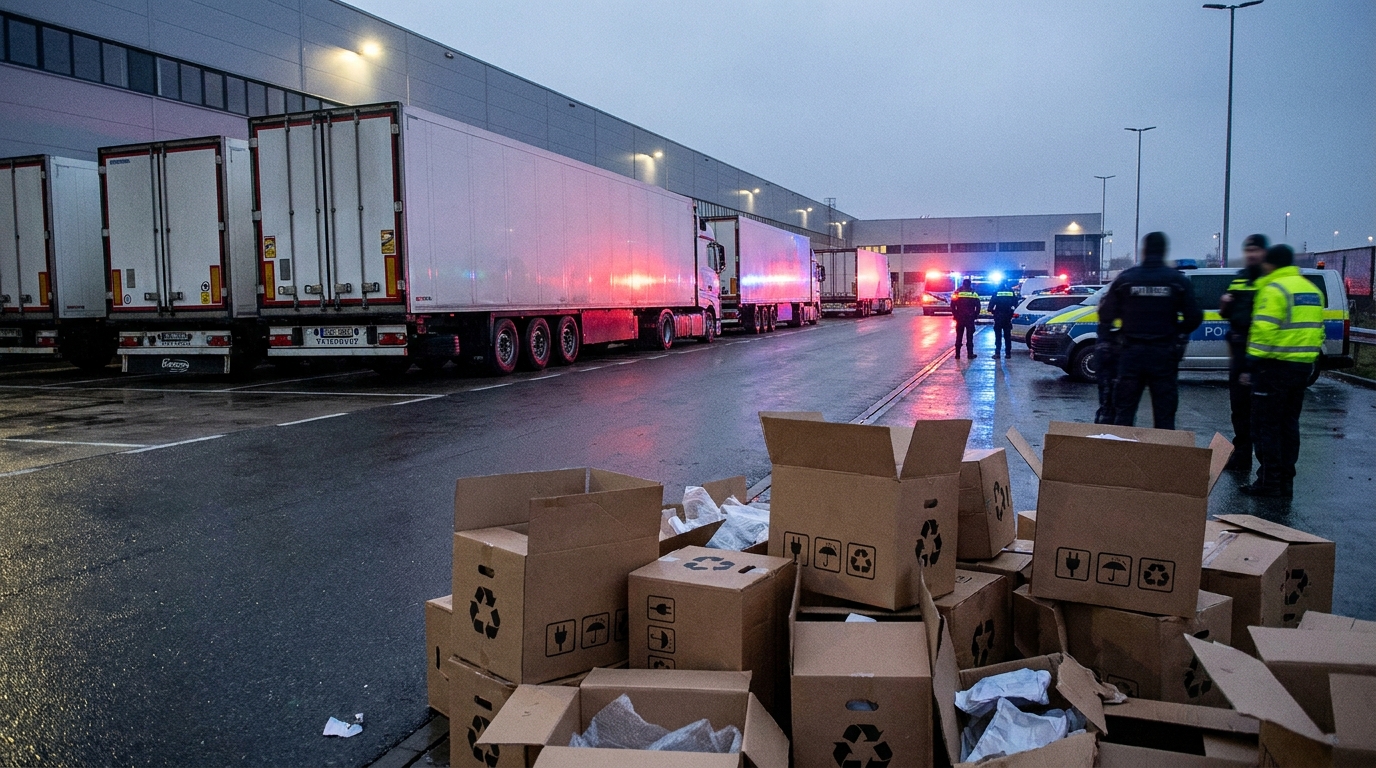
The European Public Prosecutor's Office (EPPO) conducted one of the largest anti-fraud operations in the history of the European Union. As part of the investigation, codenamed "Hermes" 62 people were detained, over 300 searches were carried out in eight Member States and assets worth nearly 310 million eurosThe total losses to EU treasuries caused by the unmasked criminal network are estimated at astronomical 410 million euros VAT fraud. The main locations of arrests were Portugal, Spain, and Italy, which clearly indicates the operational geography of this cross-border organization. For companies in the transport, forwarding, and logistics sectors, this case is a serious wake-up call—the TSL sector has found itself directly at the center of the criminal mechanism.
What is the VAT carousel and why does it affect logistics?
VAT carousel fraud, referred to in English as Missing Trader Intra-Community fraud (MTIC), is one of the most costly and difficult-to-detect tax fraud schemes in the world. The mechanism relies on seemingly legal cross-border trade within the European Union, where intra-Community transactions are exempt from VAT for the seller.
In a classic scenario, a company registered in one EU country purchases goods from a foreign customer at a zero rate. It then sells them to a domestic customer with VAT charged, collects the payment, and disappears without remitting the tax to the tax office. Subsequent links in the transaction chain submit applications for tax refunds that never reach the budget. This cycle can be repeated many times, with each subsequent "round" of the carousel generating new losses for the tax authorities.
In the case of Operation Hermes, the goods around which the entire scheme was built were primarily mobile phones and consumer electronics — products with high unit value, easy to transport, and widely available on the secondary market. Criminals deliberately chose this market segment because large transaction volumes do not raise suspicion, and trade margins are difficult for tax authorities to verify.
Transport and logistics companies played a key role in the entire operation. The EPPO investigation revealed that the criminals they massively exploited legally operating TSL entities to make the simulated trade in goods credible. In reality, the trucks were transporting empty boxes or goods of marginal value, while the falsified documentation—waybills, CMRs, invoices—indicated the transport of a consignment of smartphones worth tens of millions of euros.
The scale of the operation and the geography of the investigation
Operation Hermes was the result of coordinated cooperation between the EPPO and law enforcement agencies and tax administrations from eight European Union countries. The scale of the undertaking is impressive and unprecedented in the history of European tax crime enforcement:
- 62 people detained during simultaneous actions in several countries
- Over 300 searches carried out at company headquarters, suspects' apartments and warehouses
- 8 EU countries involved in the operation, with the main center in Southern Europe
- 310 million euros in assets frozen or seized by investigative authorities
- Two linked crime syndicates operating in close coordination
The seized assets included luxury vehicles, real estate, cash in various currencies, gold, and funds held in dozens of bank accounts in various jurisdictions. The effectiveness of asset securing was nearly 75 percent of estimated losses covered by seized assets - a result that proves the exceptional preparation of the operation and precise mapping of financial flows by EPPO investigators.
The concentration of arrests in Portugal, Spain, and Italy is no coincidence. Southern Europe has long been a significant transit hub for electronics trade from Asia and the Middle East. Ports in Barcelona, Lisbon, and Genoa are gateways for vast volumes of cargo, the actual contents of which are difficult to verify without advanced verification systems. Criminals were intimately familiar with this topography and built logistical schemes around it, which at first glance appeared to be routine European trade.
Transport companies as an unwitting link in the criminal chain
From the perspective of risk managers and business owners in the TSL sector, Operation Hermes carries a fundamental warning. The investigation clearly shows that Legitimate shipping companies can become part of a criminal supply chain without their owners knowingThe mechanism by which a legitimate company is drawn into a carousel scheme typically follows several scenarios:
- Orders from unknown intermediaries: Criminals contact a carrier through a broker or freight exchange, ordering the transport of a seemingly standard electronics shipment. The rates are attractive, and the documents appear to be correct.
- Falsified CMRs and invoices: The driver receives the load and signs the document, unaware that the goods are actually of minimal value, and the documentation describes a batch of new smartphones.
- Chain of intermediaries: A transport company is several levels removed from the shell company. The direct client can act as a buffer entity, appearing to be a reliable contractor.
- Payments from unusual accounts: The remuneration is paid on time, but from accounts registered in third countries or from entities not directly related to the order.
The consequences of unknowingly participating in such a scheme can be devastatingTax authorities in EU countries are increasingly applying the principle joint and several tax liability, based on the "knew or should have known" standard. This means that a transport company that failed to properly verify its contractor may be held jointly liable for VAT deductions – even if its involvement was limited to executing the transport order.
Moreover, in a situation where the prosecutor's office decides to freeze assets related to the investigation, the bank accounts of the transport company may be blocked overnightThe inability to make transfers, pay salaries, or repay lease installments means, in practice, a sudden loss of financial liquidity—often without the possibility of a quick appeal against the prosecutor's decision.
The Domino Effect: How One Supplier's Bankruptcy Destroys the Entire Supply Chain
Operation Hermes reveals another aspect of risk that is often overlooked in analyses – the avalanche domino effect caused by the bankruptcy of companies involved in the VAT carouselWhen law enforcement agencies raid a shell or buffer company and freeze its accounts, the consequences are immediately felt by all of that entity's creditors.
A transport company that has provided services to such a contractor and issued transport invoices may not recover the debt for months or years—if at all. The receivables are then subject to security or bankruptcy proceedings, and their recovery is very limited. Meanwhile, the company must bear operating costs—fuel, vehicle leasing, driver salaries—regardless of the situation.
An additional complication is the fact that asset freezing may apply to entities at various levels of the transaction chainEven a reputable broker who facilitated the order transfer can be subject to investigation and prevent timely settlement of invoices with carriers. This way, a single unidentified criminal entity can trigger a cash flow crisis for dozens of legitimate logistics companies simultaneously.
Compliance in the TSL sector: from good practice to business obligation
The "Hermes" case definitively ended an era in which contractor verification was merely a recommendation from auditors or good practice in B2B relations. Today, in the face of increasing activity by the EPPO and national tax prosecutors' offices, KYC (Know Your Counterparty) procedures have become an absolute operational necessity for every company operating in cross-border trade – regardless of its size.
In the transport and logistics sector, verification should cover at least several key areas:
- VAT registration and tax history: Checking the contractor's VAT status in VIES systems, verifying the company's registration date, and verifying its business activity history. Newly established companies commissioning high-value electronics shipments are a first-degree alarm.
- Ownership structure and beneficial owners: Identification of the beneficial owners of the principal company, with particular attention to multi-level structures with entities registered in jurisdictions with low regulatory oversight.
- Economic logic of the transaction: Analysis of whether the commissioned service makes business sense – whether the routes are realistic, whether the rates are market-based, whether the cargo volumes correspond to the declared activities of the client.
- Verification of cargo documentation: Procedures for checking the compliance of the declared goods with the actual load, including the rights of drivers to refuse to accept an order in the event of non-compliance.
- Payment monitoring: Automatic flagging of incoming payments from accounts of entities that do not correspond to the payer or are registered outside the EU without commercial justification.
- Chain of intermediaries audit: In the case of orders executed by brokers and exchanges, verification of the identity of the actual client, not just the intermediary.
Implementing these procedures doesn't have to be expensive or time-consuming. Modern company verification platforms like EURODEBT.eu offer access to aggregated data on entities across Europe, allowing for a quick risk assessment of the collaboration before accepting an assignment. A few minutes spent on verification can save a company from months of proceedings and millions of zlotys in losses..
The perspective of creditors and financing institutions
A separate group of entities for which Operation Hermes should be a serious warning signal are financial institutions, factors, and leasing companies cooperating with the TSL sector. Freezing the bank accounts of a transport company involved—even unknowingly—in a carousel scheme immediately generates credit risk for all financing entities its activities.
A factor that has collected receivables from a carrier operating a front company may face a situation where the debtor is insolvent and the receivables themselves are the subject of prosecutorial proceedings. A leasing company discovers that the lessee has lost liquidity due to the prosecutor's seizure of assets and is unable to make payments. A bank financing its operational activities faces the risk that its client is listed in the EPPO investigation files.
Therefore, financial institutions serving the TSL sector should consider incorporating tax risk assessment and compliance into standard due diligence procedures when assessing creditworthiness. Questions about the contractor verification system, KYC procedures, and internal compliance policies are no longer the exclusive domain of large corporations—they should be standard assessments for every entity operating in cross-border trade.
What does Operation Hermes change for the European logistics industry?
The EPPO investigation has implications that go far beyond the capture of a specific criminal group. It sends a clear message to the entire market: European law enforcement agencies have gained the ability to conduct complex, multi-jurisdictional operations on an unprecedented scaleThe European Public Prosecutor's Office, established relatively recently, has proven its ability to effectively coordinate operations in eight countries simultaneously, securing almost three-quarters of the losses incurred by the tax authorities.
For the transport and logistics industry, this means several significant changes in the world.rodooperational area:
- Increased intensity of control: Tax and customs authorities in EU countries will intensify their verification of transport documentation, particularly in the consumer electronics segment. Irregularities in CMR documents or discrepancies between declared and actual cargo will result in increasingly severe sanctions.
- Extension of the scope of joint and several liability: More and more EU countries are implementing regulations imposing due diligence obligations on supply chain participants. The lack of verification procedures is no longer a mitigating circumstance—it becomes grounds for liability.
- Pressure to digitize documentation: Law enforcement agencies are increasingly analyzing digital transaction traces. Digital CMR documents (e-CMR), electronic delivery advice notes, and GPS vehicle tracking systems are becoming both investigative tools and proof of innocence for honest carriers.
- The growing importance of compliance reputation: Companies that have implemented documented contractor verification procedures and can demonstrate their compliance gain a competitive advantage – both in the eyes of corporate clients and financial institutions.
Risk Assessment: What You Should Do Now
In light of the findings of Operation Hermes, we recommend that all companies in the TSL sector and their trading partners immediately take the following actions:
- Conduct an audit of your current contractors in terms of their VAT status, business history and ownership structure – with particular emphasis on entities operating in the consumer electronics industry.
- Introduce a procedure for verifying new clients as a mandatory element of the order acceptance process. Failure to verify should be a sign of refusal to cooperate.
- Train drivers and operational staff in terms of recognizing warning signals - inconsistencies between cargo and documents, non-standard loading instructions, requests for non-standard documentation.
- Consult your tax advisor about the scope of your joint and several liability. for the main industries and markets in which you operate.
- Implement a contractor monitoring system, which automatically informs you about changes in the legal and tax status of companies in your customer and supplier portfolio.
Summary: The risk is real and the response time is short.
Operation Hermes is not only a spectacular police victory over tax crimes. It is, above all, a mirror showing the weaknesses of the European cross-border trade ecosystem — especially the transport sector, which for years has been unwittingly exploited as a credible element in criminal schemes. The scale of fraud—€410 million—and the effectiveness of asset recovery—€310 million—both demonstrate the EPPO's determination and the real capacity of European law enforcement agencies.
For logistics, forwarding and transport companies, the conclusions from this case are clear: Verifying contractors is not a bureaucratic obligation, but a key element of the survival strategy In a market where criminals are increasingly adept at concealing their activities behind the facade of legal trade, a single improperly verified client company can trigger a cascade of events—from tax proceedings, to account freezing, to criminal liability.
The European TSL industry faces a choice: invest in risk assessment systems and compliance procedures – or risk that another operation codenamed after a letter of the Greek alphabet will bring unpleasant surprises even to companies that never planned to break the law.




